
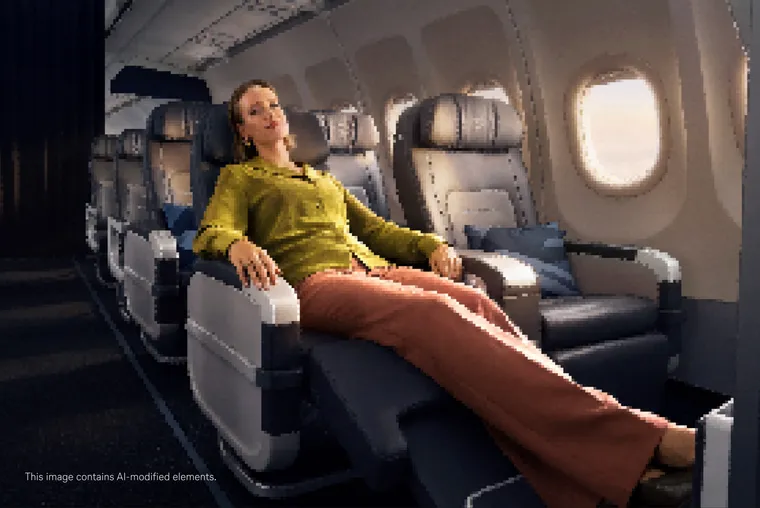
Lufthansa is joining its low-cost carrier Eurowings in offering recliners at the front of a small subfleet of mainline narrowbodies. Calling it a “commercial test”, initially on a limited set of routes, the move brings big front seats to EU-based network airlines.
The problem is that Lufthansa has only put out one media image of the new Premium Business seats, and the airline admits that “this image contains AI-modified elements”, with no detail on how this image has been modified, or in what way.
More concerningly, Lufthansa shows AI images of the seats in its sales path, but does not disclose that those images are AI-generated — something we only discovered once we opened them in a separate window to reveal an AI disclaimer. Normal passengers will not see the AI disclaimer.
The use of AI-generated images to show details not present in reality is a growing problem in a number of areas. In the residential real estate world, this is known as housefishing, after the term catfishing, or setting up a fake online identity to trick others.
Welcome to the age of seatfishing.
We do not have confidence in the accuracy of this rendering and how it represents the Premium Business product, so we are presenting a pixellated version to you as our header image on this article, for the reasons we’ll outline shortly. It is visible on Lufthansa’s own news site, and we present it in context below.
The Up Front asked the Lufthansa press team for images that have not been “AI-modified”. We have not, as yet, received a response.
The seats are, in theory, a big boost, but the AI-modified image is riddled with detail errors
The way these new seats have been announced is deeply frustrating. Overall, the introduction of large recliners to shorthaul business class on an EU network carrier is a major upgrade.
In pure soft product seat terms, these are better than most US domestic first seats since they have legrests and are pitched at an impressive “one metre”, which converts to 39 inches, although they will not have inflight entertainment.
As on Eurowings, Premium Business recliners will sit ahead of the existing Eurobusiness-style product at the front of the aircraft: this is not a separate cabin of service.
Starting 1 March 2027, the initial pricing model is as an ancillary upgrade on top of the middle-seat-free Eurobusiness seats during the booking process. At least as of the date of publication, this starts at €139 to Athens, and €99 to Nice, from Frankfurt.
The Eurowings ancillary comparison upgrades from Eurobusiness start at €300 to Dubai, €60 to London, and are included with the standard business fare to Mallorca and Málaga.
The speed of all of this, after the announcement of A320ceo retrofits in February that included the updated Geven Essenza economy seats as a front row behind the bulkhead, raises questions.
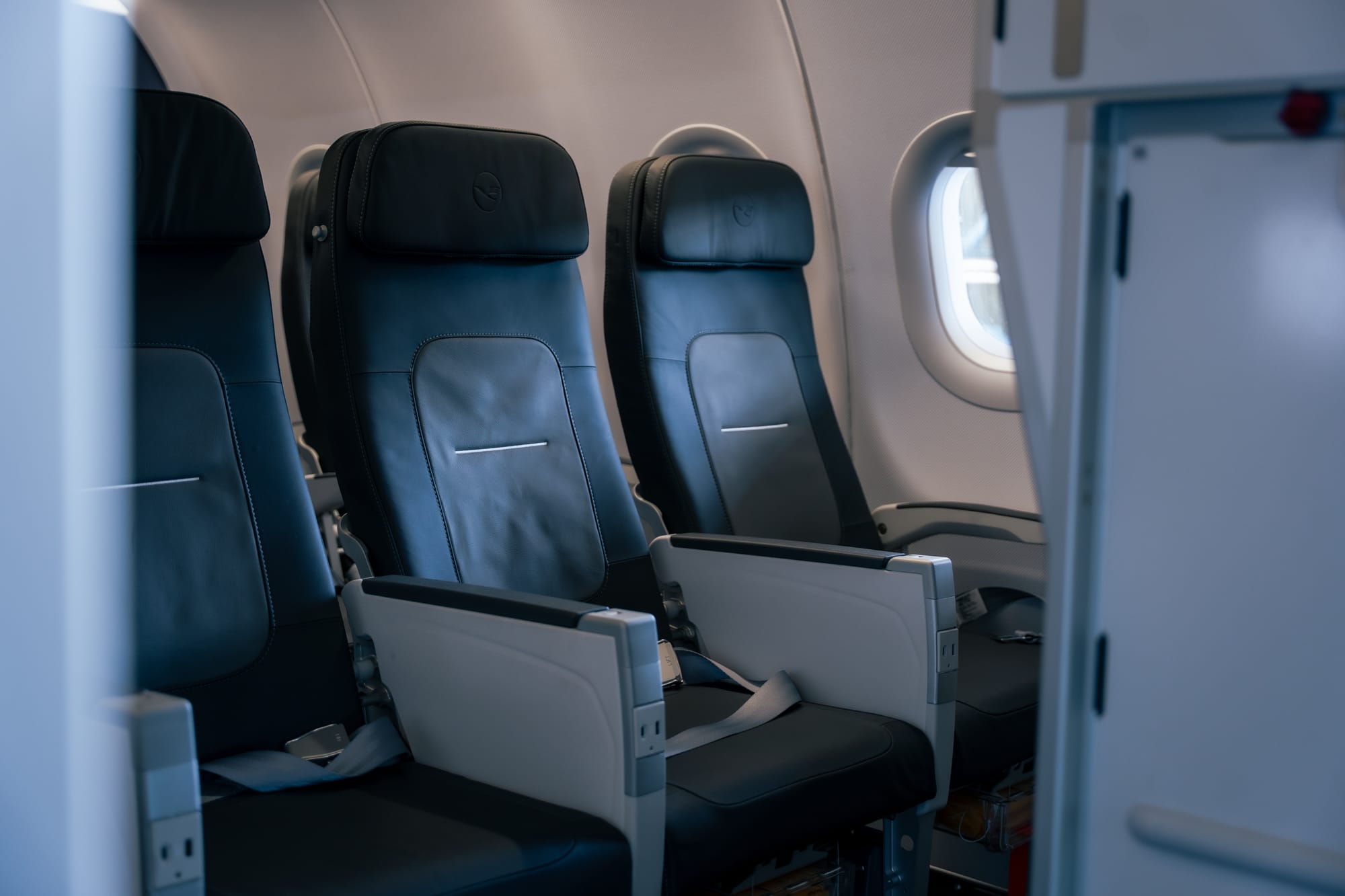
We wonder whether these seats were originally intended for Lufthansa, or whether the US-Israel-Iran war, and the subsequent Gulf instability, meant that the seats to be used in a wider test on Eurowings have now instead been pushed to what the airline group calls Lufthansa Classic.
In support of that line of thinking, The Up Front understands that these seats will not initially have in-seat power when they are first installed in December. The USB sockets are to come later, with February currently the target date. That points towards a rushed implementation: an airline would not ordinarily bring a newly refurbished aircraft back into the hangar so quickly to add power.
There are no further benefits beyond the seat: this is not a separate class of service, or even a semi-separate business-plus situation like Lufthansa’s own Business Suite in its Allegris cabin, which gets a bit of extra soft product.
A standard part of our reporting on new seats and cabins is examining the images and illustrations an airline supplies with its announcements to glean further detail. This time, however, we can’t do that.
Lufthansa is preventing media from scrutinising its newest product by using “AI-modified” images
Lufthansa’s single press image is marked “AI-modified”, without any further detail about how, or in what way, the image has been modified. We do not know whether any product expert, CMF specialist, certification official, or anyone else with cabin detail knowledge, has reviewed the AI modifications.
We do know that we can see multiple inconsistencies and detail errors within this image.
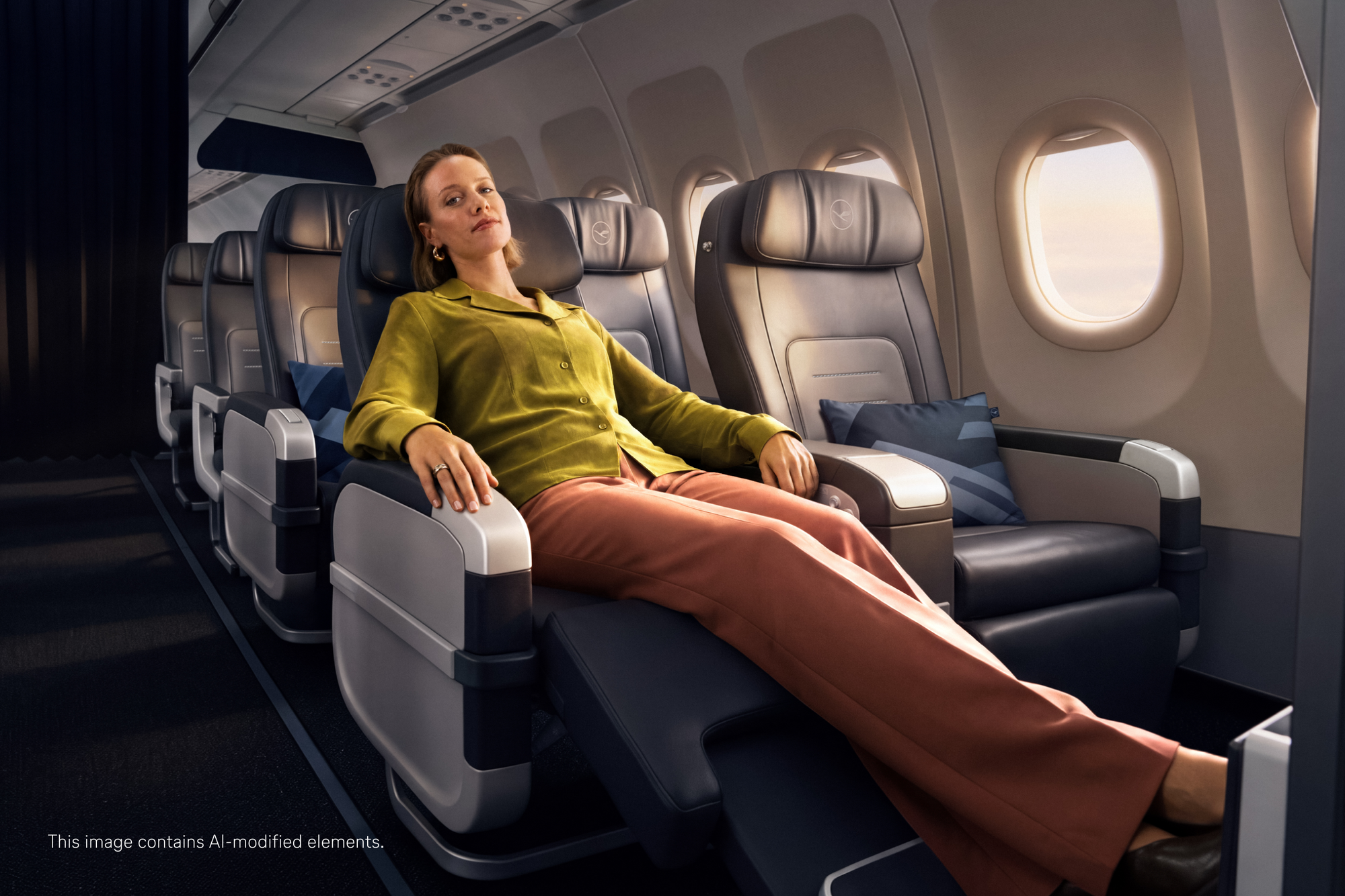
These are probably Geven Comoda seats, since that’s what Eurowings is using, and because some of the structural elements of the seat are Comoda signatures.
But the “AI-modified” images mean we can’t be sure, not least because some of the Comoda signature elements are missing in the rendering. The slightly raised metallic panel element on the 1A and 2C armrests, for example, is missing under the hand of the likely imaginary person in 1C.
These are probably going to be at least some of the aircraft announced for retrofit in February with the updated Essenza slimline seats. These include headrests and PED holders, but we can’t be sure, not least because some of the crucial cabin detail doesn’t match.
There are probably eight seats per aircraft, given the two rows of two seats shown on the left-hand side of the aircraft.
But again, we can’t be sure — from the image — because that might be part of what was “AI-modified”.
It certainly looks seat 1A has been “AI-modified” in some way, since there’s an odd twist in the angle and shape of the backrest. There are further inconsistencies in the shapes of the headrest further back. There are also inconsistencies with other images Lufthansa is showing on its own site, which we’ll come onto later.
Unsurprisingly, there’s that can’t-quite-place-it uncanny valley feel to the rendering, as a result of the AI being used. The closer you look, whether it’s the weird way the passenger’s arm is resting in thin air off the armrest, or the way the space stretches out behind the centre console as the seat reclines, the more unnervingly unnatural it looks.
Beyond these just being slop images, the wider implications on honesty and trust are concerning
This image is particularly problematic because it destroys the industry-journalist social contract between companies like Lufthansa and media like The Up Front. This is inside baseball, but it’s relevant as media, aviation and other industries try to navigate the age of easy generative AI in an ethical and responsible way.
As media, our professional goal is to bring our readers accurate, truthful reporting. In the rare event that we’re mistaken about a detail, we issue corrections. That’s part of the social contract between us, our readers, and the companies we write about. Those companies are entitled to point out what they believe are errors in our writing as part of the process, and to have those corrected.
Another part of the social contract is that companies make statements and issue information that is accurate and truthful, whether in press releases, interviews, or via their own channels (such as their website, social media, and so on).
In the rare event that a press release contains a mistake, or a company representative says something mistaken, they issue corrections. If we’ve written about it, or we’ve published our interview with their person, we issue a further correction to our readers. Companies, or representatives, are also free to make no comment at all.
At the core of it: we are truthful and accurate in what we write about them; they are truthful and accurate in what they tell us.
AI images break that social contract in a new — and newly problematic — way.
Staged PR photos or even glossy renderings painting a cabin in its best light are nothing new. Nor are changes between original renderings and a cabin in its final form as it goes through design, production, certification, and manufacturing. Indeed, we will often caveat renderings, as we did this week with Frontier’s new first class reveal.
The expectation and understanding, however, is that those images are based on something real, or at the outside created by experts based on something real using professional tools. This is instead something created out of nothing or manipulated from something different using generative AI without any detail.
It would seem that Lufthansa itself felt that this image was too manipulated using AI to simply put it out as a professional rendering. That acknowledgement is, we suppose, one silver lining here.
But not every outlet is as careful and considered in its image usage as we are. We’ve seen the image on other media, presented as any othe rendering, with the “AI-modified” disclaimer cropped out entirely.
Moreover, most outlets’ websites — including ours — use responsive web design, where images are automatically cropped and resized for whatever device a reader is using. That’s why and how The Up Front is readable both on your phone and on your desktop or iPad. That’s one of the reasons we pixellated the seat in our header image: we think it’s important anyone seeing this image also sees the disclaimer.
The problem is that the tiny Lufthansa-generated “This image contains AI-modified elements” disclaimer is all too easily cut off — either by whoever is formatting and uploading images to a site, by the site’s responsive web design itself, or when extracted and reformatted by a social card (the thumbnail-header-text combination you’ll see on social media).
That’s why simply putting a tiny disclaimer on an AI image, in an area where it is likely to be cropped off, isn’t enough. We don’t know in what way, where, how, or by whom it has been “AI-modified”. We do not know which tool was used, or to what extent the image has been changed.
Did someone from the PR team just run the Eurowings Comoda renderings — which were not AI-disclaimered — through an AI engine and tell it to make the cabin look Lufthansa? If so, what were the prompts provided? Will these seats even be Comoda? Will they have all the visible functions from the AI-modified rendering? Was the modification just an adjustment to the colour of the passenger’s trousers? We don’t know, and that’s a problem.
Moreover, Lufthansa’s open use of AI to create images inherently asks the question of whether AI has been used to create the text that goes along with them — or indeed to translate it.
If we cannot trust that Lufthansa has not introduced errors into its images, and clearly from the errors here we cannot, how can we trust the text?
Delving further, we uncover some unpleasant dark pattern design at work in Lufthansa’s sales path
We looked at pricing and availability — and did some dummy booking tests — for flights on 4 March, going as far as confirming seat selection.
During this process, Lufthansa used some of the most predatory dark pattern deceptive design on its site that we’ve seen in an airline booking page — worse than flying Ryanair last year.
The “Business Impact” fare — the greenwashing one formerly branded as “Green Fare”, which gives Lufthansa money that they will in theory spend on environmental initiatives — is yellow-highlighted and made more visibly prominent, as if it were the default. That’s barely acceptable, frankly.
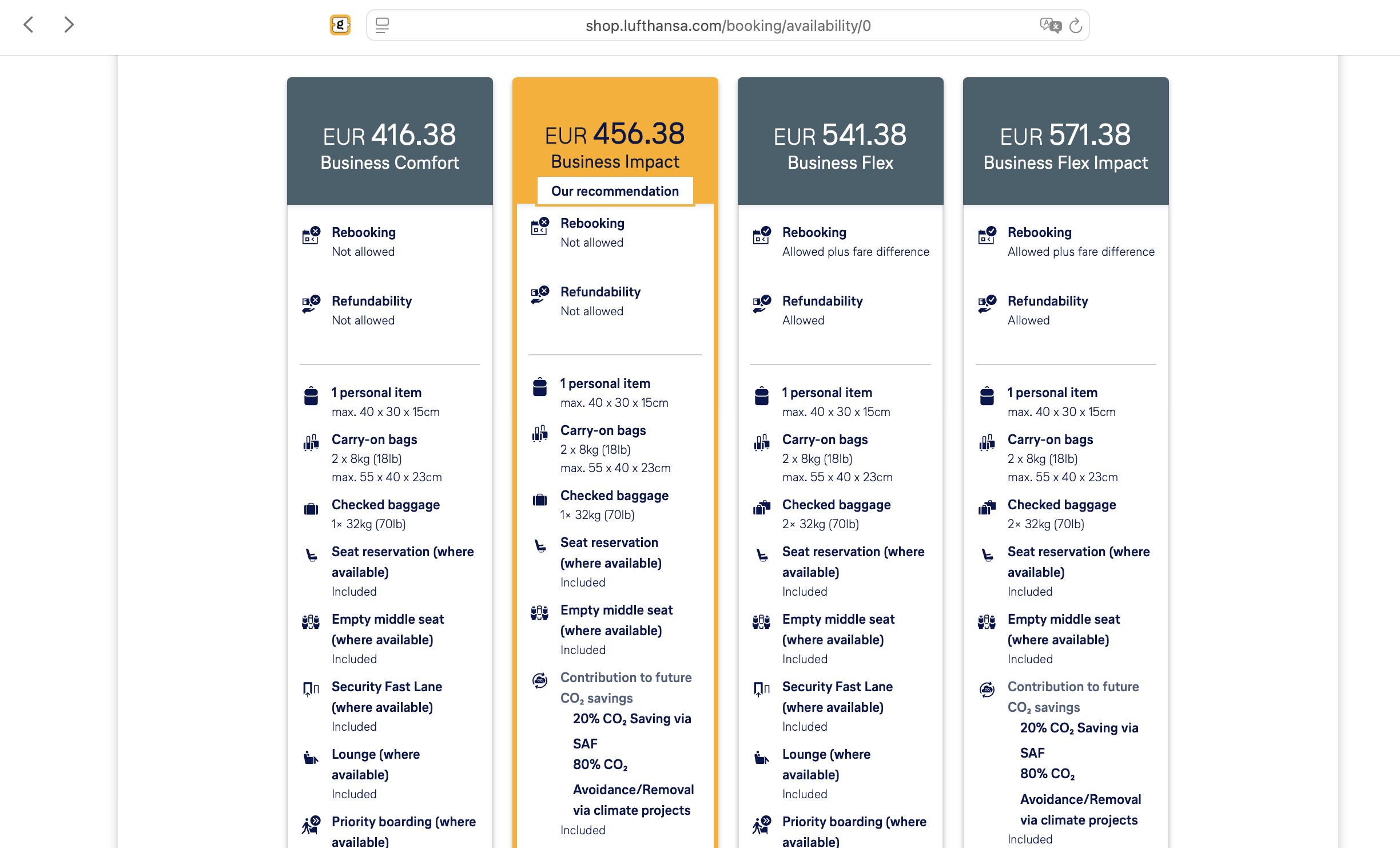
But if you select the cheaper Business Comfort fare, you then see a summary page with a dark pattern selector that has “Select Business Impact” highlighted — in the way you’d expect to mean “continue with what I selected” rather than “change to the more expensive option I specifically didn’t select one click ago”.
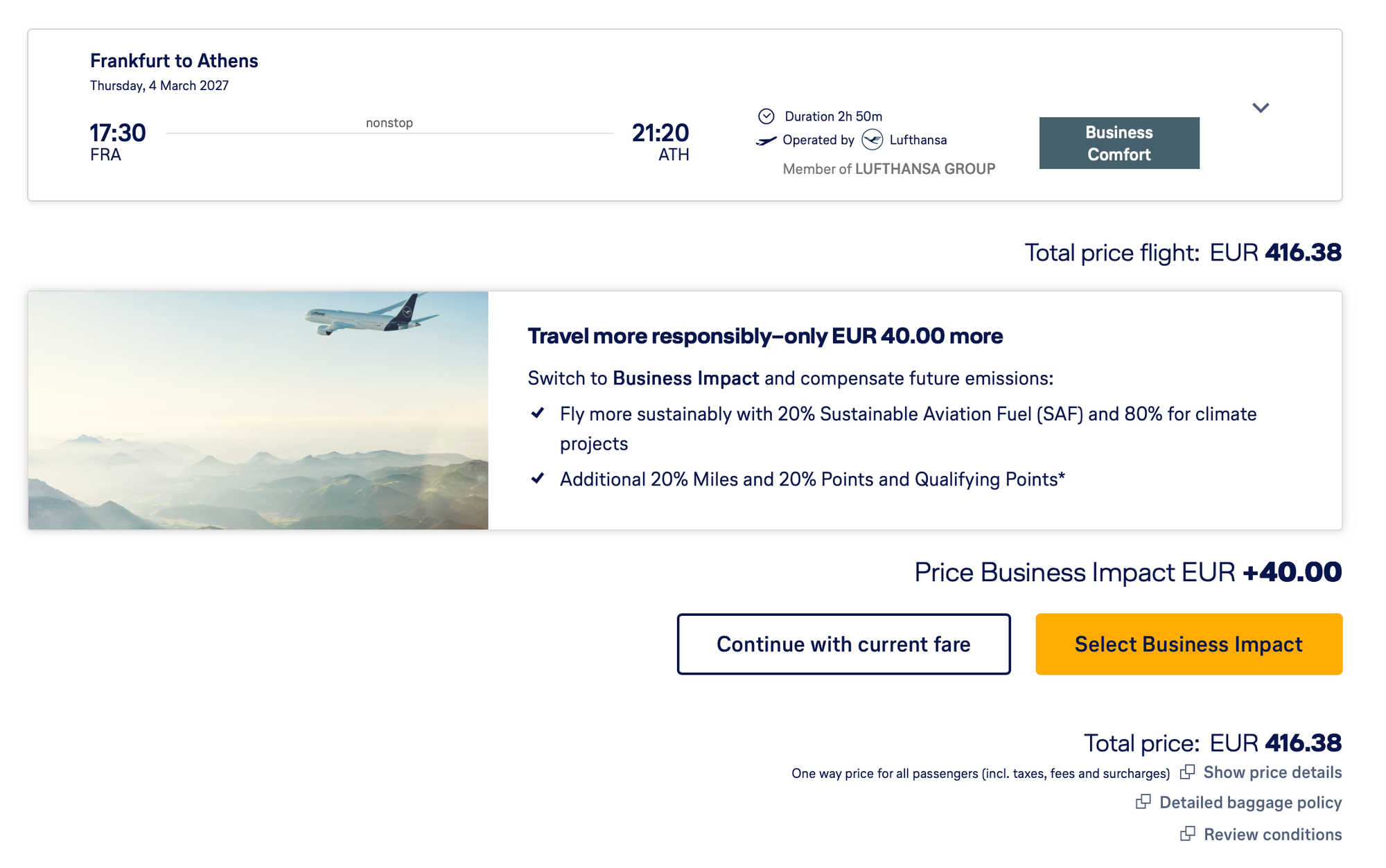
On the next page, there’s more dark pattern design at work. Lufthansa auto-selects you into the most expensive seats on board, the €139 Premium Business, again with the “default yes” design.
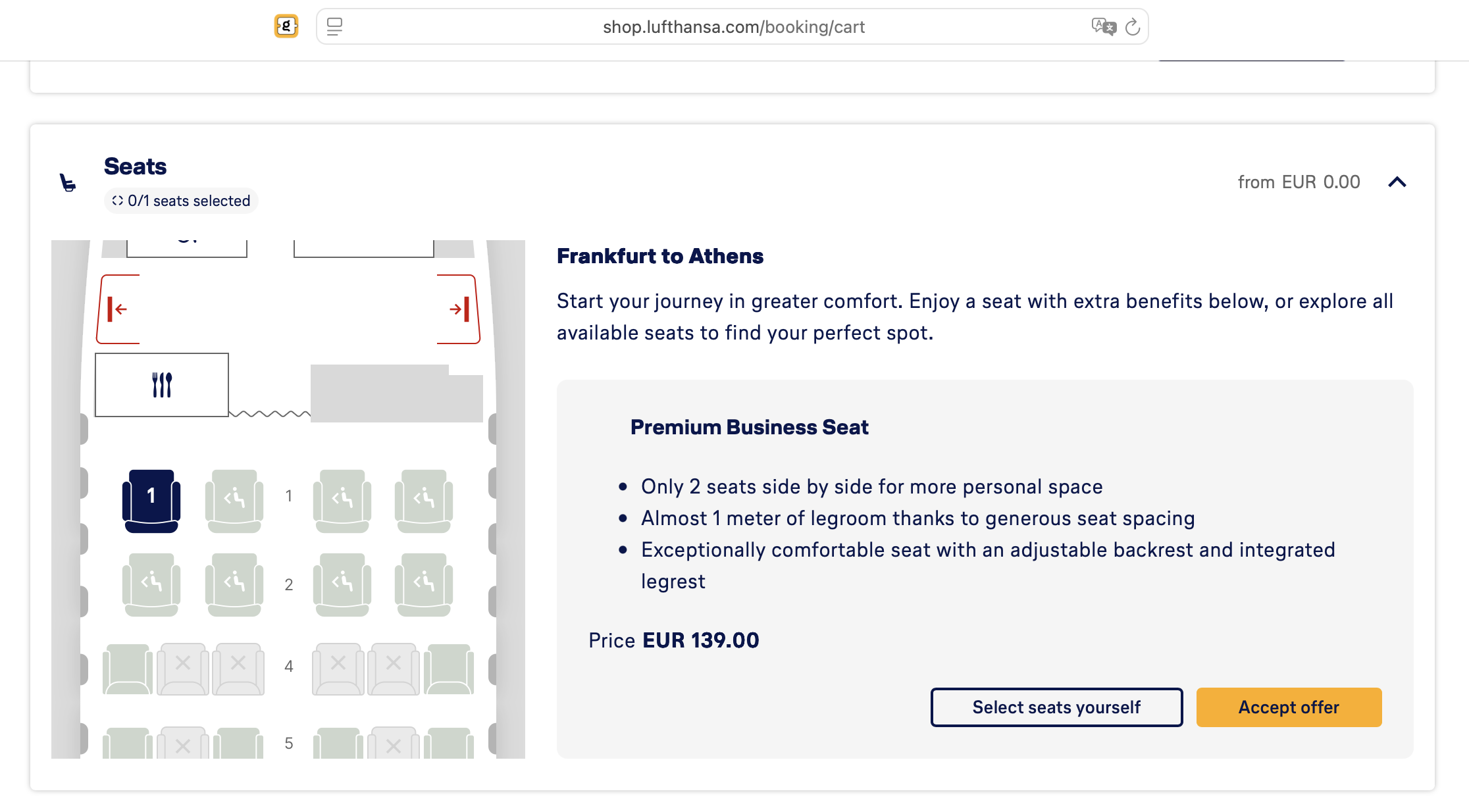
It both shows a “from EUR 0.00” number as the headline, and also doesn’t include the seat fee in the subtotal on the page. The “Accept offer” wording in the default “yes” design is, we imagine, just on the right side of EU and German consumer law requirements.
Lufthansa is also advertising its seats with undisclosed AI images within the booking path
A fundamental question for our times is whether companies have to disclose when the images of products they are advertising are AI-created or AI-modified.
If you make a booking, choose to select your seat, and click on one of the Premium business seats, up pops an image of the seat. Note that there’s no AI disclosure tag anywhere here.
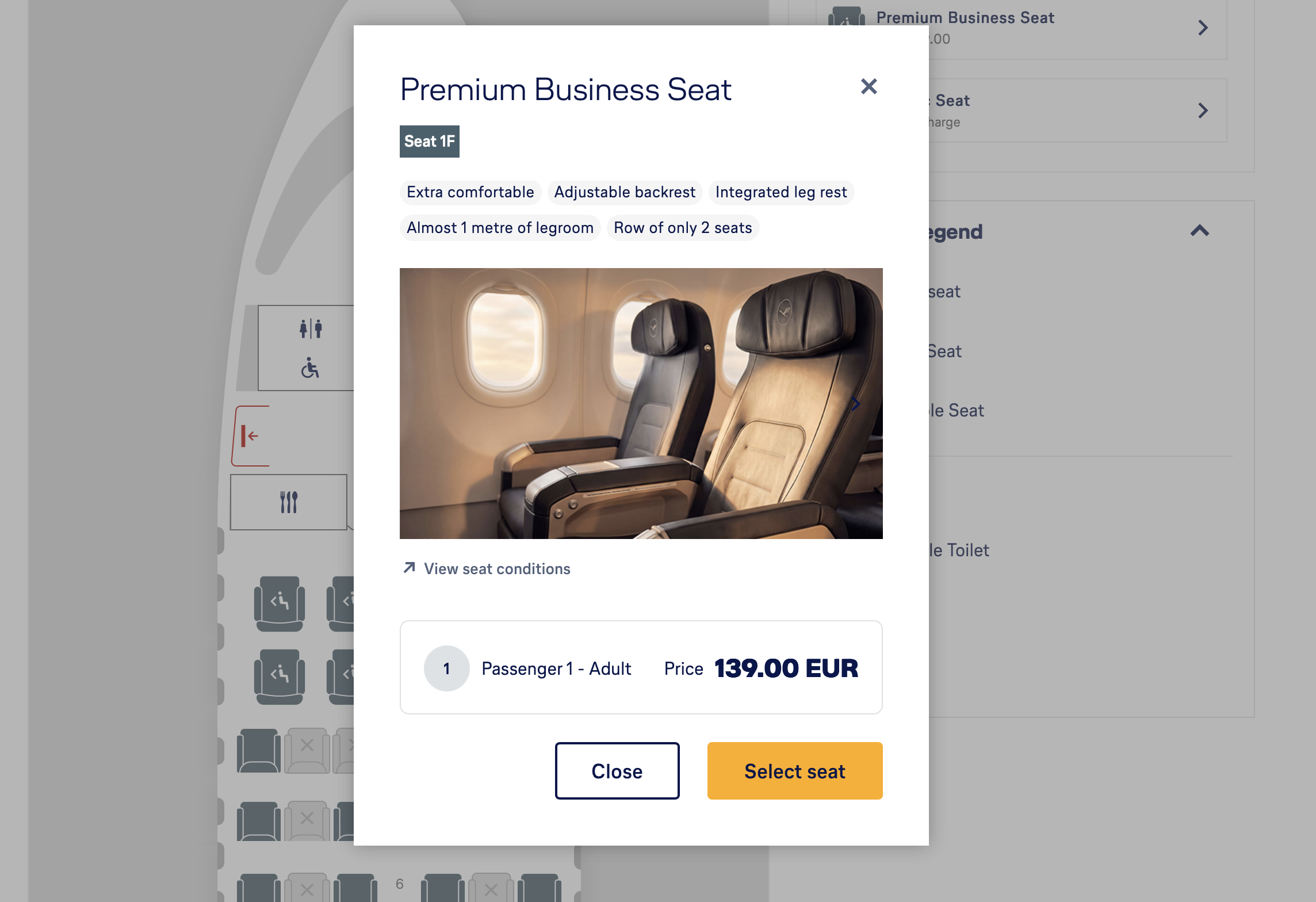
Intrigued, and keen to see this image up close, we right-clicked on the image and opened it in a new window. It was quite the surprise to discover that, in this full-sized image that’s clipped on the main site, there’s an AI disclaimer on the lower left that isn’t visible on the main site.
(We also discovered several other images from this set by manually changing the numbers in the filename from 3 to 2 to 1, uncovering three other images not displayed on the site, but publicly visible by going to the images here, here and here. We include them below in their entirety, with the clear proviso that they are AI-marked, as part of our reporting and as a record in case Lufthansa removes or modifies them.)
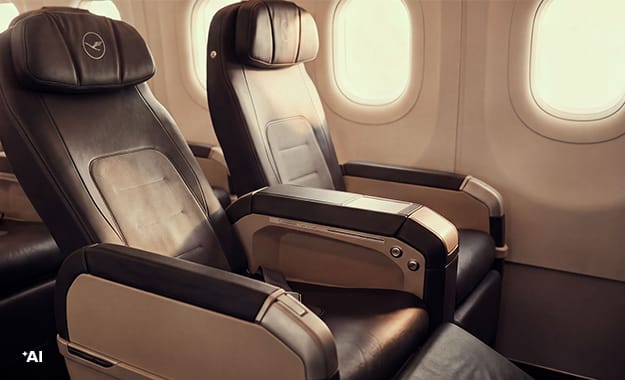
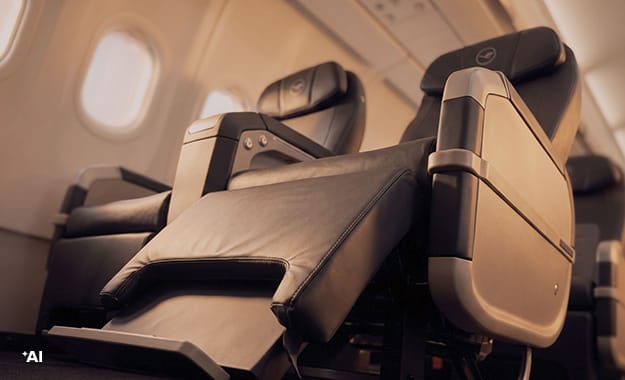
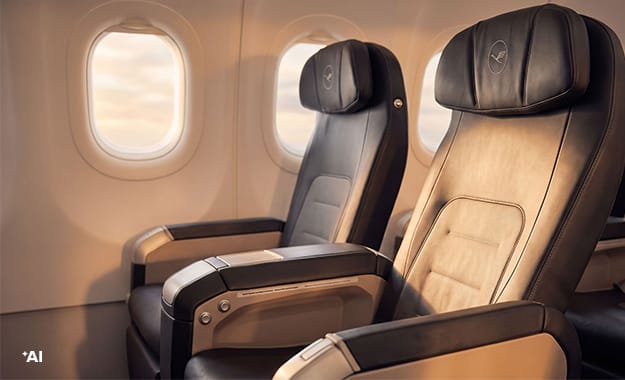
The AI markings on these images are not visible within the Lufthansa booking flow for these seats. Images: Lufthansa
Lufthansa also shows these images, along with the image supplied to media, with a much smaller “AI-modified” disclaimer, on its Premium Business product page. Is that the corresponding “shortlabel” compared with the “longlabel” on the press image? The pictures include the words “AI Label Short” in their file name on that part of the site.
So are these images AI-created, as their “AI” mark in the booking path part of Lufthansa’s site suggests, or are they “AI-modified”? Fundamentally, under the EU Code of Practice on marking and labelling of AI-generated content, these are very different things.
It’s notable that Lufthansa thought it necessary to include an AI imagery disclaimer on the full-sized version of the image that isn’t visible to normal customers, and on their product information page, but not the one visible in the sales path for the paid 139 Euro upgrade.
Perhaps this is simply an unfortunate cropping issue. If so, then this highlights the danger airlines face when web design and labelling clash. But the multiple versions of the images, and their multiple sizes and locations, would call that into question. Lufthansa also chose to make the anchor point of the cropping the opposite side of the image from the AI marking.
We’ll also note that key structural elements of the seat in these three “AI”-marked renderings are visibly different to the one provided to media and marked as “AI-modified”.
So which of these sets of AI seat renderings is real? Or is it neither of them? We don’t know. Neither do passengers who are already buying these seats. And Lufthansa isn’t saying.
That’s seatfishing — and it’s worrying.
At least with housefishing, the buyer is likely to visit and see the actual property before they buy. With seatfishing, the buyer may not see an accurate rendering of the inflight experience they bought until they actually board the plane. At that point, it’s too late to back out of the purchase.


