
Singapore Airlines has not had a good weekend of it. Unveiling its new first, business, premium and economy seats at a glitzy unveiling at the iconic Marina Bay Sands on Friday, the airline will have hoped for a much better reaction to a series of onboard cabins that it has clearly been working on for more than a decade.
But it’s hard to imagine a worse reaction to the business class seat, and that reaction is deserved in many ways. But it risks overshadowing the greater implications of how the delays to the 777X programme have made a generation of seats and cabins obsolete on arrival, meaning that the latest and greatest from standard-setter airlines like SQ arrive looking behind the times.
In this case, Singapore Airlines’ new first class is a decent improvement as it returns to a more standard suite form factor, while the premium and economy look fine but aren’t moving any needles.
The business class, however, is a bizarre and incomprehensible departure — from the decades of investment by Singapore Airlines its industry-leading passenger experience and brand equity, from the standards of business class aesthetic design, and from the expectations of today’s premium passengers.
The response to the business seat has been roundly condemnatory. Rarely if ever have our inboxes and messaging apps blown up so comprehensively with bafflement and disappointment at the announcement of a new cabin: mostly around aesthetics, but also about some functionality elements too.
One knowledgeable source says that “none of the designers can justify why they’ve made the decision”, while another insider calls it an “identity crisis”. An experienced airline hand is “genuinely shocked”, using the 🤢 nauseated face emoji.
Rhys Jones at Head for Points, in Singapore for the unveiling, calls the seat “a total divorce from its existing brand experience”. Ben Schlappig of One Mile at a Time says it’s “botched”, “cheap” and “mismatched”.
It’s especially notable that even the most enthusiastic among the influencers and media SQ flew in and put up at the Ritz-Carlton have struggled to find positives in the new Designworks-styled, Recaro-manufactured suite. The best feedback is that it is causing discussion, that it will be controversial, and that it’s better than the 2013 seat. One should hope so.
You’ll have noticed that we at The Up Front don’t pull our punches or gloss over missteps in the service of airline trip invites — or anything else — and we don’t intend to do so here.
SQ has four new seats coming: first and business class suites, premium economy recliners and regular economy
Singapore Airlines has worked with two seat manufacturers and three design houses for these cabins:
- Collins/PriestmanGoode for first
- Recaro/Designworks for business
- Collins/Factorydesign for premium and economy
The airline says these will be “progressively introduced from the second half of 2027 on SIA’s 41 retrofitted Airbus A350-900 long-haul and A350-900 ultra-long-range (ULR) aircraft, and its all-new Boeing 777-9 aircraft”.
But not all the new seats are going on all the new planes. The plans break down as:
- 777-9: first, business, premium, economy
- A350-900ULR: first, business
- A350-900 long-haul (non-regional): business only
Of note, the ULRs are gaining a first class cabin for the first time, with four seats, while the 777-9 will see six. Let’s start there.
An earlier version of this article cited six first class seats on the A350-900ULR and eight on the 777-9 in error.
First class sees SQ returning to a much more traditional model of recline-to-flatbed suite from its seat-plus-bed option
Singapore Airlines invented the first class suite on its A380 twenty years ago, and its forthcoming product more closely resembles those suites than the single-aisle version its superjumbos currently have on board, which has a separate swivel chair and bunk.
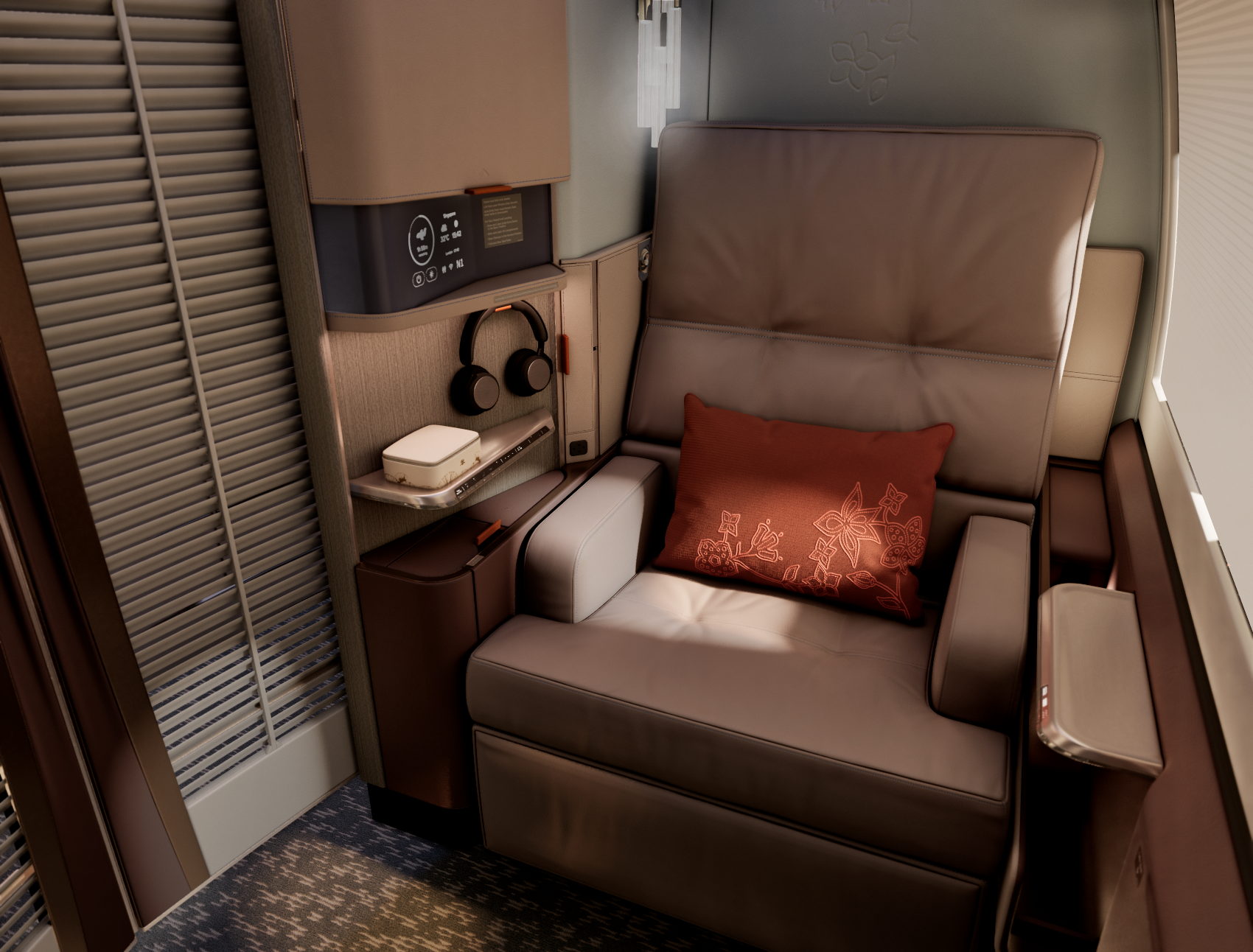
This is a two-aisle model like the original A380, but is even more traditional in its reclining Z-bed option compared with the unusual Murphy bed element that folded down from behind those seats.
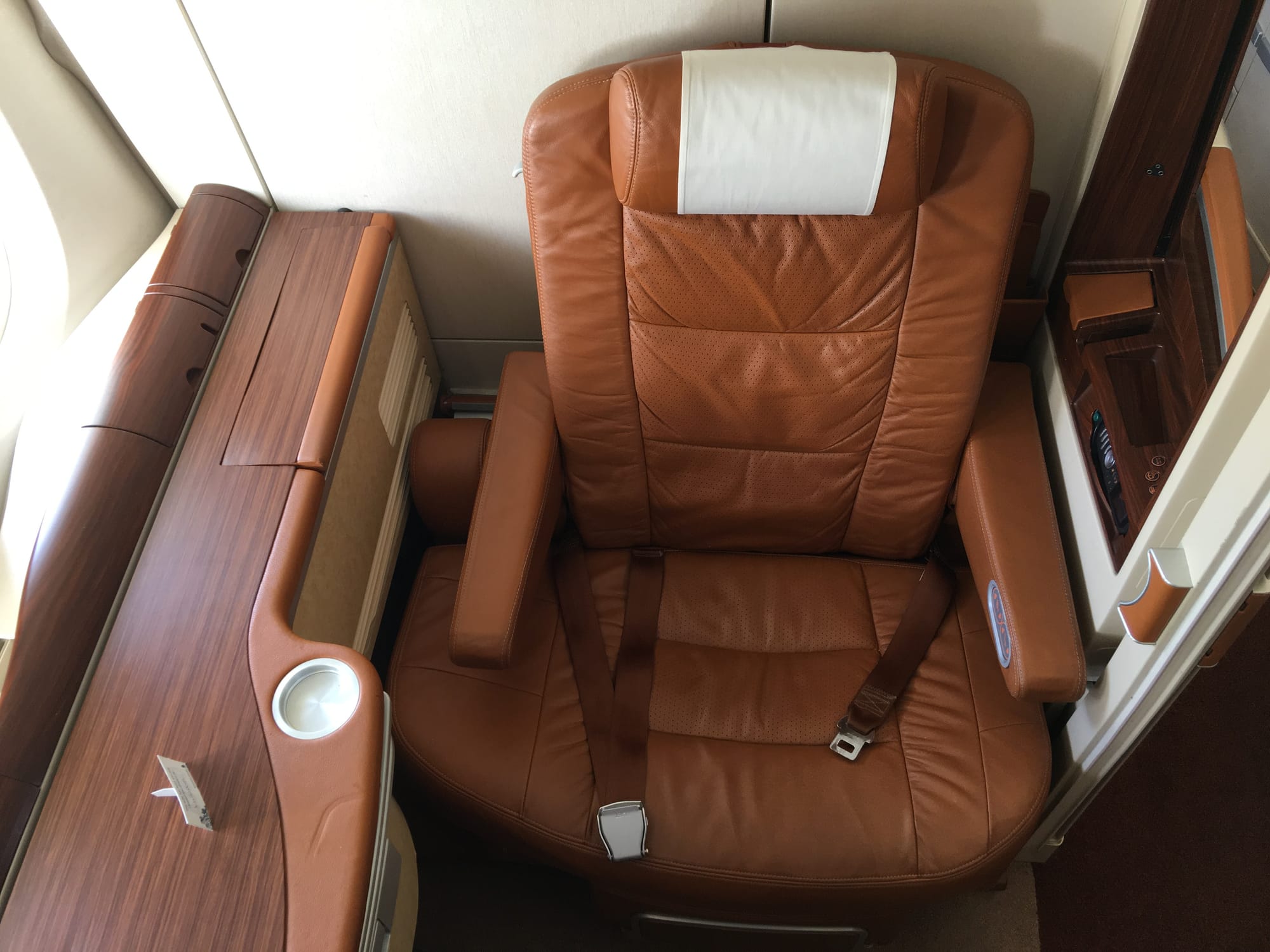
SQ’s original A380 Suites class seat flipped forward, with the bed deploying from the wall behind (to the left of the seat’s centre in the left image). Images: John Walton
Overall, it looks to be a similar Collins Aerospace base model to British Airways’ latest cabins, though different in the non-critical structure, storage, the warm brown and red aesthetics, CMF detail, and so on.
The centre pair forms a full double bed, which SQ claims is queen-sized, and if the 30-inch (76cm) armrests-down seat width is doubled that makes 152cm, which is exactly what mattress company Sealy states is the standard Singaporean queen.
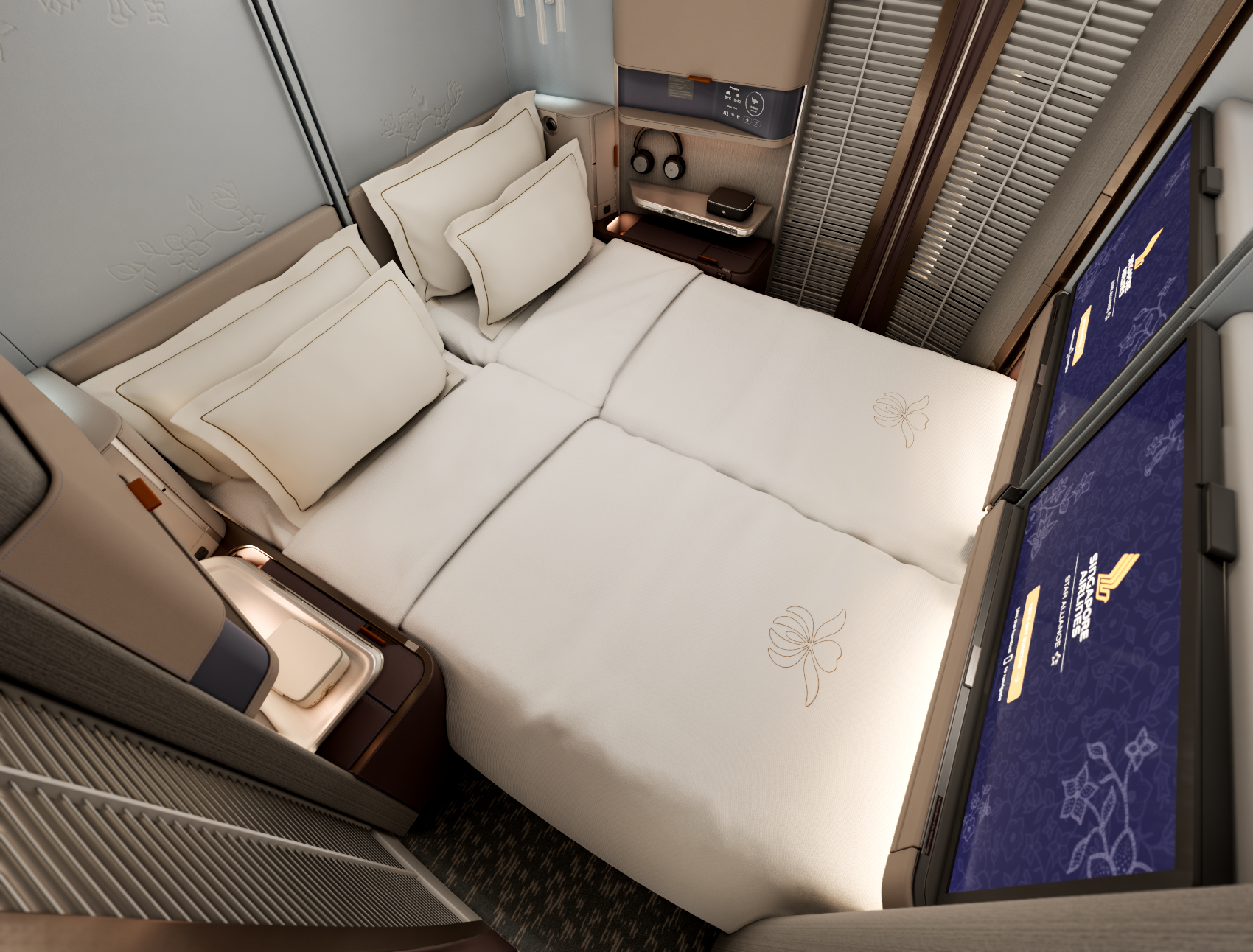
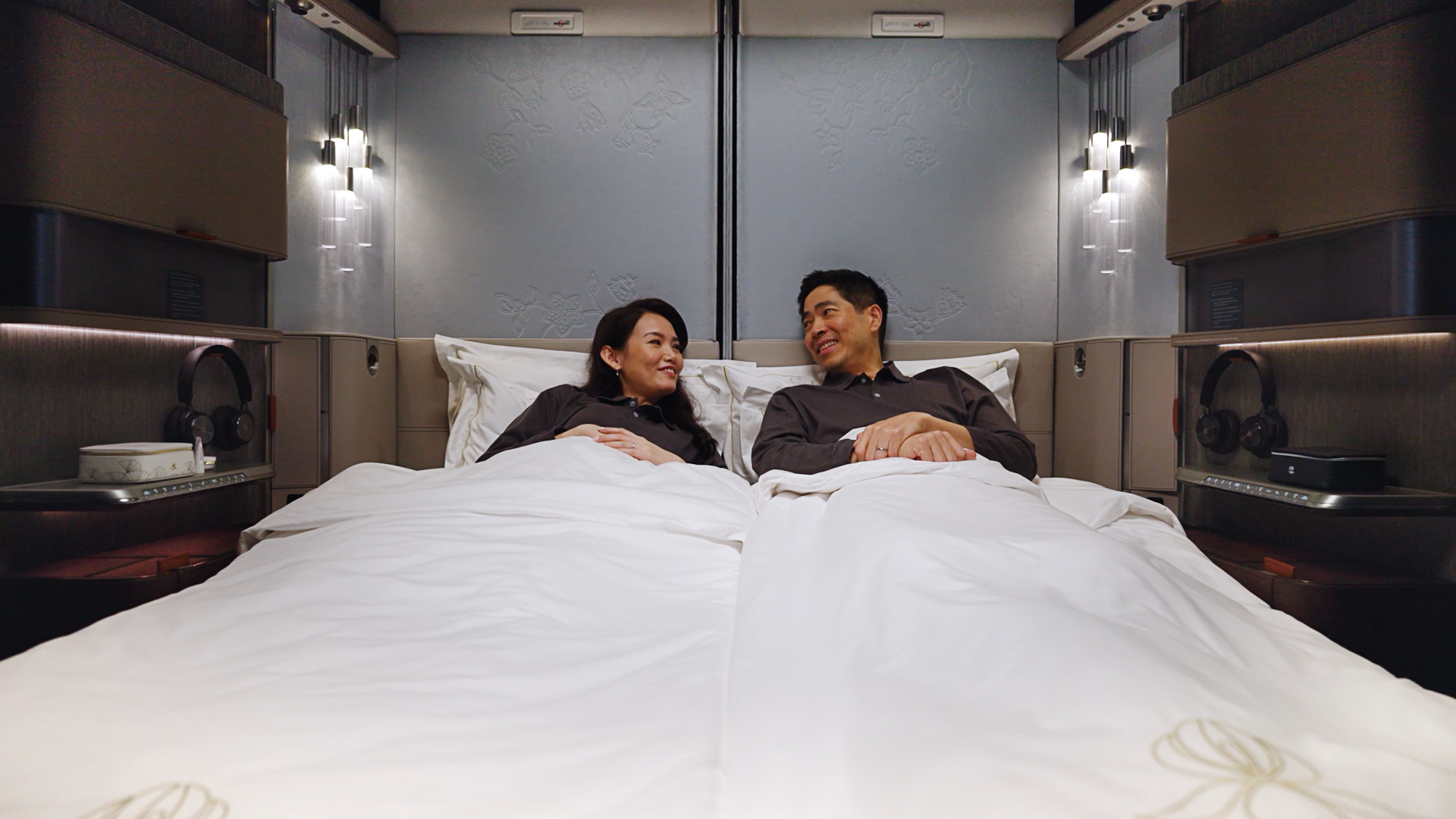
This is one of the better double bed implementations in first class. Images: Singapore Airlines
The lack of a centre structural bar between the two beds compared with either of the two most recent cabins is a bonus as well: this feels like a real, proper, large double bed.
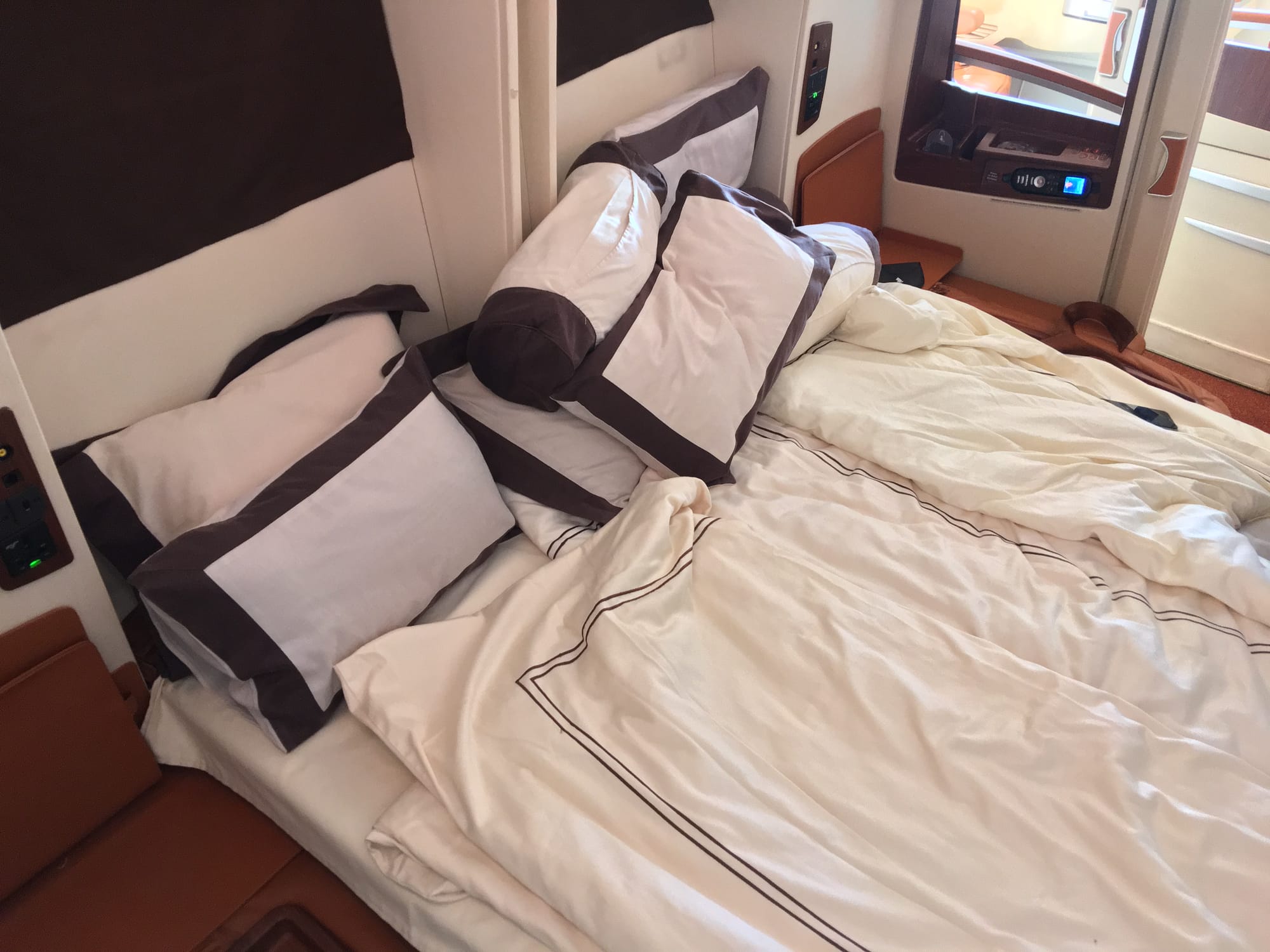
This looks to work far better in practice for both sitting and sleeping comfort than Singapore’s second-generation A380 cabins, with their slow electrical rotate of the Dr Evil dentist chair that’s less comfortable than a premium economy seat, plus a separate, narrow and hard flip-down bunk.
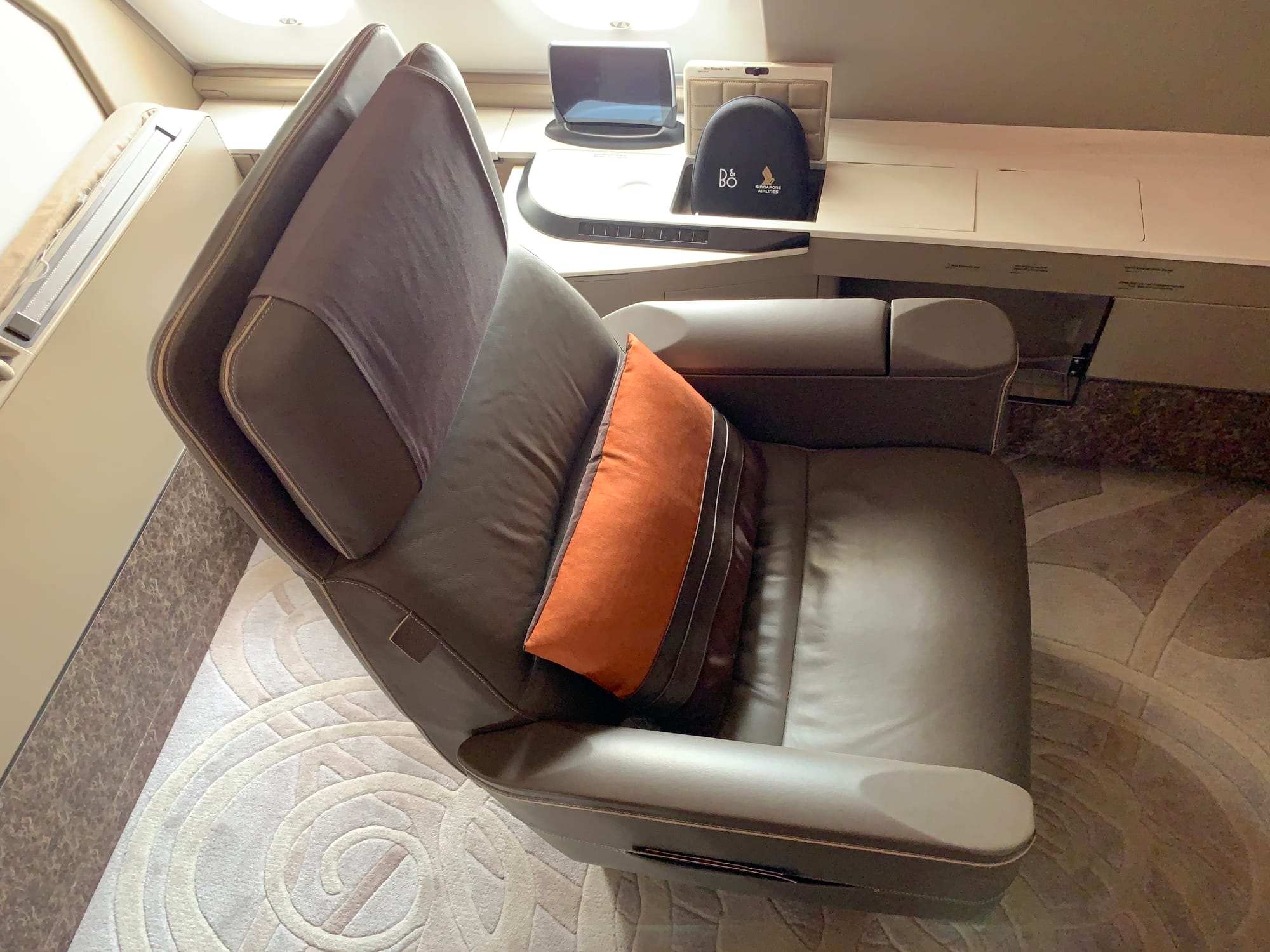
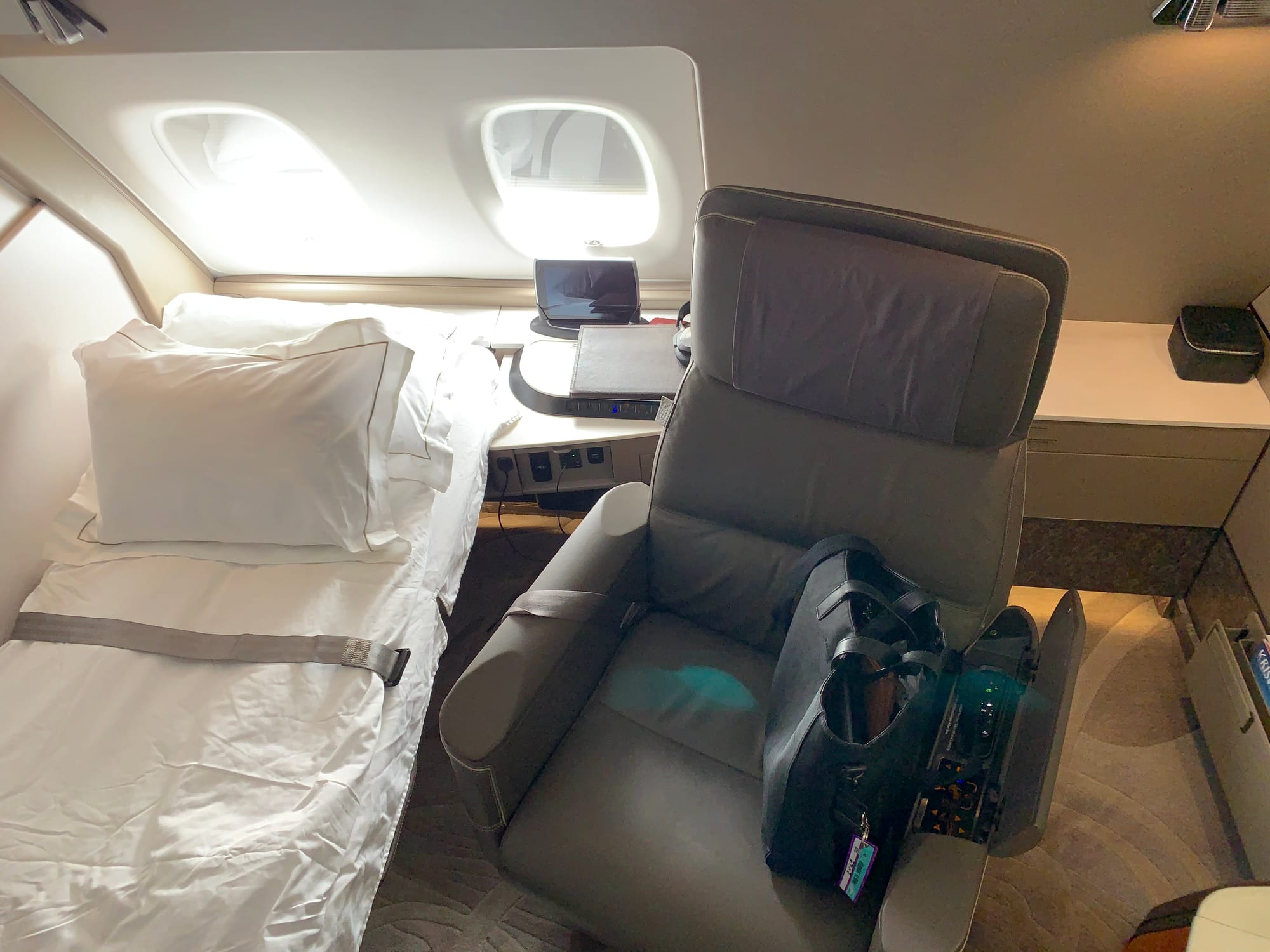
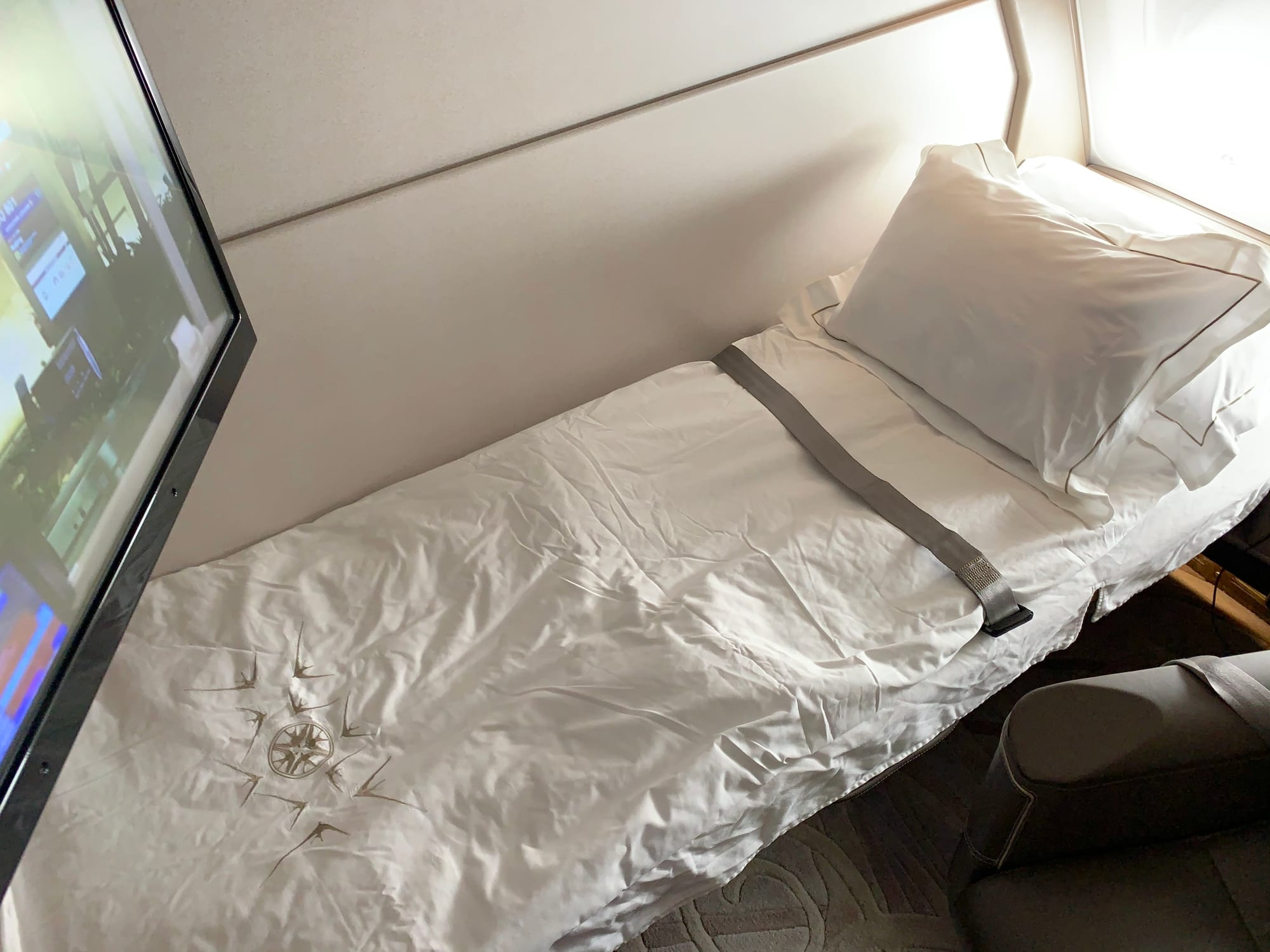
SQ’s implementation of the seat-plus-bed concept is the least well executed in modern times. Images: John Walton
It’s rather more refined too, feeling mature and elegant with its burgundy accents, the batik pattern in relief, peranakan-style louvre slats on the doors, and classic aesthetic.
The sky blue on the walls is an unusual choice from PriestmanGoode, and one that brings to mind the JAL A350 business class from tangerine, while the relief will neatly catch the light both from mood lighting and from the residential-style signature light feature.
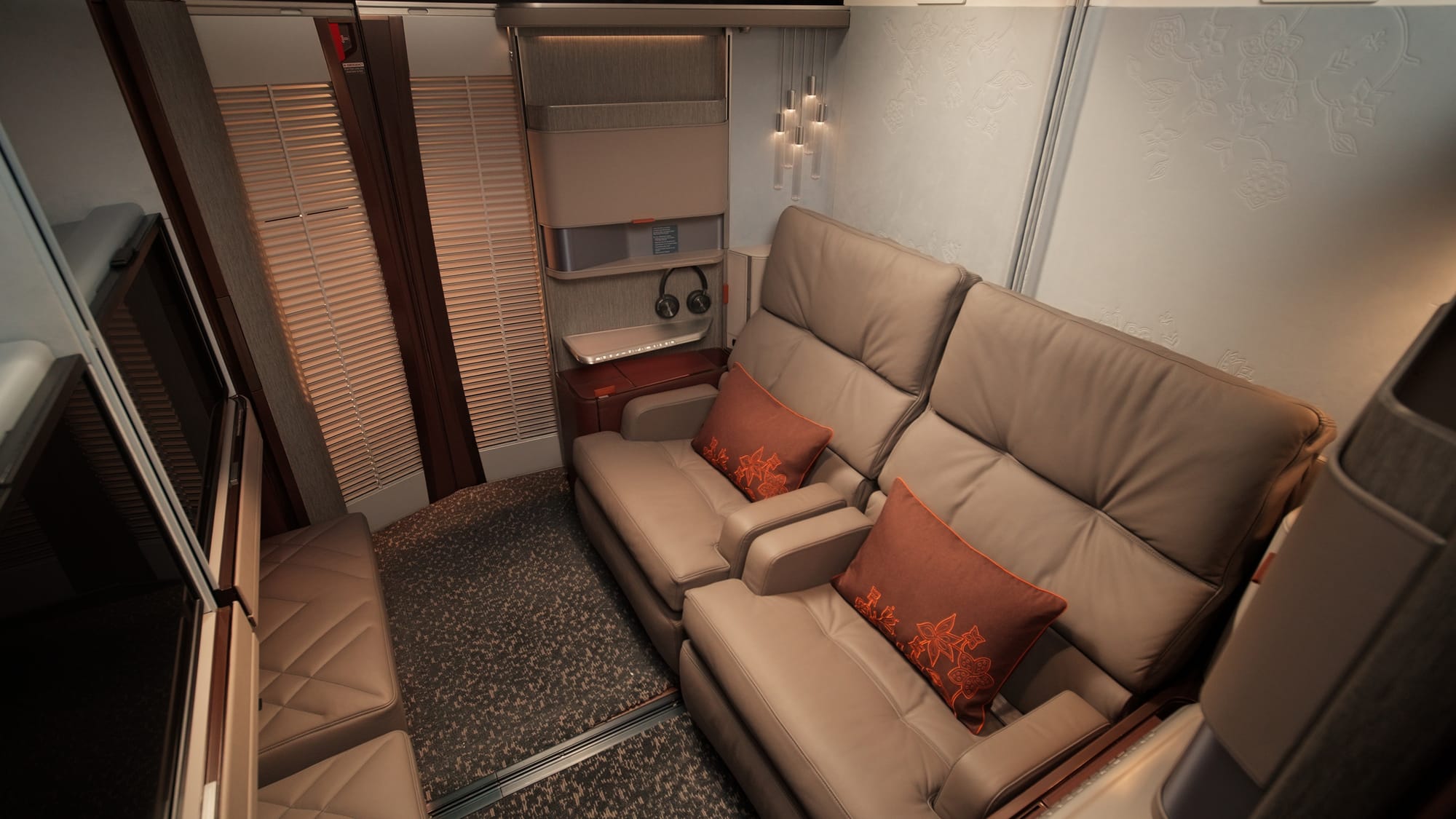
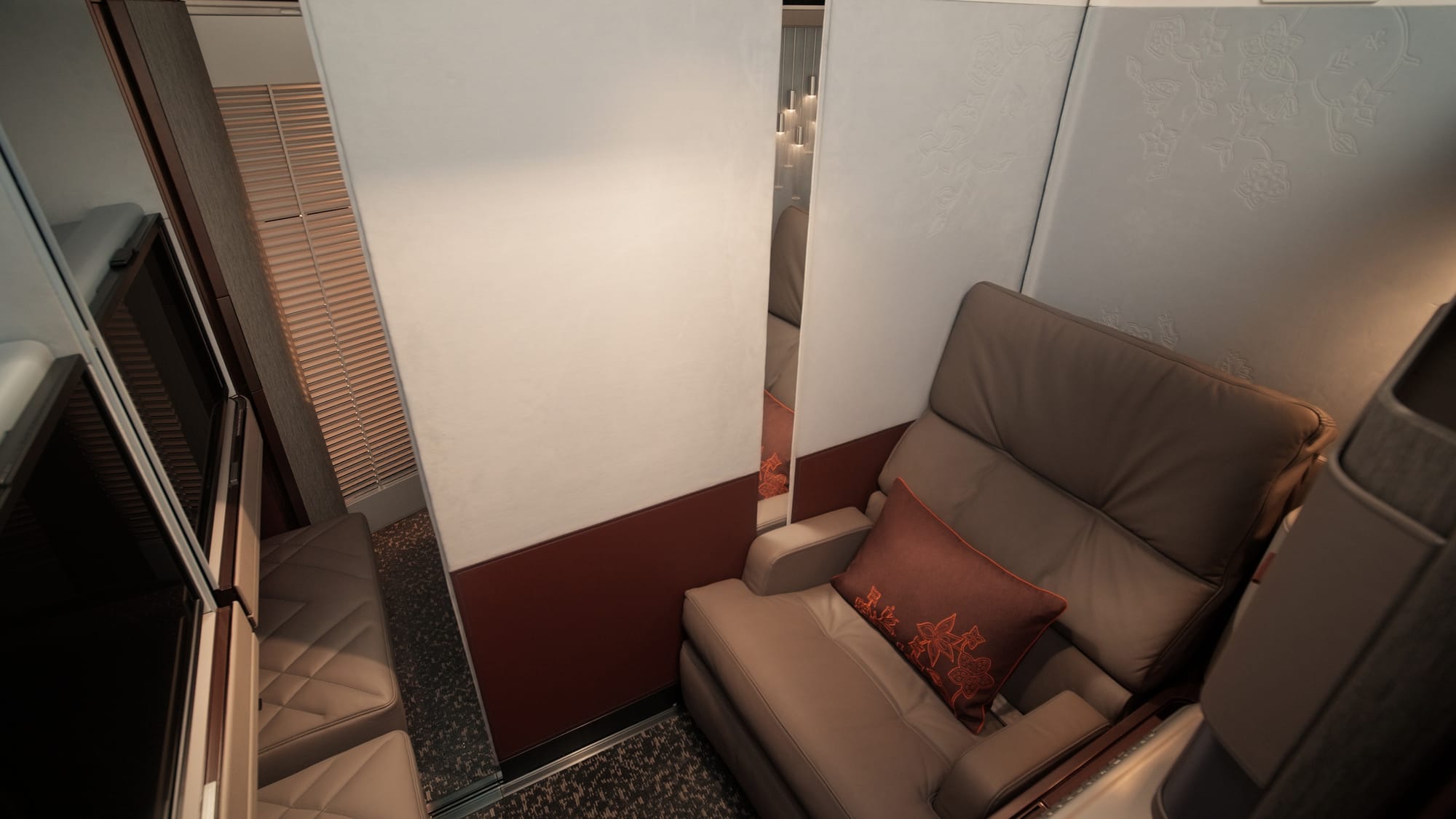
The relief-patterned divider deploys or is retracted depending on whether the centre seats are sold together or separately. Image: Singapore Airlines
In shapes, the seats bear a strong resemblance to the Etihad 2010s era of cabins with the large square leather tufting, and indeed the layout harkens back to the same era on Etihad’s 787 (manufactured by Collins predecessor B/E Aerospace) with the curving corridor.
Unusually for the latest generation of first class, it’s a full 1-2-1 configuration across both the A350 and the 777-9, compared with the 1-1-1 of JAL and Qantas, or the 1-1.5-1 of the Lufthansa FICE/Allegris seat, where the centre pair are only ever sold to pairs of travellers.
The suites have high aisle-side doors, but these are not entirely floor-to-ceiling, although the horizontally deploying divider between the centre seats does actually reach the ceiling structure.
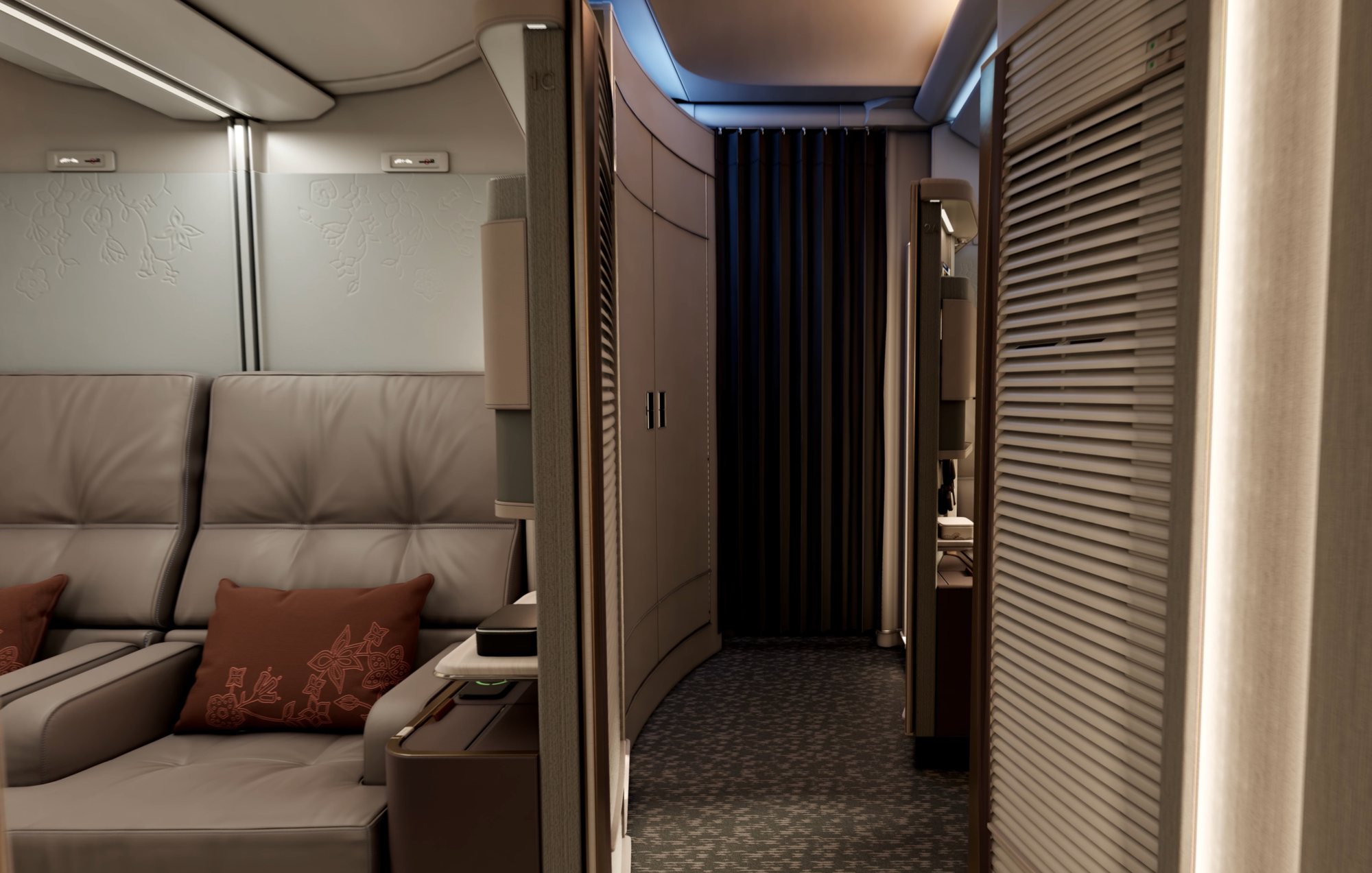
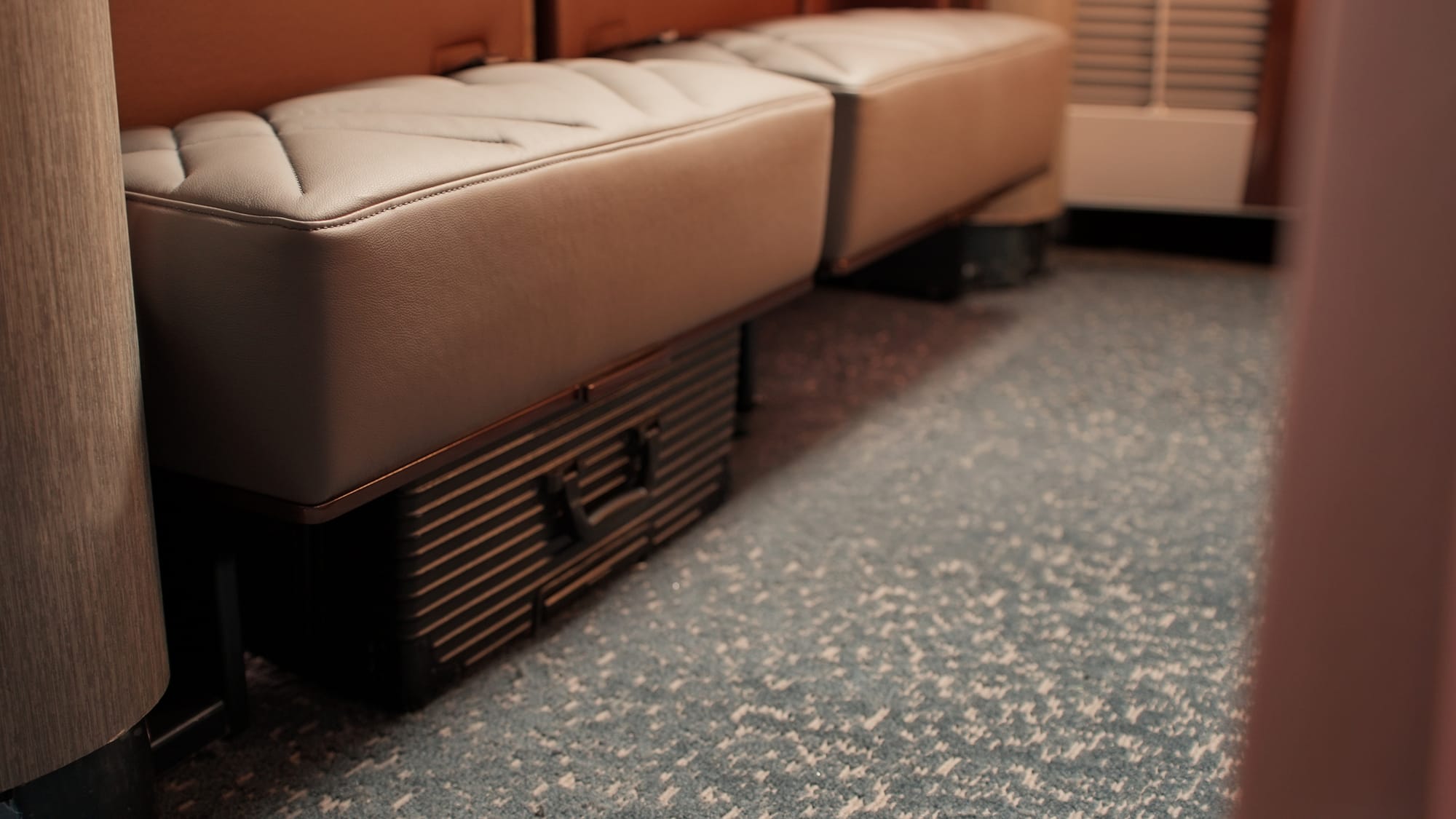
That divider deploys from the closet assembly behind the middle pairs, and it’s good that there’s that closet there: there are no overhead bins in this cabin, and the sole storage is underneath the (liftable) ottoman.
This seems sufficient for a rollaboard, but many passengers will also have a handbag, laptop bag or similar. This may well fit into the side cupboard, but the details there are as yet unclear, so it will be interesting to see how the storage works in practice.
There are the usual large 32” modern screens, a leather-topped wireless charging plate, and there’s both AC and USB power as well. The tactile buttons are also very welcome in an age where most airlines are leaning towards using either the main screen or a secondary tablet to control the seat.
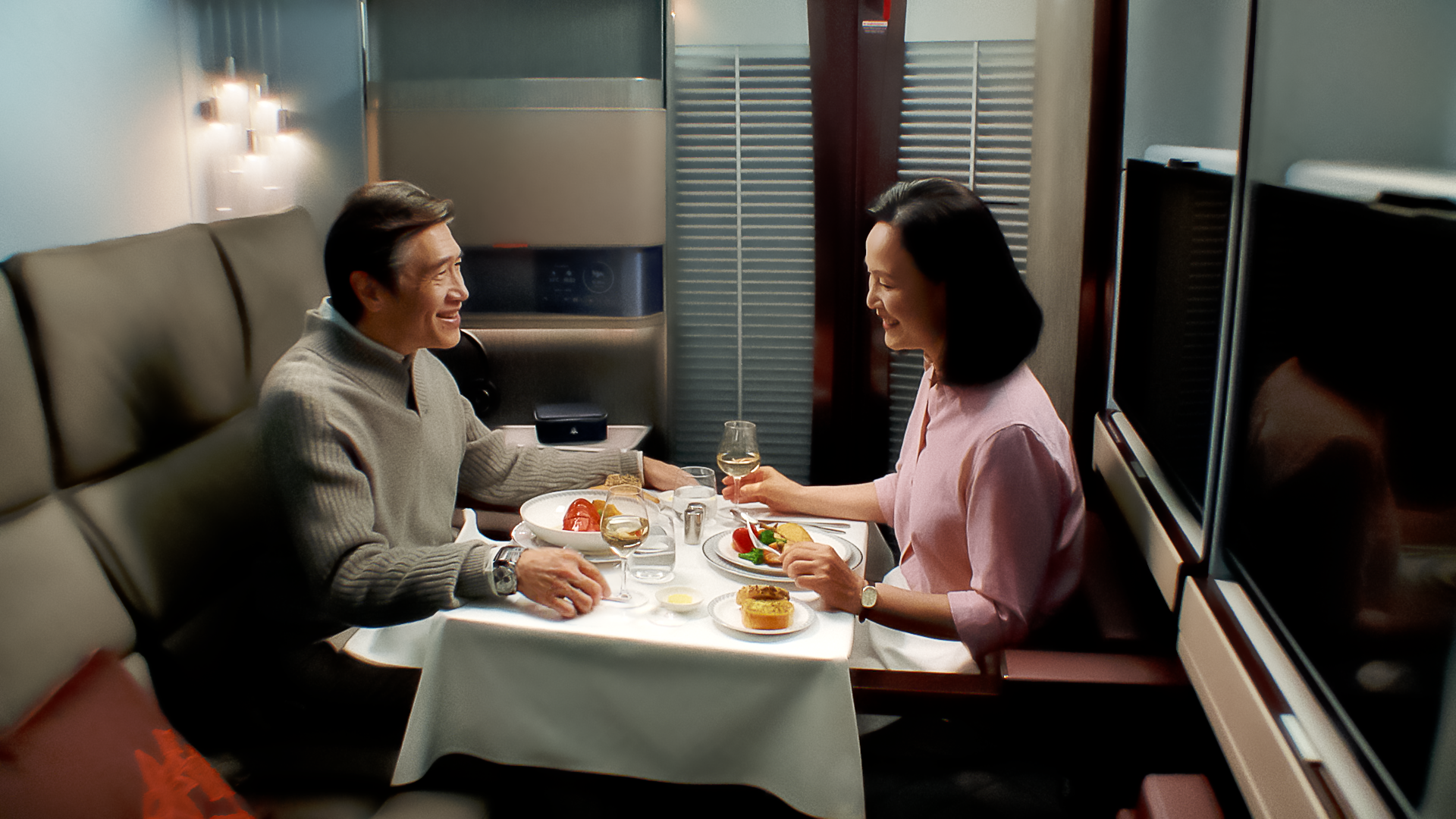
Companion dining is also available, as shown on the centre pair — although it’s not entirely clear why the centre passengers would choose to share one table instead of just sitting next to each other. The window seats, sure, or for a group of three or more, but this is an odd rendering choice.
The business class aesthetics are both visually unappealing and technically disappointing in their styling and CMF
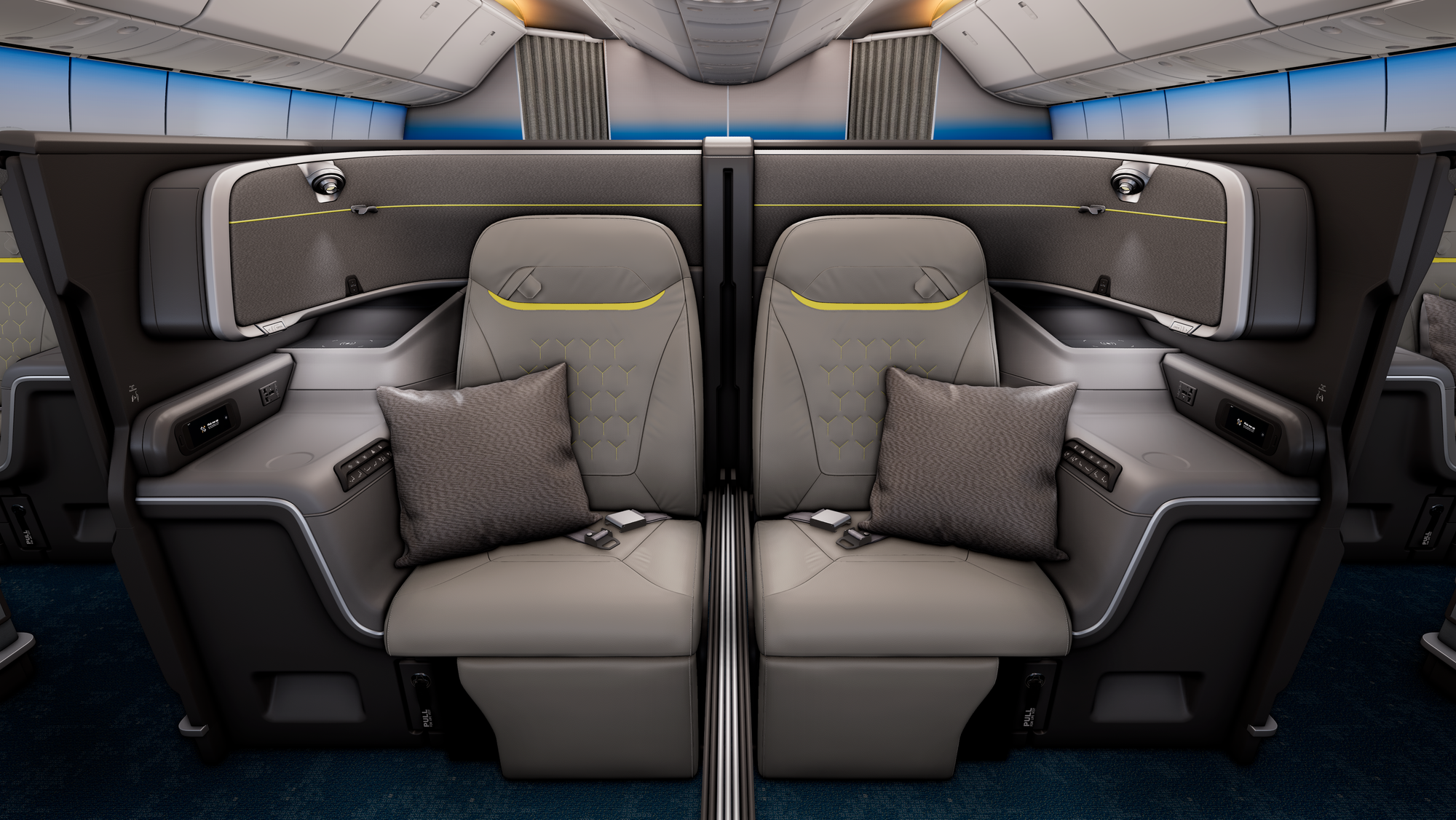
We’re not here to sugar coat anything: the new business class is an enormous departure, and very un-Singapore Airlines, abandoning more than half a century of some of the most positive brand equity in the industry for some of the worst CMF execution we’ve seen in recent years.
Business class is the profit engine of every longhaul network carrier, and this is perhaps the worst received business class suite, aesthetically speaking, in recent memory. To our mind, that’s deservedly so.
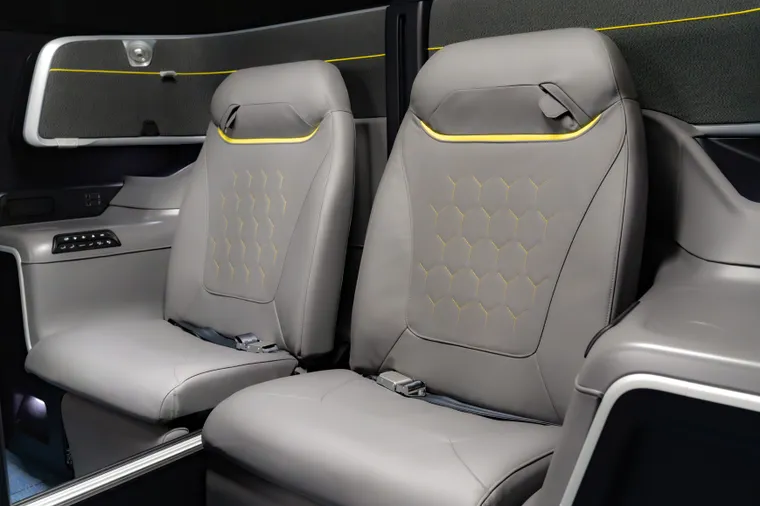
Not only does this not say “Singapore Airlines”, it says “Scoot”. It’s cold, hard, grey, bulky, and for some reason the main accent colour is somewhere between the bright yellow from SQ’s low-cost subsidiary and the “this is safe for us to use — no airline would ever pick this!” neon green that Recaro used to use as its inhouse show CMF ten to fifteen years ago.
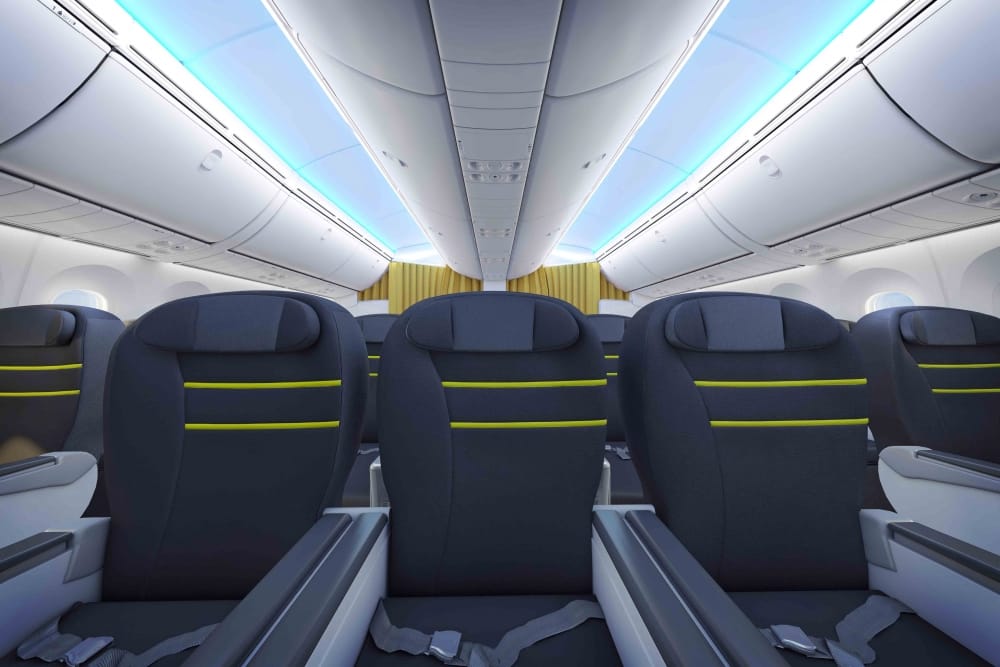
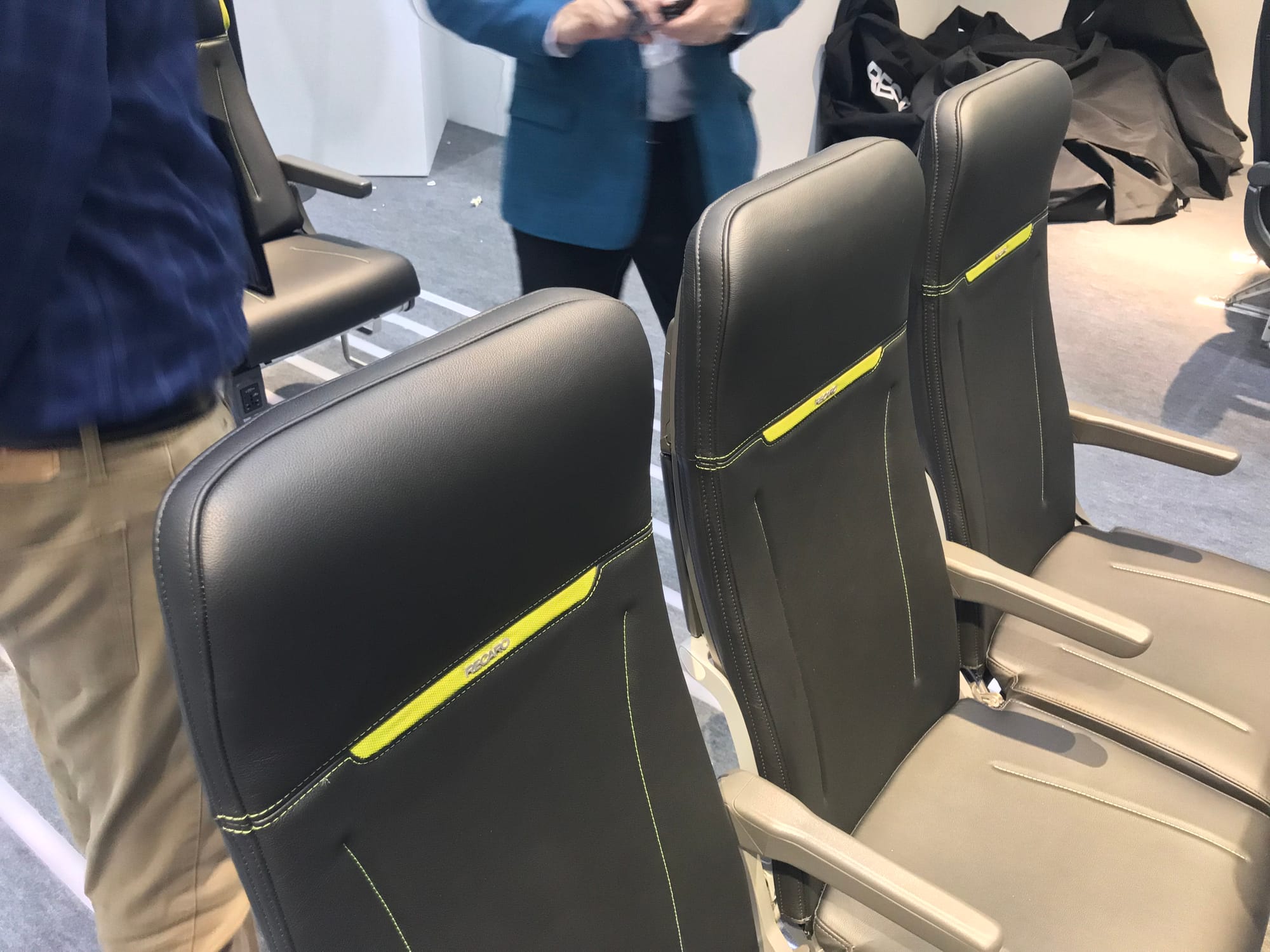
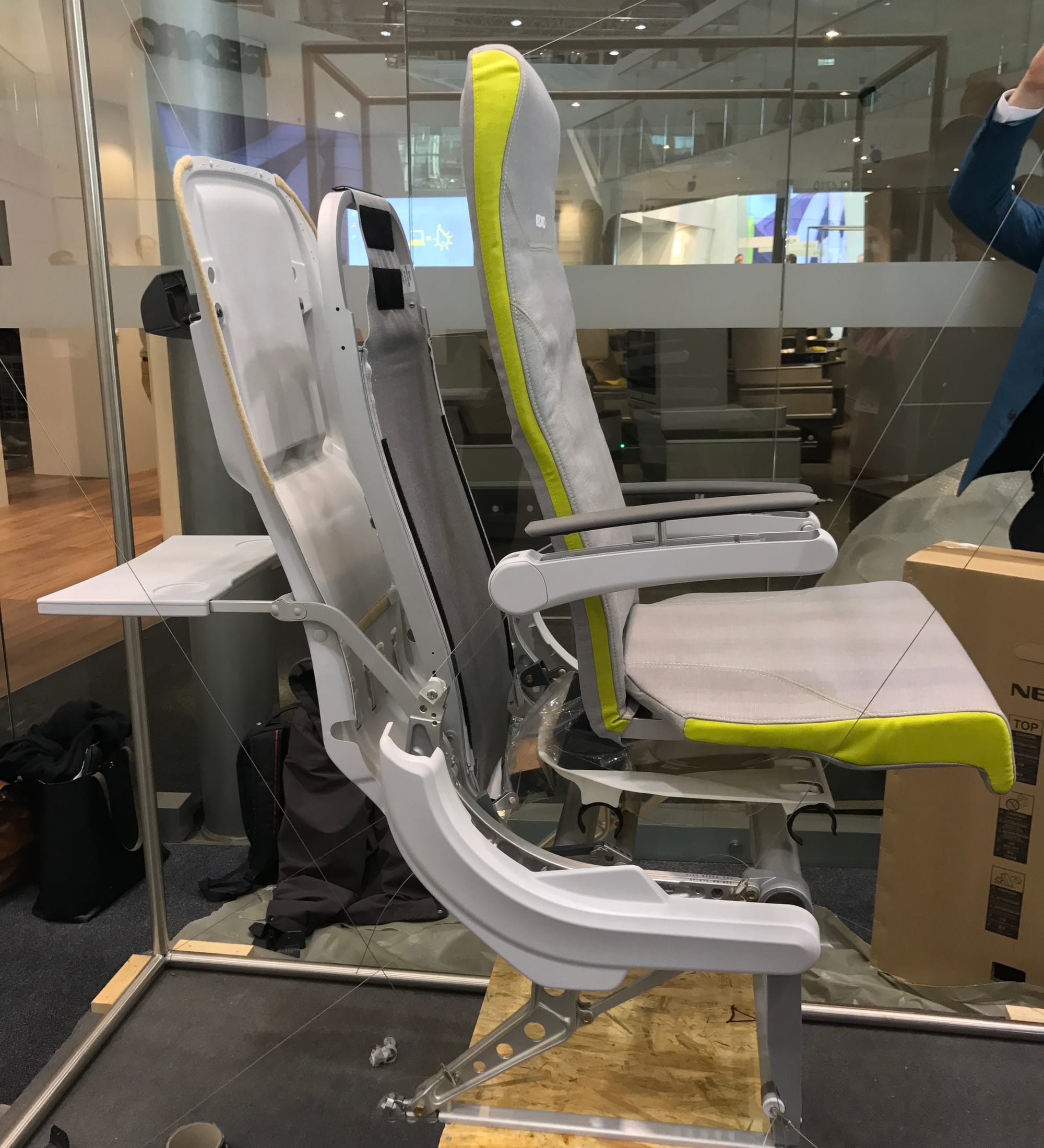
Between Scoot’s 2015-era Dreamliner front cabin and Recaro’s 2010s house styling, the aesthetic context for this seat raises eyebrows. Images: Scoot, John Walton (x2)
Frankly, it is a baffling decision by SQ and Designworks to use visual language that says “this seat belongs to our low-cost carrier”. Yes, it’s automotive, but in a way that says cheap EV rather than luxury car.
Moreover, the aesthetic is just so completely different to anything that has come before within the SQ palette, in which the airline has made substantial investment in recent years, including with the revised batik motif from 2022 that originally dates to Pierre Balmain in 1968.
Nor is this aesthetic like anything else on the plane — or elsewhere in the SQ passenger experience. There is more visual linkage between first class and premium economy than there is between business and those two cabins.
Also baffling — and that superlative is quite notable in this context — is the neon cyan and yellow Y motif on the seat, doors, and storage nooks that The Up Front understands is supposedly inspired by the shape of NASA’s Juno satellite.
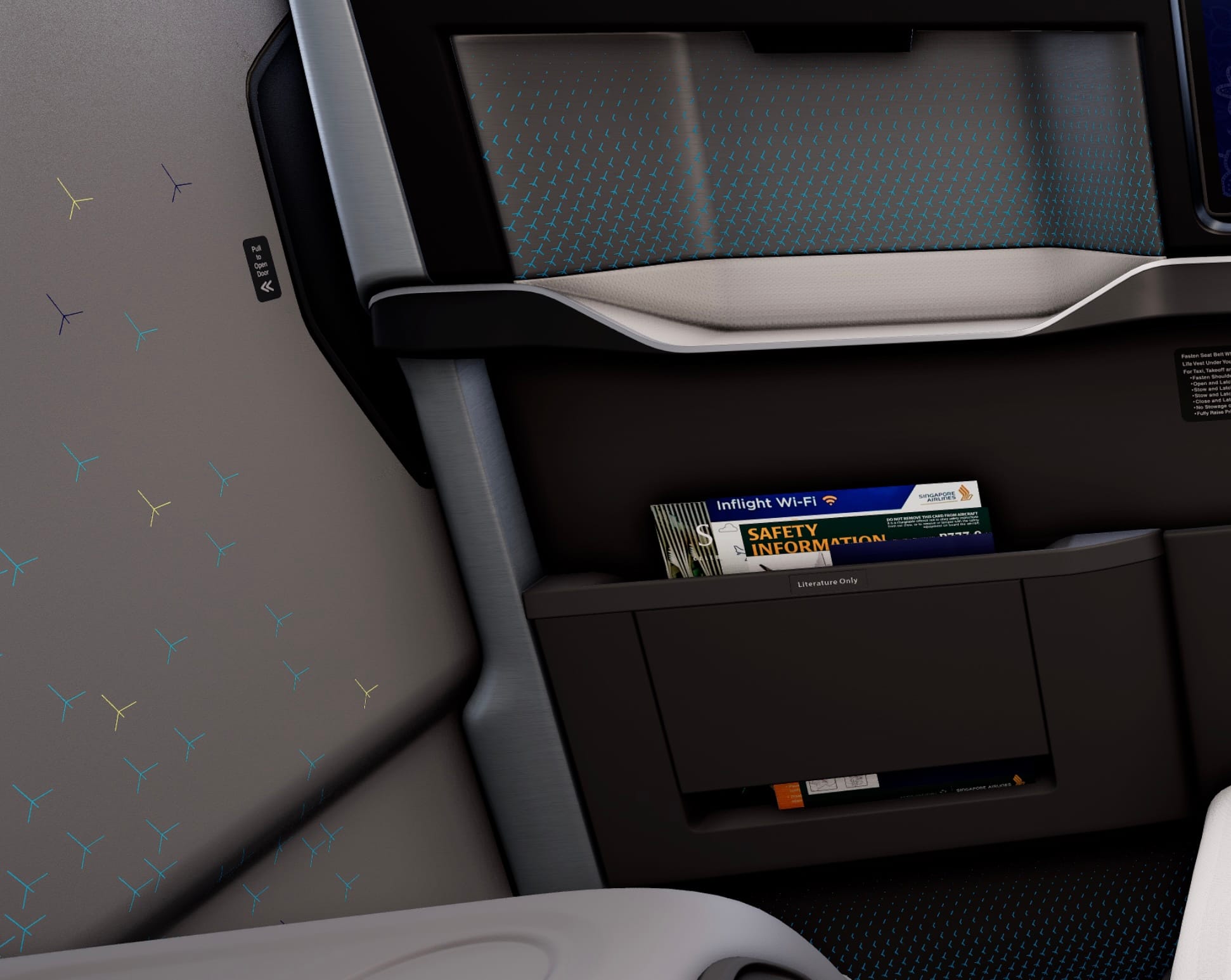
Somehow, hearing the satellite inspiration makes it worse. If you are not a space exploration nut and don’t remember Juno, that’s perhaps not surprising — it was launched in 2011 and arrived around Jupiter in 2016.
The only association between Singapore and Juno seems to be a rather hackneyed segue in a 2016 government note by the country’s then-Senior Minister of State for Law [PDF], the gist of which can be gleaned from the sentence: “The Juno mission put me in mind of the current state of the world economy and the work of Singapore’s Committee for the Future Economy (CFE).”
Well, indeed, nothing so firmly resonates with the futurist hope of space exploration as the work of a government economics committee.

Given all the delays, to the 777X (initially planned for a 2019/2020 entry into service) and to this seat, that makes me rather suspicious that the Juno reference suggests that it was designed somewhere between 2011 and 2016.
So does what looks very strongly like a Panasonic NEXT system, the one quickly supplanted by Astrova. The Up Front is given to understand that the A350s will have Astrova, and that later 777Xs may also have that system. The shibboleth to tell which is which, apparently, is NEXT’s 47W USB maximum, and Astrova’s 67W.
We’ll analyse the implications of all those delays further in our subscriber-exclusive section, below.
Even if this design were for another airline, how does it stack up in technical and implementation terms?
Let’s try to discount the fact that this simply doesn’t look or feel like a Singapore Airlines seat. Even for any airline, there is a lot of exposed plastic and flat leather in very boring greys, monolithic black, charcoals and greys, with neon accent colours.
That’s simply not a palette that is seen elsewhere in premium and luxury passenger experience. Sofitels, Park Hyatts, Mandarin Orientals and Ritz-Carltons — or even the upmarket, semi-boutique arty hotel brands — don’t look like this.
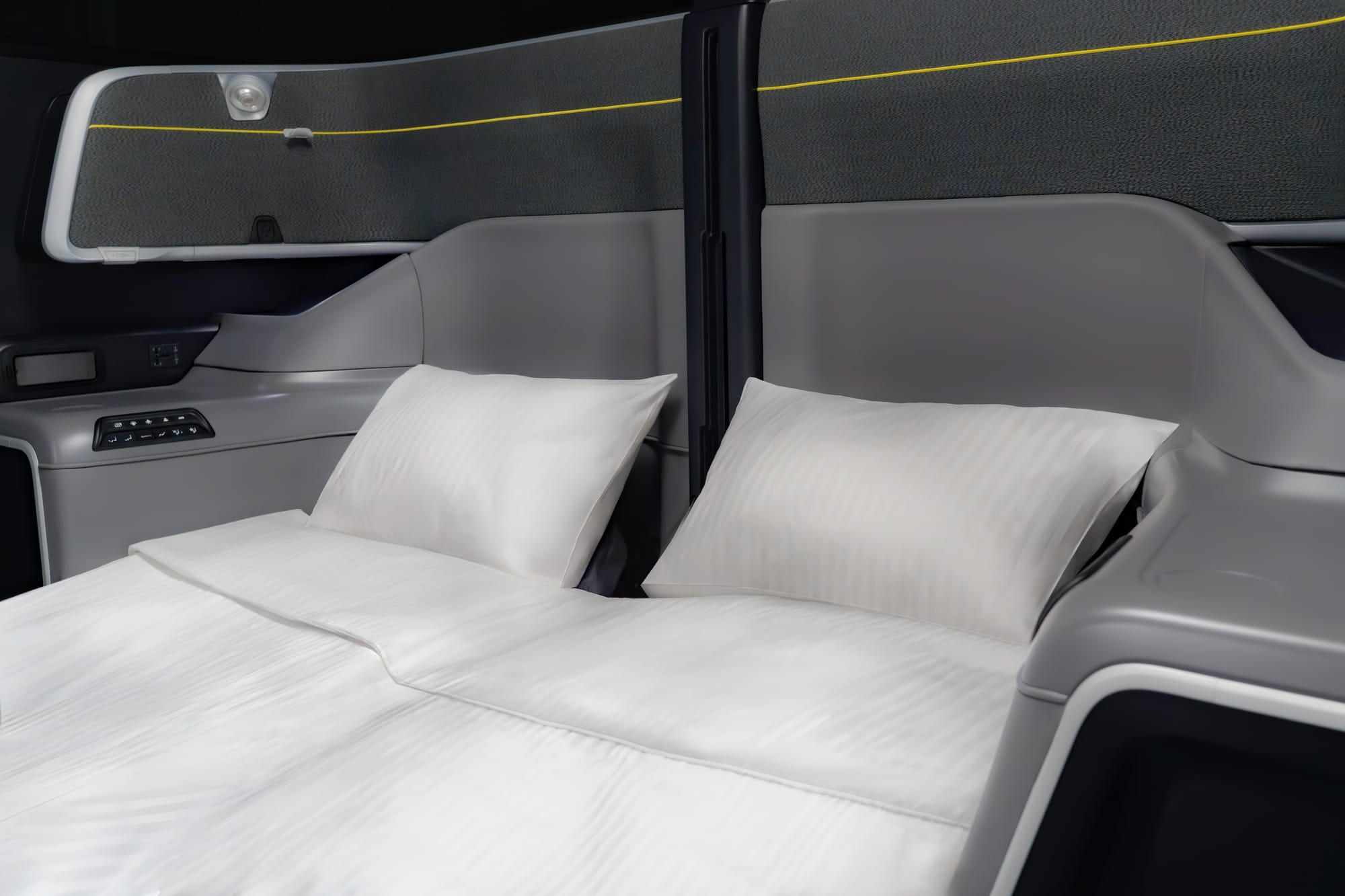
Delving into specifics, the shiny, hard plastic on the side console feels twenty-years-ago, almost clinical. Other airlines are installing leather, real stone or impressive textured/tactile thermoplastics in this sort of spot.
The view in front of the passenger is also very plastic, and that is very odd: seatmaker Recaro was showing fabric-effect vertical surfaces at AIX as far back as 2019. Even if the much-reported issues with the composite structures of Recaro seats limited the CMF choice, the result is deeply underwhelming.
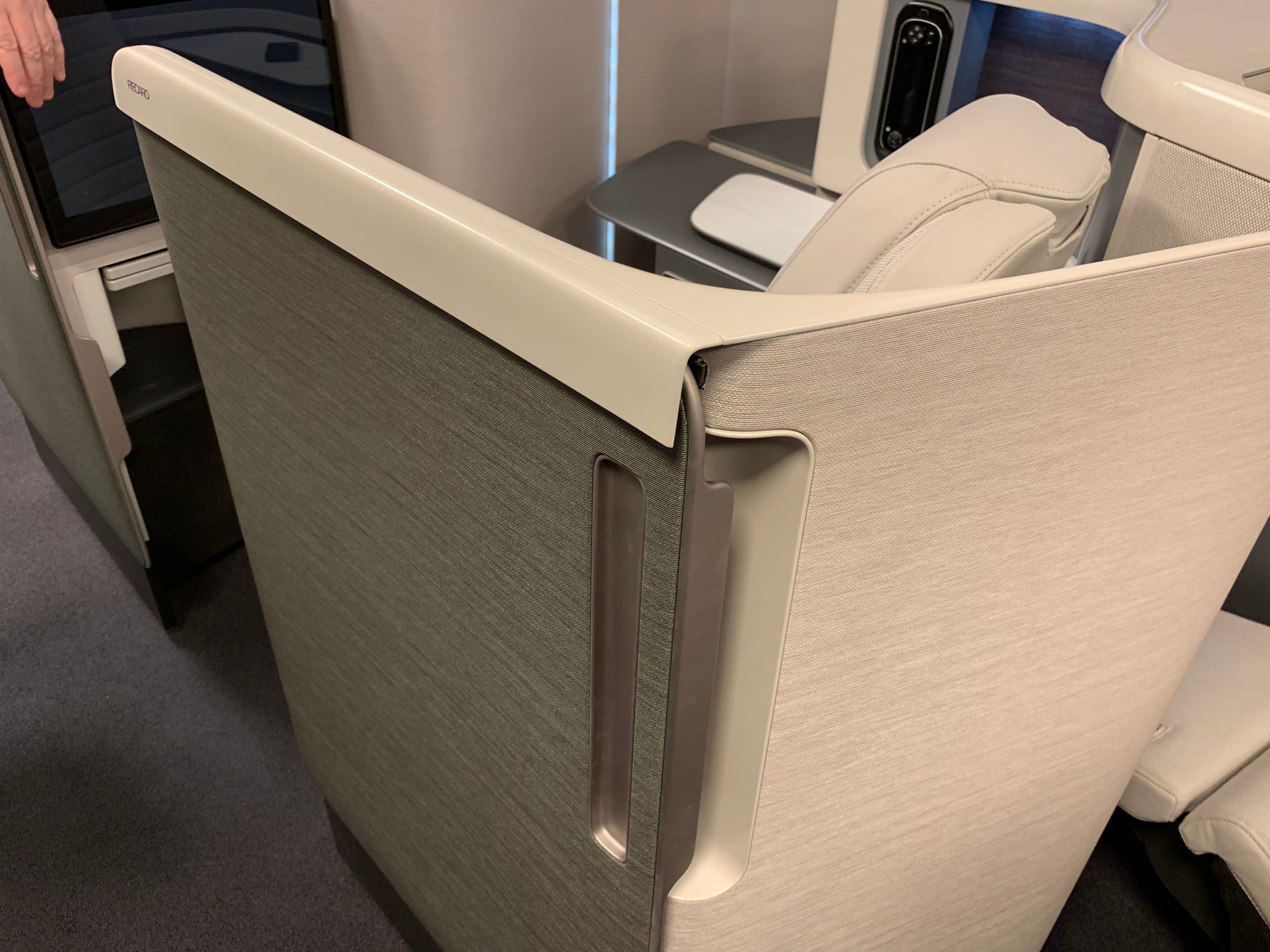
Equally incomprehensible is the strange visual static motif on the head shroud and the satin-effect cushion, which appears nowhere else, and is not linked by a colour or texture to any other part of the seat, let alone the aircraft.
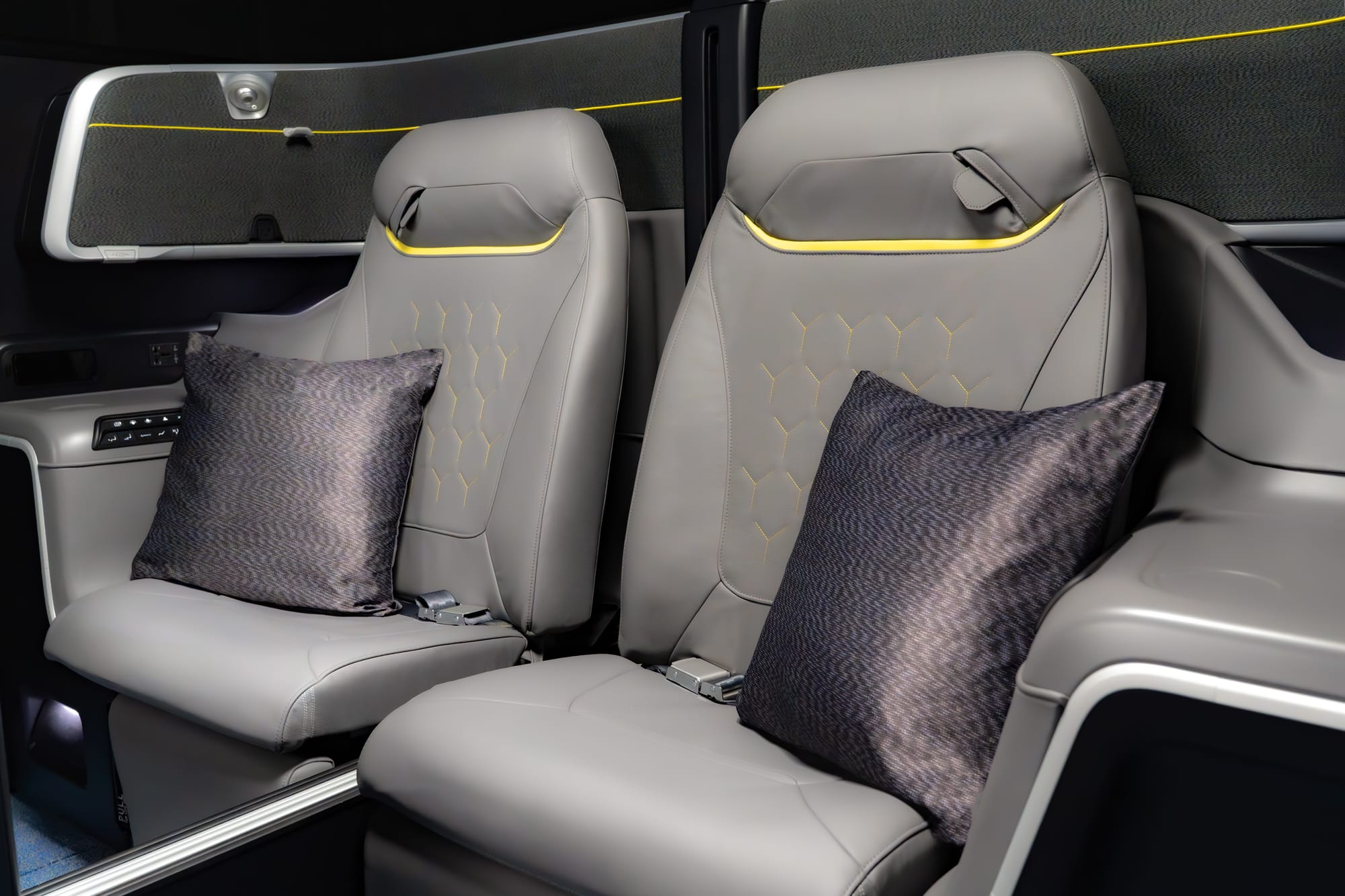
In the renderings, there also an odd bright blue gradient on the rear bulkheads, and what is presumably a matching bright blue wash down the 777X sidewalls. Even some attempts at LED moodlighting, the suite spots pooling on the shroud, and the warmth of sunshine don’t seem to help here.
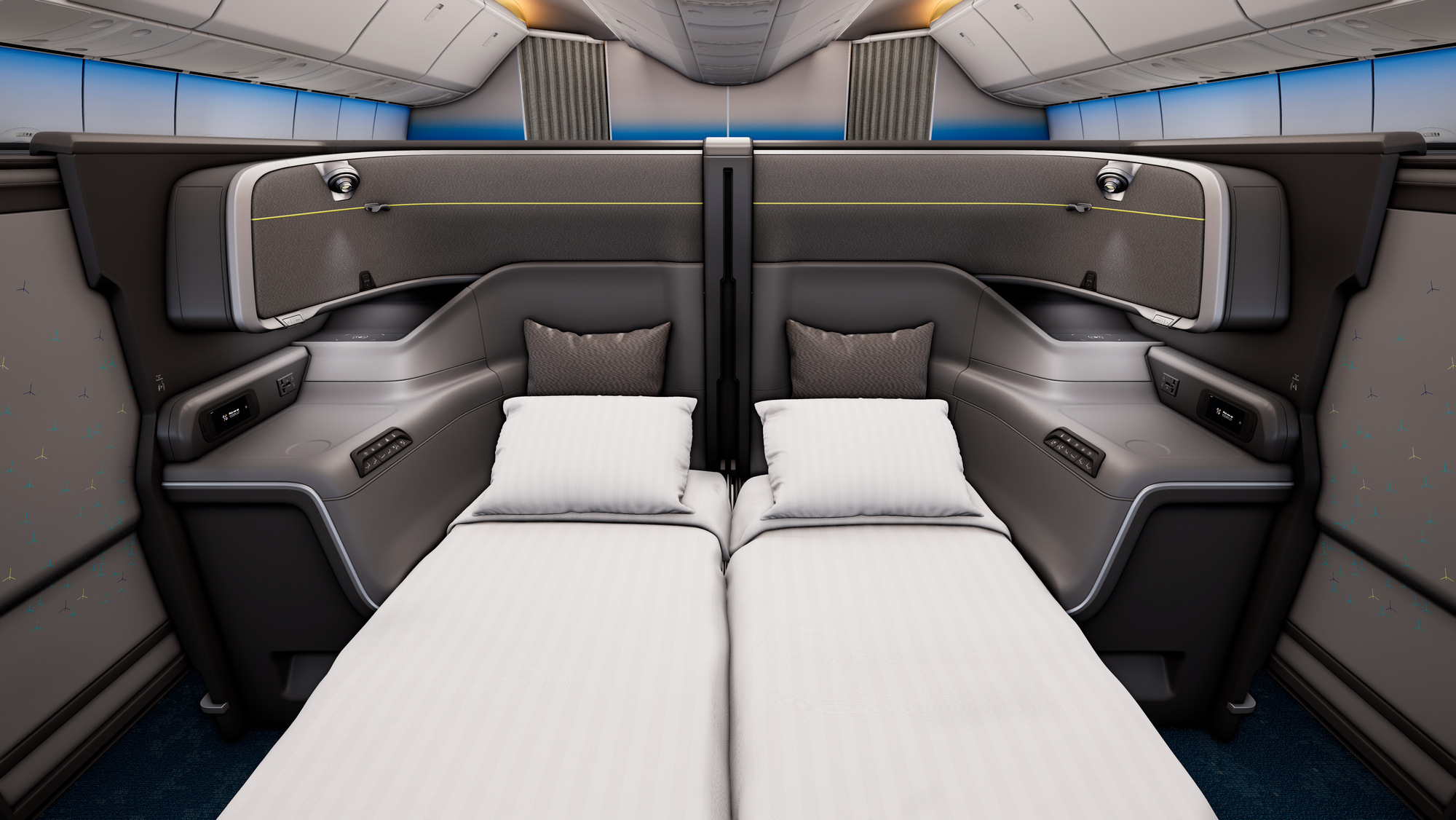
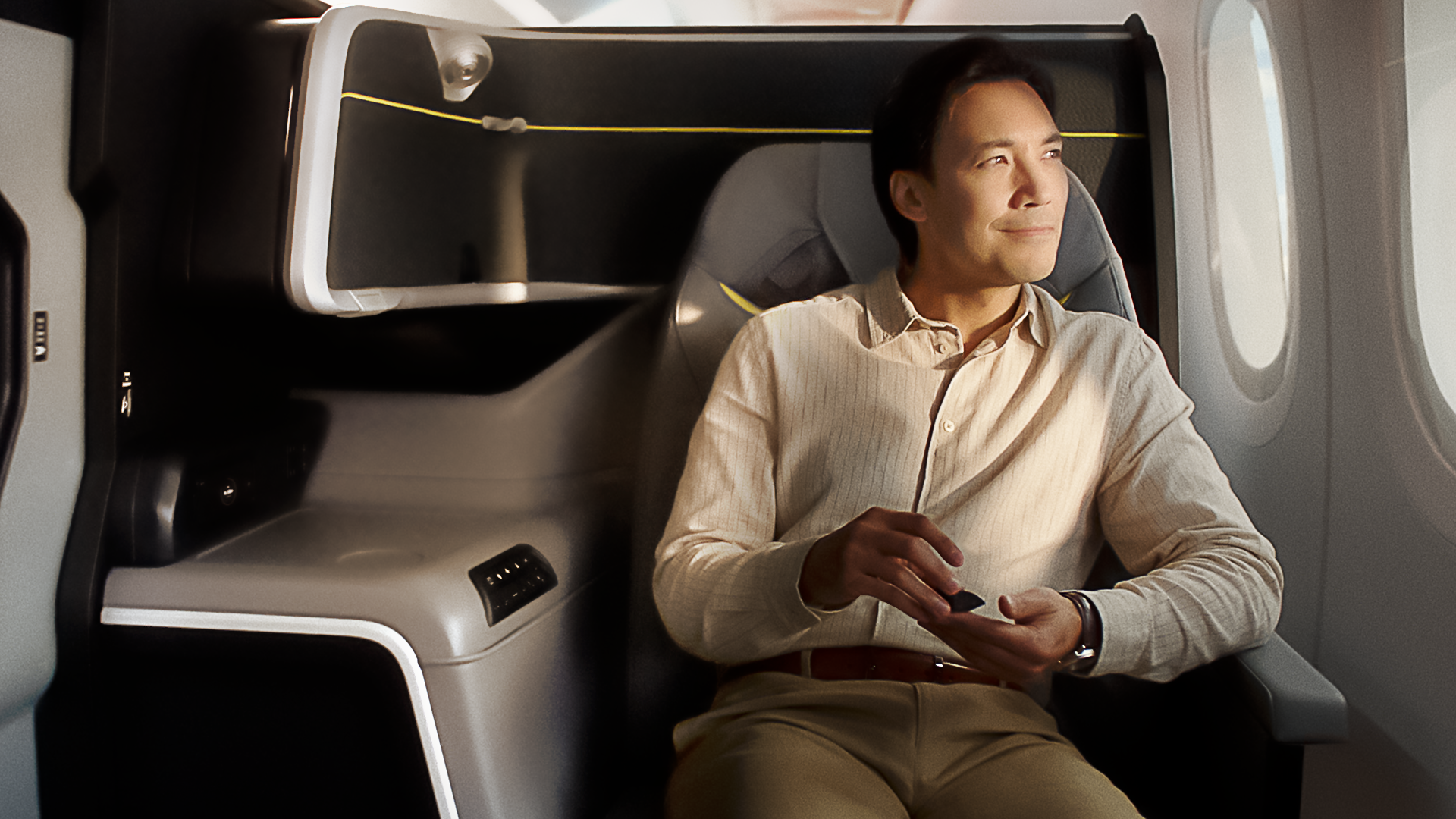
Even with the most generous of professionally lit renderings, it still looks like this man is flying Scoot. Image: Singapore Airlines
To be clear, Singapore Airlines had these images and videos created and issued. We haven’t edited them. This is the aesthetic SQ chose to display.
There may be some slight benefits in-cabin from moodlighting, but that only becomes the primary light source at night or when all the window blinds are down or the electronic screens at full dark.
Even on the newest aircraft, the moodlighting choices are still down to cabin crew, and this is rarely consistently applied, and even more rarely in the way that the moodlighting designers expected.
But even with moodlighting, the cold greys here are an unwise choice in the cabin. Without getting into discussions of chroma and reflectivity, one need only look ahead of the bulkhead divider to the first class suites to see why. Which one looks more inviting? Indeed, which one has received the better reception since the unveiling?
Beyond the aesthetics — in honestly, a hard ask — what about the functionality of the seat?
Cards on the table, at this point in our analysis it’s starting to feel like we’re beating up on this seat, and specifically its design. But we’d be doing a disservice not just to our readers but to other designers, manufacturers and airlines not to give this the analysis such a departure merits.
To start, it’s important to note that the renderings provided — and mockups in Singapore — are from the 777X version of this seat, not the A350 version, which will be significantly narrower because of the smaller cabin. That is likely to bite in seat width and footwell space specifically.
SQ has 41 A350s already in service, and 31 777-9s to come. So not only will the A350 version be more widespread in the airline’s fleet overall as currently planned, it will also operate the flagship ULR routes, and in the near- to medium-term will be the seat that defines the product in passengers’ experience.
This Recaro product is Singapore Airlines’ first business suite. That said, the airline has had a fairly private seat design, and direct aisle access for every passenger, in its longhaul product since 2006.
In a change from SQ’s long-held and unusual seat style (fully forward facing combined with an angled sleeping position) this is a fully staggered seat, with alternating aisle-adjacent and window-adjacent seats on the side, and alternating honeymoon/divorce pattern in the middle.
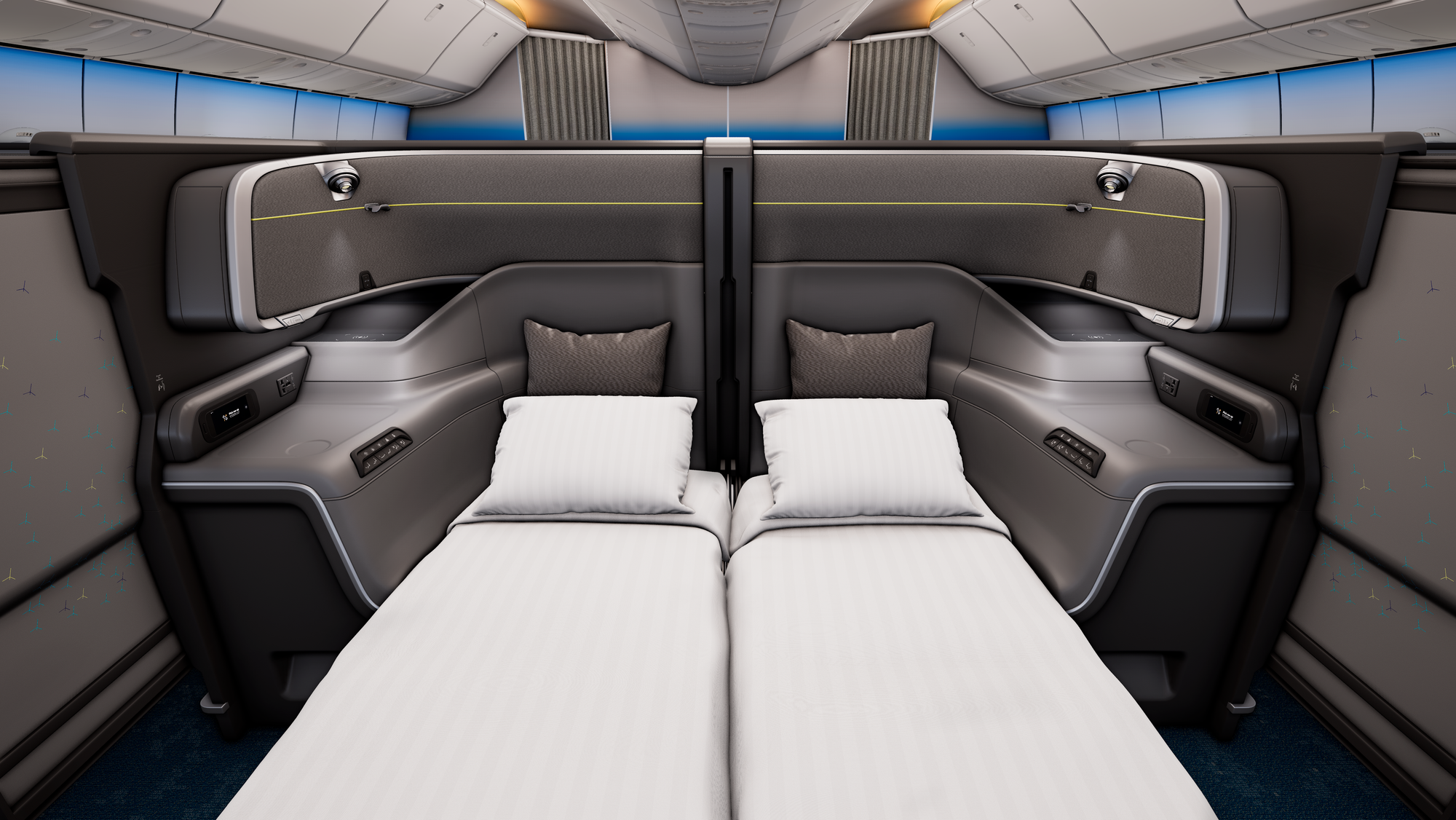
This does create more opportunities for double beds, an increasingly popular and important option for the growing premium leisure travel market, whether that’s couples or parents with children.
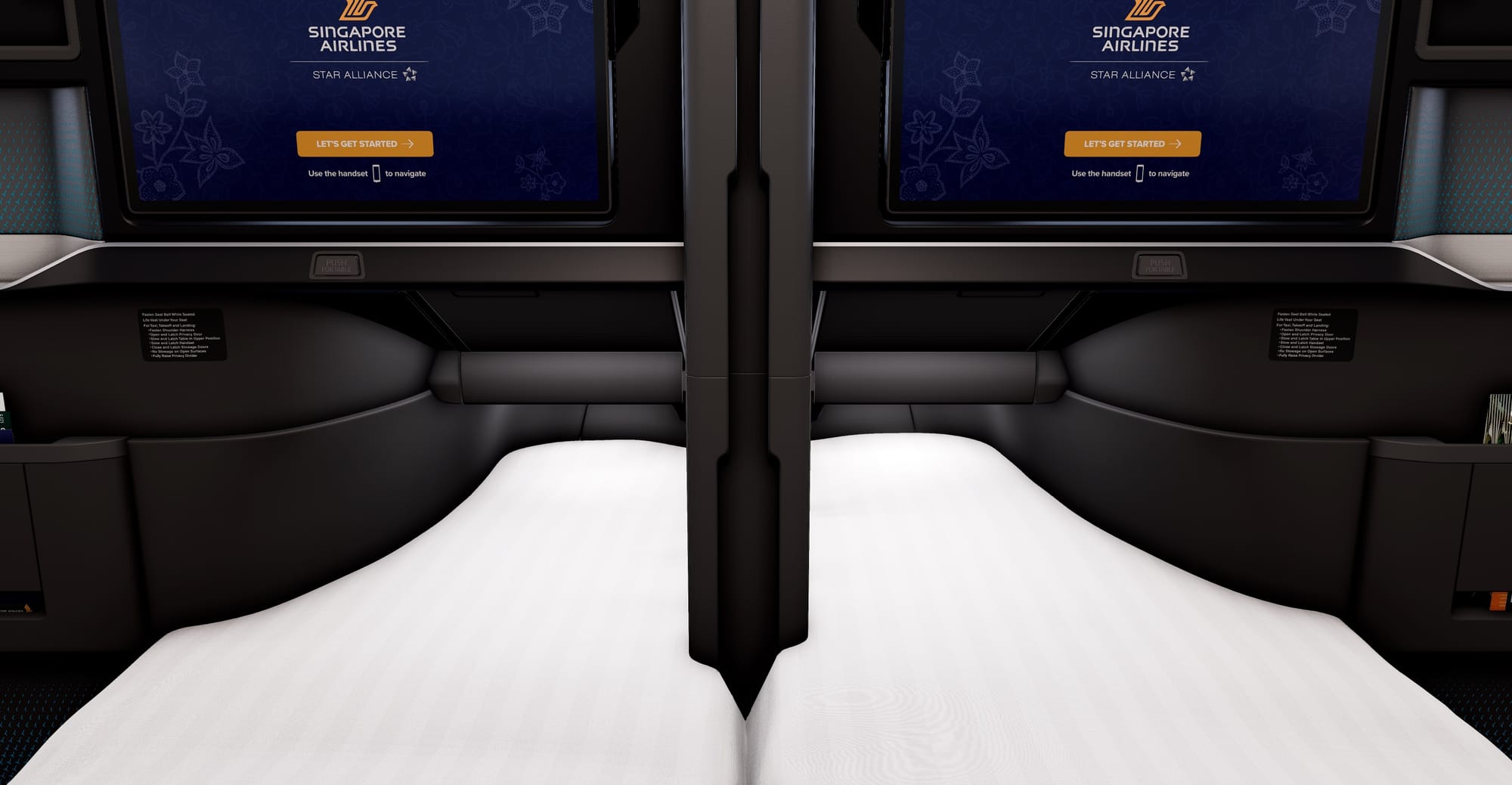
The double bed looks good — but crucially not as good as first class — although the thick housing for the three-part extending mechanical vertical divider does take up several inches of space.
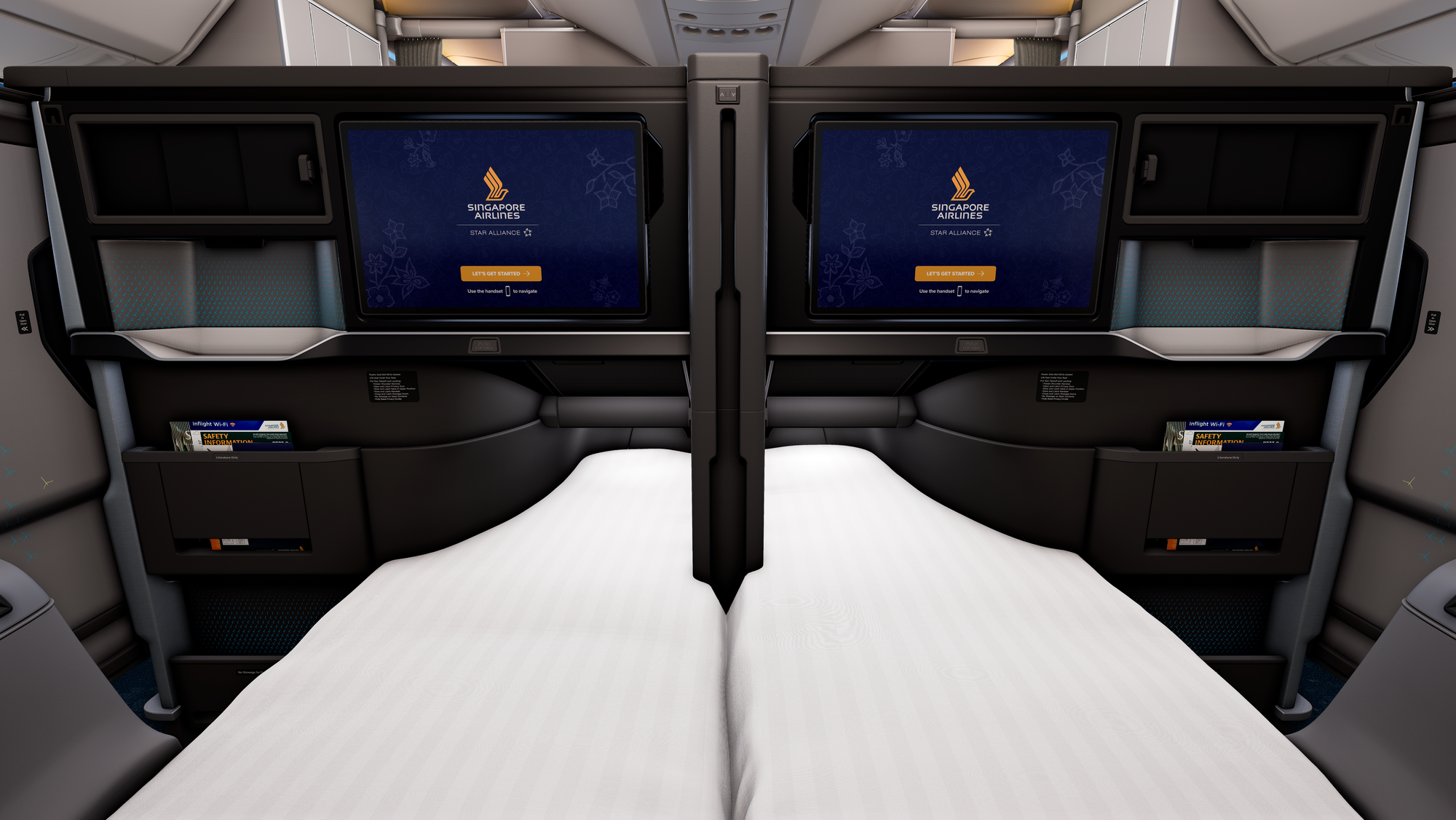
The 52” door height, suite height, similar to JAL’s and an inch lower than the Qsuite, is relatively high, while the maximum seat width will be 24” on the 777X and 22” on the A350.
Pitch is well above average at 50”, meaning that the cabin is not especially dense, with a bed length of 79” (6’7”, or 201cm).
Recaro says that this is a bespoke seat, but the fundamental underpinnings are clearly from the CL6710/6720/R7 staggered family that Recaro has been expanding on in recent years.
In SQ context, the major criticism of previous generations, especially the ones following the urgent replacement for the scandal-hit Koito seats of the mid-2000s, were the unusually tiny footwells, combined with the angled sleeping position.
To those footwell issues, this seat seems like an improvement, but not much of one.
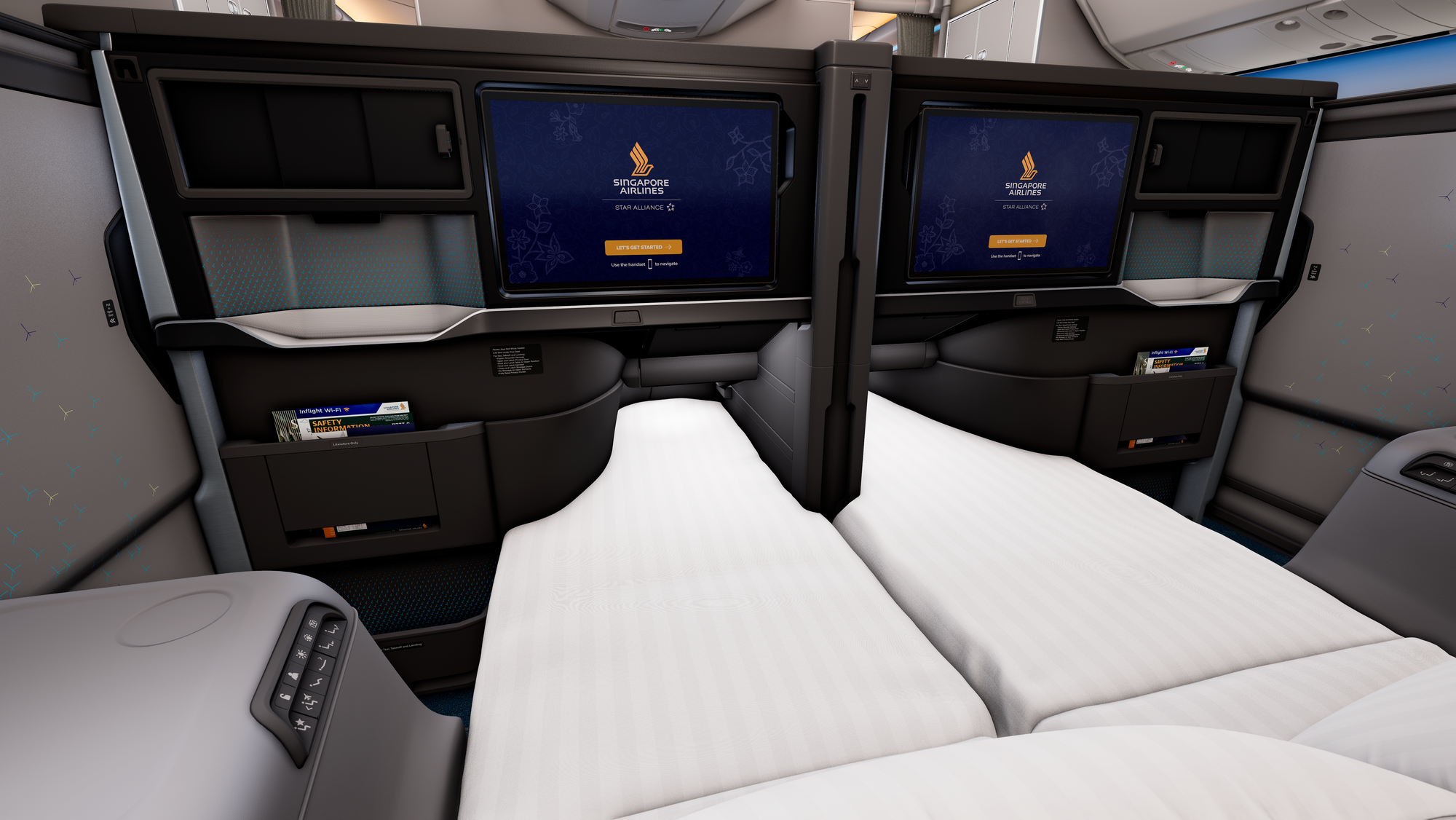
The choice to have the footwell so strongly constrained not just horizontally but also vertically is an odd one. The down-angled descending slope below the monitor, plus whatever more seemingly rounded apparatus is below it, will inherently be right in the way of passengers’ feet and ankles when they’re trying to sleep.
Fundamentally, Singapore’s new seat isn’t competing with Singapore’s 2013 seat, it’s competing with other airlines’ 2026 seats, and much work has been done by other seatmakers to avoid these smaller footwell constraints.
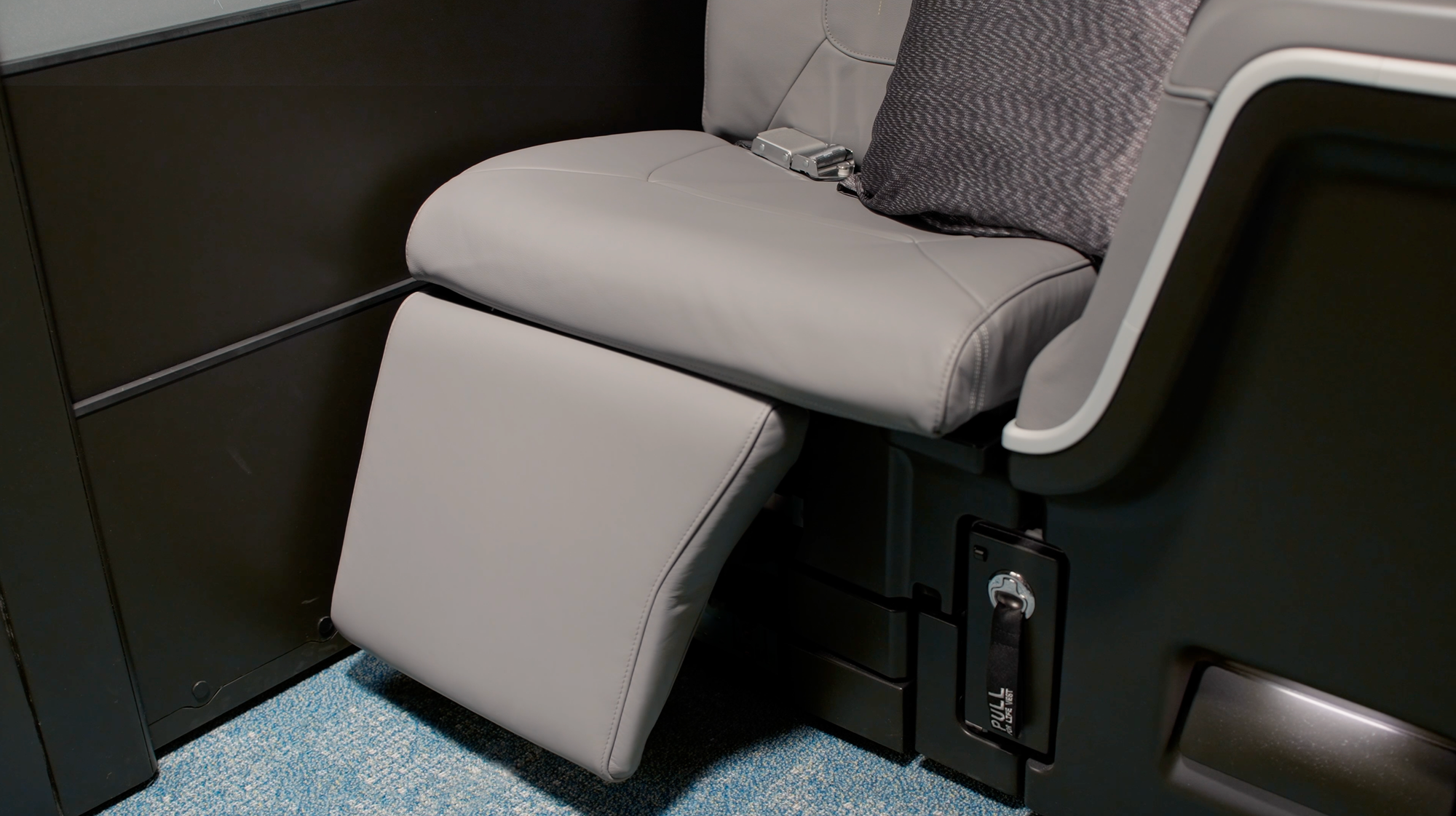
There is a rising legrest, which is a plus, but it’s shaped so that you can only rest one leg on it. Passengers will need to select wisely which leg they want to rest during the seat selection process.
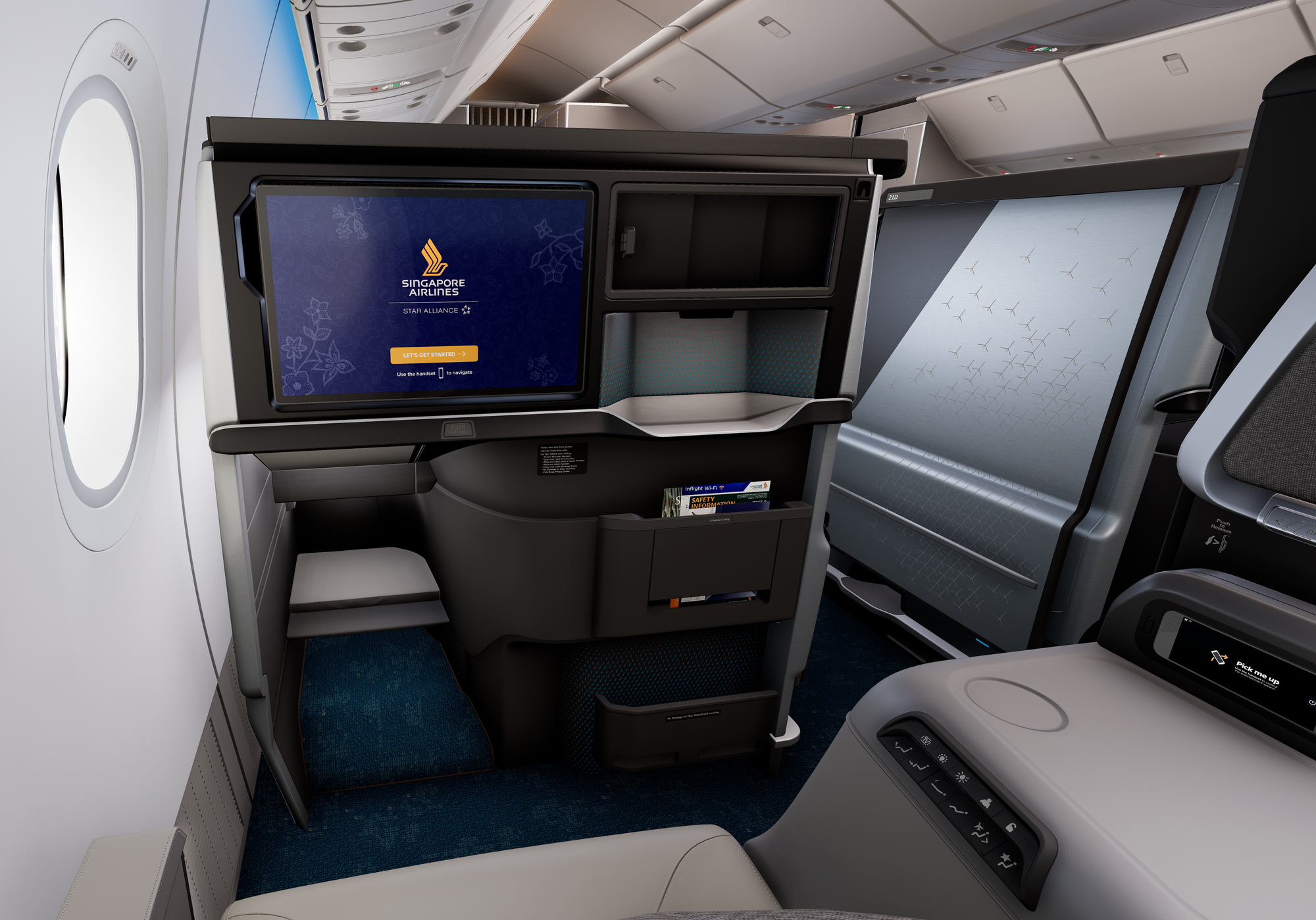
In functional terms, there is a significant missed opportunity in not opening up the window-adjacent seat to the sidewall rather than having a thick restricting foot box.
This is wasted space that many other seats and seatmakers, even 2016-contemporary ones — goodness, even the early 2000s-era Sogerma Solstys — have long clawed back for passengers’ benefit.
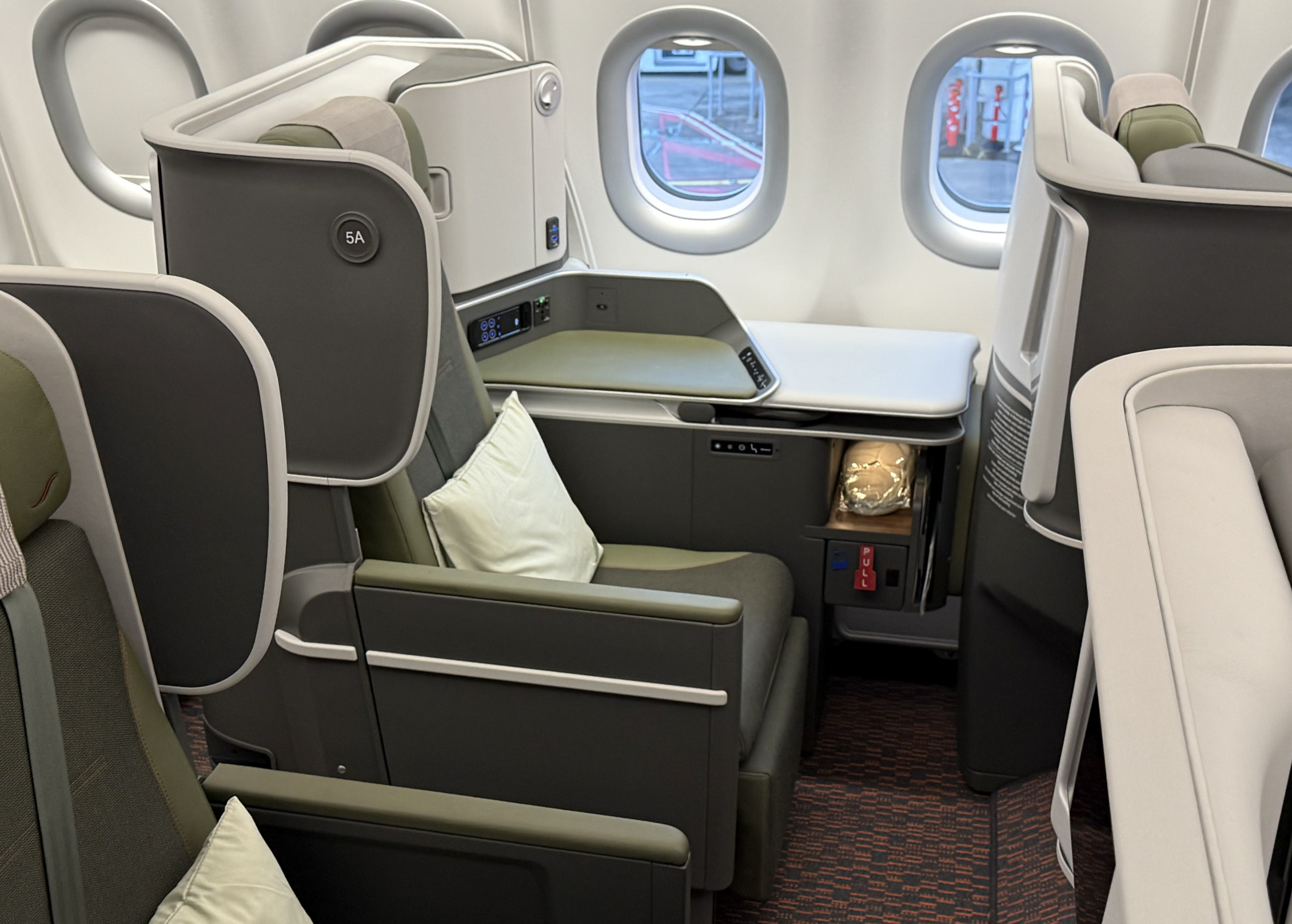
There’s also no movable headrest, which is a surprising omission, not least because combined with the colours that makes it look too much like a low-cost carrier slimline seat.
On-the-ground scuttlebutt and videos from the mockups in Singapore also make the door look rather wobbly and flimsy. It’s also notable that the only media images are of the better seats in the cabin — those adjacent to the windows and in the centre pairs — and not the immediately aisle adjacent ones.
One of the mockup rows in Singapore is the aisle-adjacent version, and peering at various videos it’s surprising that there is no forward-extended side-table surface, which other seatmakers offer to balance out what would otherwise be lower desirability for these seats.
The armrest situation is also notable: all seats use the side table as an armrest, but it will be instructive to see how much the significant side table/footwell chamfering means this is usable, especially by more petite passengers. The table is also in a hard plastic material, which is less than ideal as an armrest.
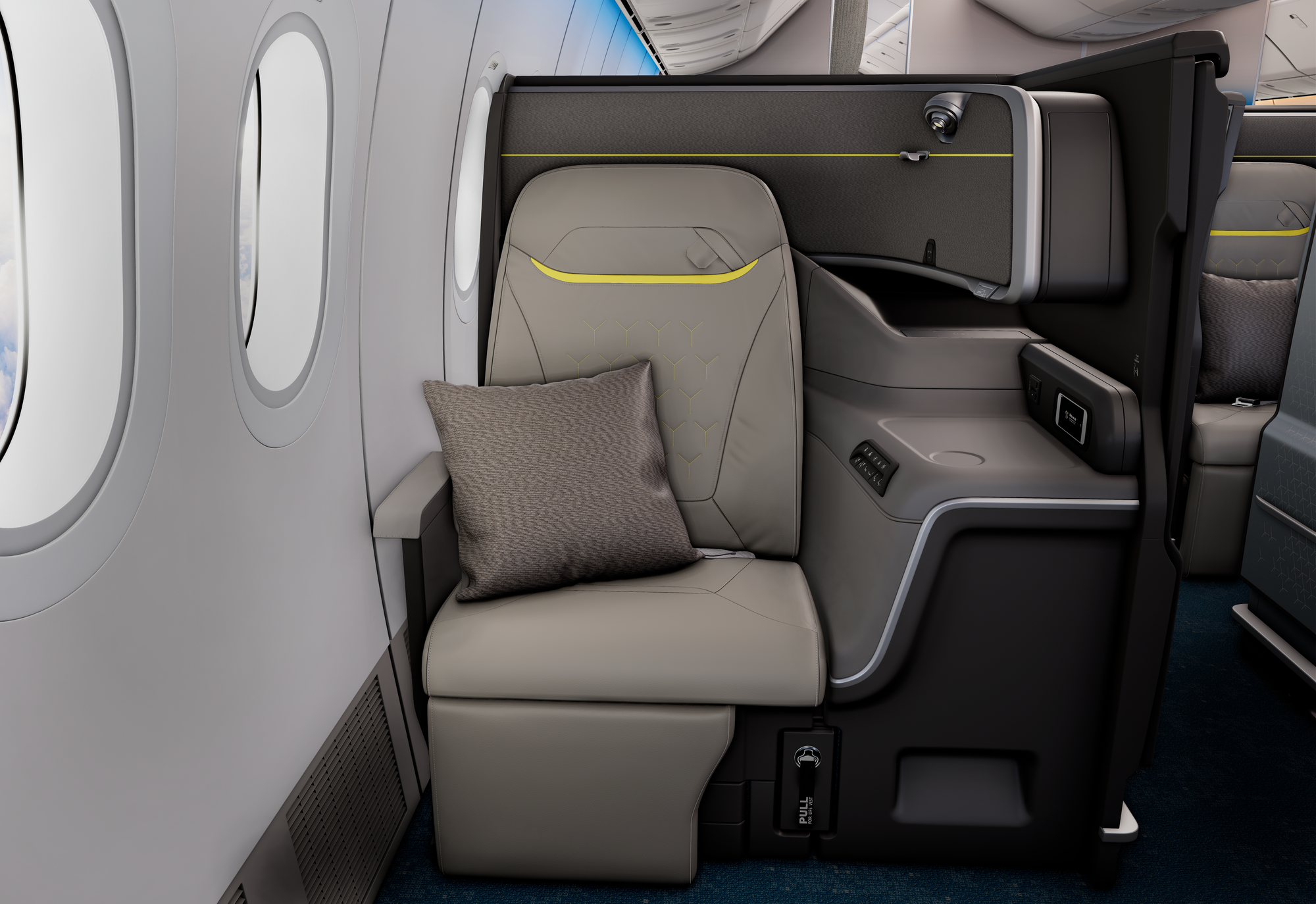
Opposite the side tables, immediately aisle-adjacent seats get a small ledge-style armrest attached to the door horizontally, while the window-adjacent staggers have a more standard type connected vertically to the seat structure. Centre pairs, however, have no second armrest.
Another odd choice is the high-and-heavy shrouding with its built-in forward-deploying storage shelf.
This is a lot of weight to put high up on a relatively high business class seat, for very little functional benefit but a substantial amount of certification complexity.
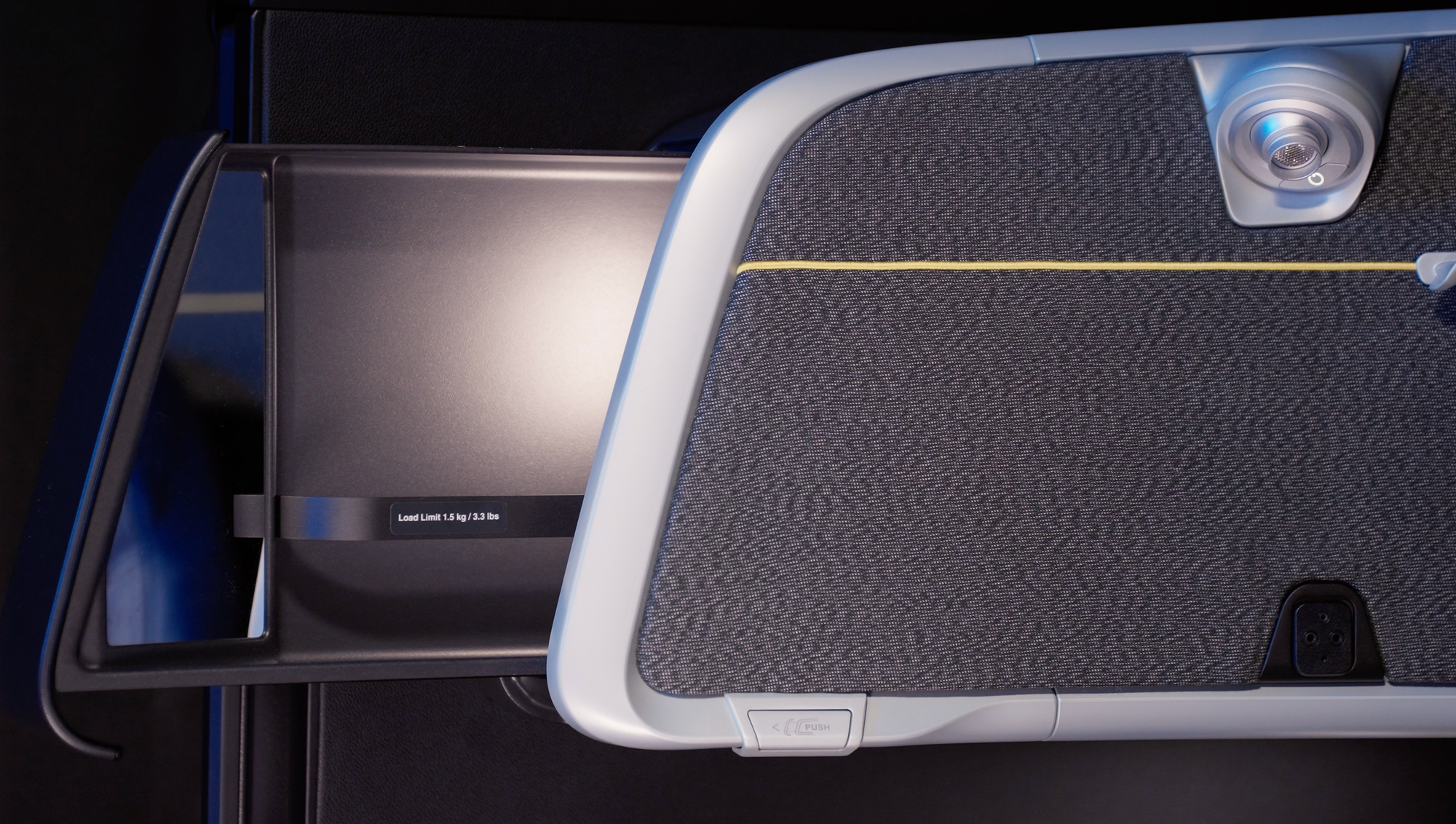
That three-part divider gives pause, too, in its mechanical actuation — a nightmare in practice, as many airlines and seatmakers have found over the years. Experience flying Recaro’s CL6720 on Iberia’s A350 suggests its actuators are not the most reliable in practice, so it will be notable to see how these work in practice.
Physical seat buttons are a positive, and there’s also a “save my position” that those of us who enjoy a Z-bed recline will appreciate.
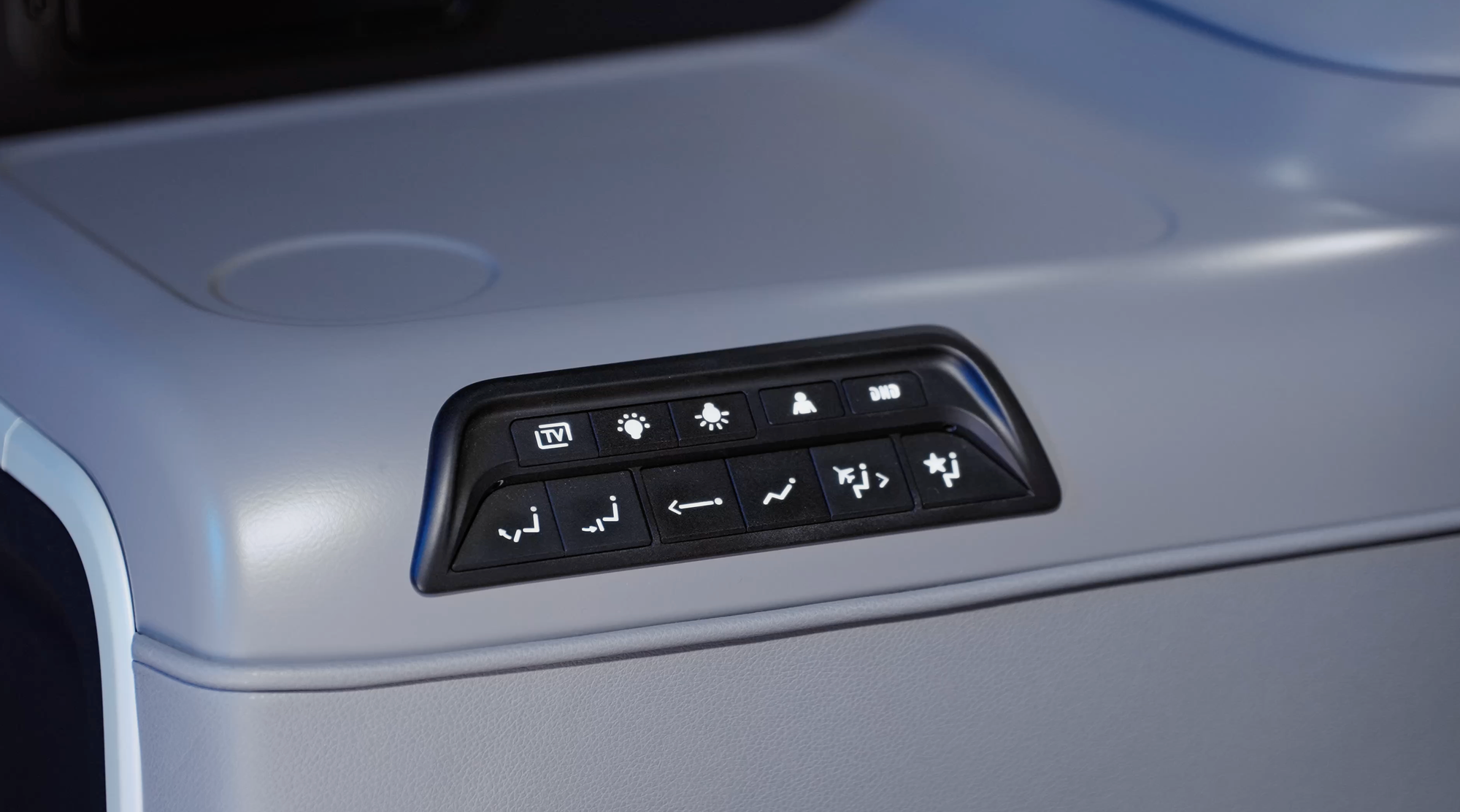
This apparently also allows passengers to save their seat position preferences to the inflight entertainment system for their next flight.
Perhaps this will be lifechanging for some passengers, but your author cannot ever remember having inflight entertainment preferences successfully saved to an inflight entertainment system, let alone anything else.
This will only be available, presumably, when flying on these seats rather than earlier models, and inherently the comfort of the A350 vs 777 model will be different.
Is this too much of an automotive mindset? In a car requirements and adjustments are different: seat height, pan tilt, forward-rear position, recline, lumbar, and so on are adjustable because passengers need to reach the wheel, pedals and controls. But requirements are fewer, and certification constraints greater, in an aircraft.
I’m also reminded of the aphorism that Chris Brady from Unum has been using for so long that it has become something of a call-and-response joke between us: the most comfortable position is the next position. In terms of human body kinematics, staying in one position inherently becomes uncomfortable.
That’s why innovations like Comfort Motion Global’s Healthy Motion Seating are so intriguing: they move the seat minutely, changing the pressure points on passengers’ bodies and thus increasing comfort. Those may not have been available at the point of design of this seat, but they are something to keep in mind as seats continue to develop.
Overall, the function of the seat is less of a miss than the aesthetics, but in a combination of both analyses, the numerous individual plastic elements, including many in the very monotonous greys, are likely to pose issues.
This isn’t just a subjective aesthetic consideration: colour matching of leathers, plastics, and other materials in the cabin is incredibly difficult even at launch, let alone as the materials age.
In product and rollout terms, premium and economy are clearly not the focus for Singapore Airlines
If this section seems like an afterthought, that’s because, in terms of the information put out from the airline, it is. Premium economy and economy get just two shots of each.
To be fair to SQ, the new seats are only going on the 777X, with the A350s just getting an as-yet-undisclosed refresh. And even on that aircraft, economy is only between the last pair of doors, with premium economy immediately ahead of it. Business class, for all its faults, is the primary tenant on this aircraft.
The premium economy is visibly Collins’ MiQ seat with a lot of extra cushioning, but with no privacy wings, dividers, or anything else. This looks like an old seat, and in many ways it is.
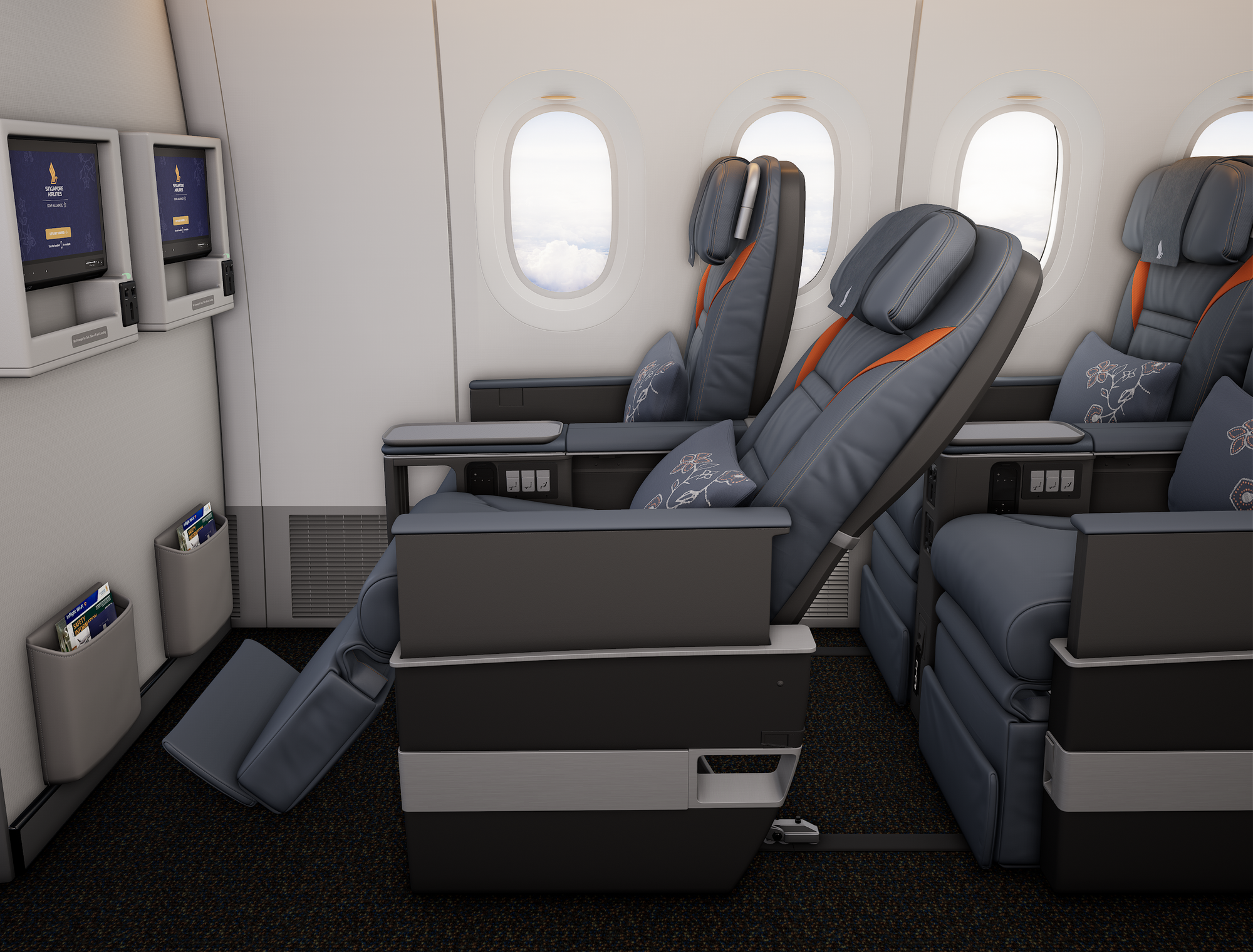
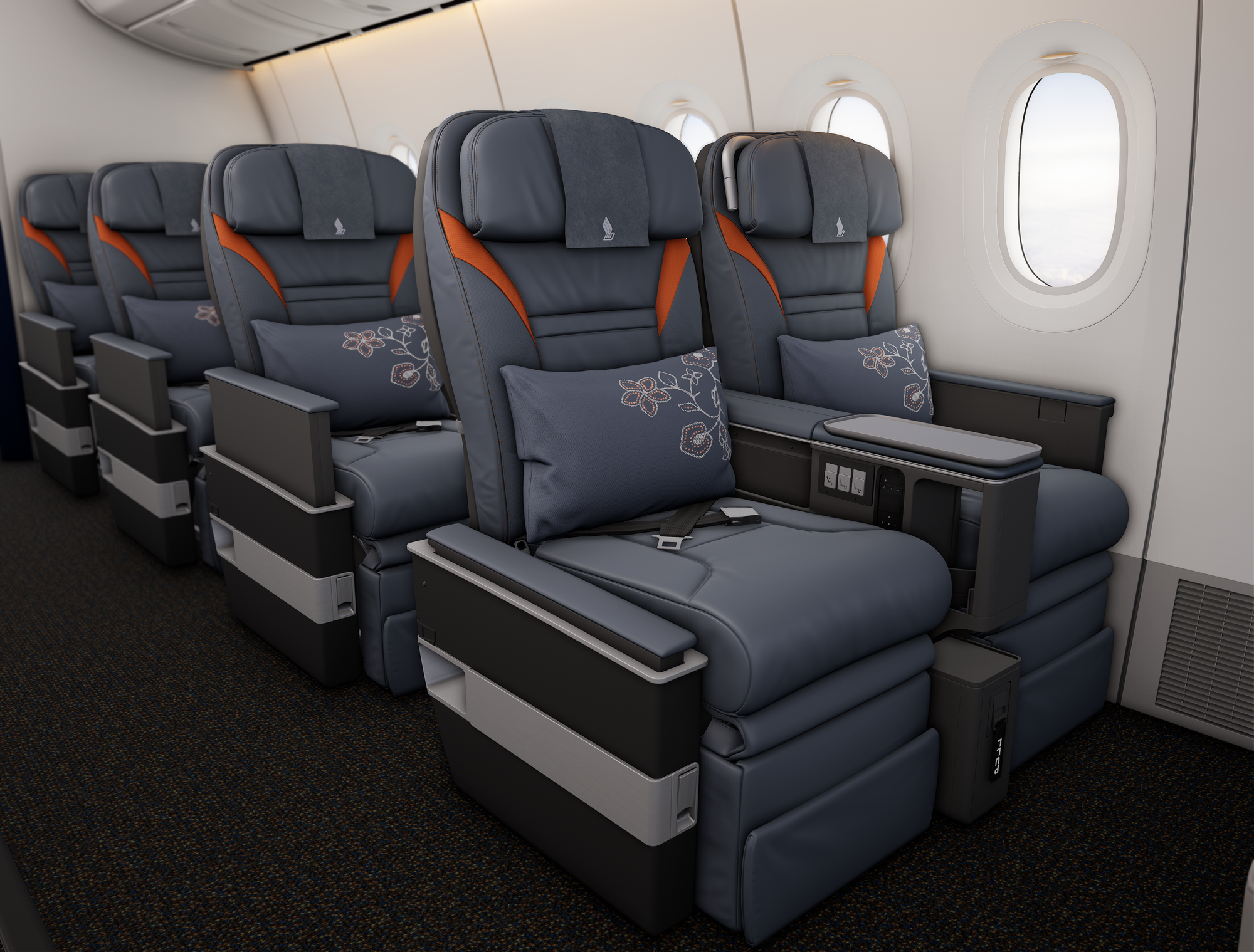
There’s little innovation here, but it at least looks SQ. Image: Singapore Airlines
The orange pop on the seat linking to the orange in the batik motif in the cushion works very well. It’s certainly a lot better than the business class, and that just makes the complete aesthetic and brand departure in business more starkly incomprehensible.
Economy looks like the commodity that it now is. It’s an industrial charcoal grey with pops of a stark teal, magnifying an existing SQ trend but in a way that feels darker and less distinctive.
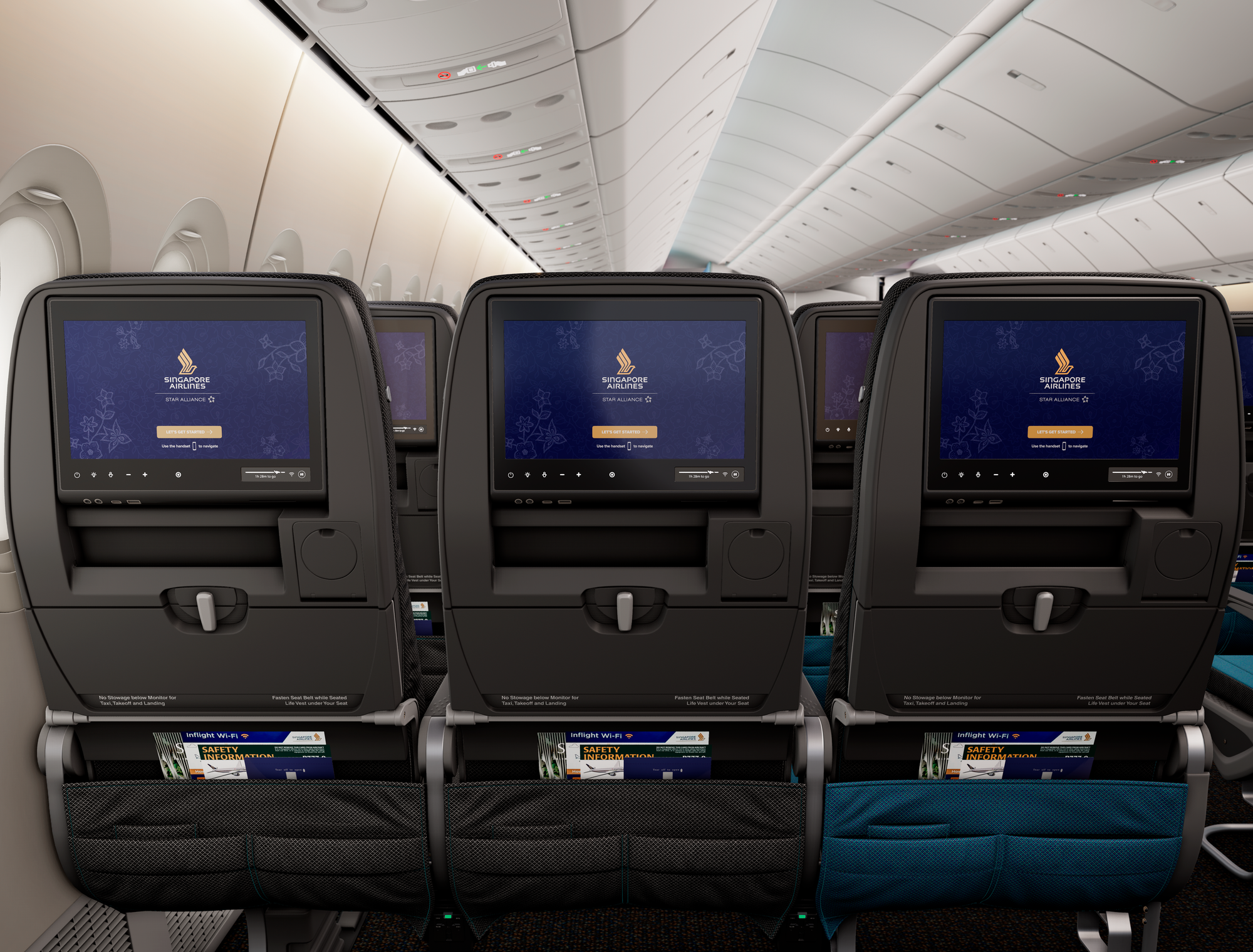
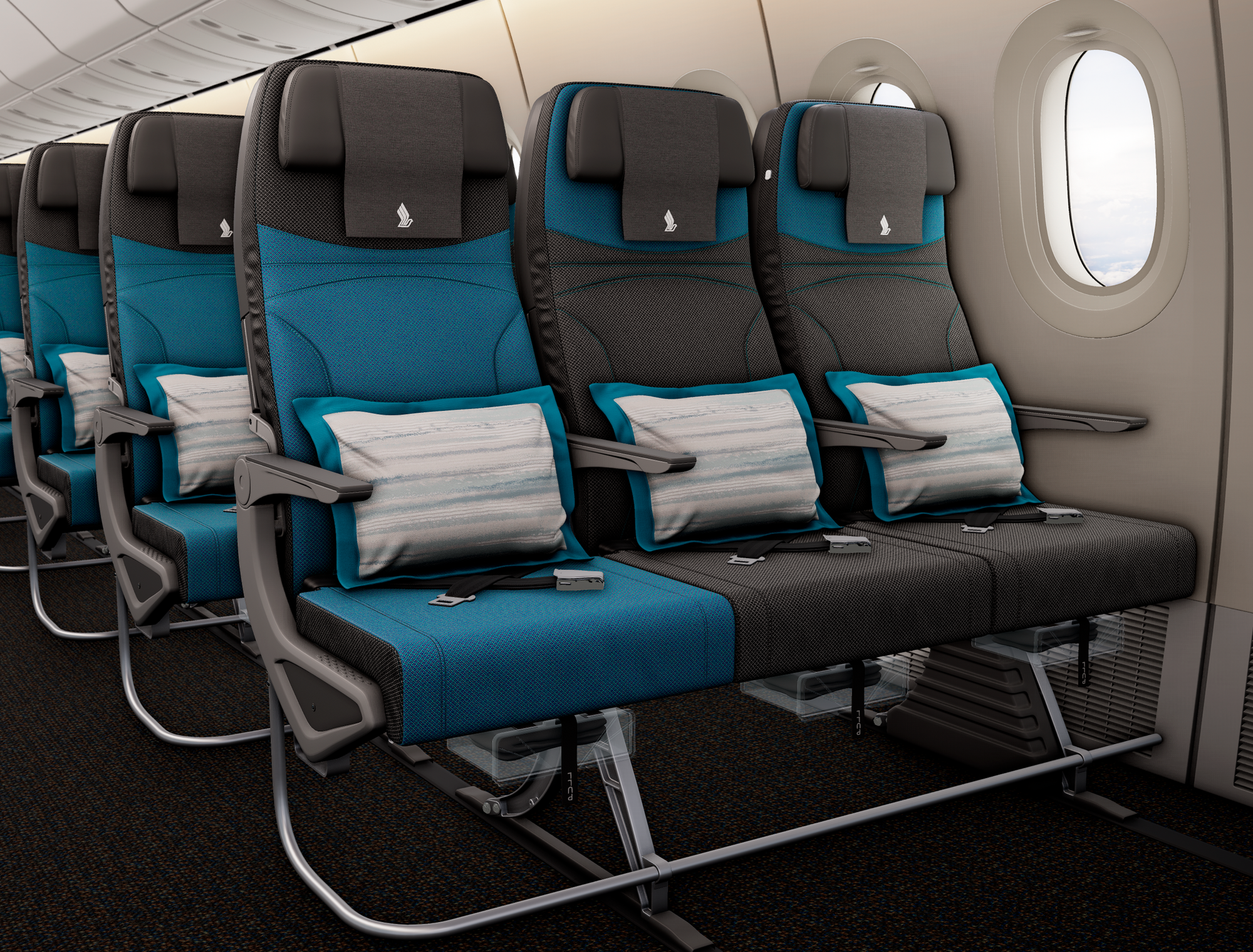
Teal isn’t new to the SQ palette in economy, but this seat feels average to out-of-date, and the older Panasonic NEXT screens don’t help. Image: Singapore Airlines
Indeed, those 777X economy seats are in the higher density 3-4-3 configuration that Singapore has been one of the few airlines to eschew over the last twenty years. With the extra cabin width of the 777X’s sidewall sculpting, it will be instructive to observe the passenger response.
Between the delayed 777X and delayed seat, this is a complicated industry context to try to unpick
As with many new seats and new cabins initially planned for the 777X and now delayed by the best part of a decade, a key part of any detailed analysis is trying to understand how much of the cabin has been delayed by the aircraft.
The same is true for the ongoing issues around business class seat design, prototyping, certification, and manufacturing — and both these issues intersect to make things even less clear.
Are these Boeing problems? Recaro problems? Both? Something else? And what are the wider implications?
