
O Canada!
Our home and native land!
True patriot love in all of us command.
With glowing hearts we see thee rise,
The True North strong and free!
“What is the Air Canada brand?” asks Mark Nasr, the airline’s executive vice president and chief operations officer, sitting down for a wide-ranging discussion with The Up Front alongside several colleagues from product and brand. “What do we want it to stand for? What do we want our positioning in the market to be — not just from the notion of, let’s say, premium versus non-premium, but also very importantly within the country, given we are the flag carrier?”

The thinking, says Nasr, was to “not just take delivery of what we’ve been doing in the past — let’s maybe apply some new thoughts, some new energy… this is where the other attractive work, the work we have been doing on the brand, really dovetails in. This is a once in a generation opportunity for this team, to do something that was really a moment of reappraisal of our brand. And that’s how we came up with Glowing Hearted.”
The inspiration for the national carrier comes from its national anthem, O Canada! — whose fourth line is With glowing hearts we see thee rise.
“What we saw with Glowing Hearted was an opportunity to look at all of the customer facing touch points, and even actually some of the internal co-worker facing touch points, and allow really that manifestation of what we want the brand to be,” Nasr says, “which is first and foremost a national champion for our country around the world.”
Glowing Hearted starts as a one-in-a-generation reimagining of Air Canada’s core identity
These big questions for the airline come, senior creative director for brand design and storytelling Dzeneta Zunic tells The Up Front, at “a once in a generation moment: you have this really large investment across a number of properties and experiences.”
From a series of new aircraft with new capabilities inbound, to new seats and cabins, plus a major refleeting exercise between Air Canada and its low-cost subsidiary Rouge, this investment is genuinely unprecedented for the airline.
“We want our frontline staff to be able to deliver Glowing Hearted hospitality,” Zunic explains. “When we were thinking about how we create a vision, this concept of Glowing Hearted came out. We really wanted to make sure that they were really proud, and really excited, to be in these spaces — and that we were giving them best-in-class tools to be able to deliver an exceptional experience.”
Inherently, creating and delivering on this Glowing Hearted vision meant breaking down numerous organisational siloes at the legacy national carrier, which celebrates the 90th anniversary of its founding as Trans-Canada Air Lines next year.
“When we embarked on it, from a process perspective,” Zunic says, “we had brand, and in-flight cabin product design, and lounge product design, and soft product design, and operational airport experiences, and employee spaces. All of these teams, they’re all very different, sitting in different groups. And so in order to create this cohesive, unified execution, we really had to make sure that we were buttoned up in how we translated the concept of it into the design language.”
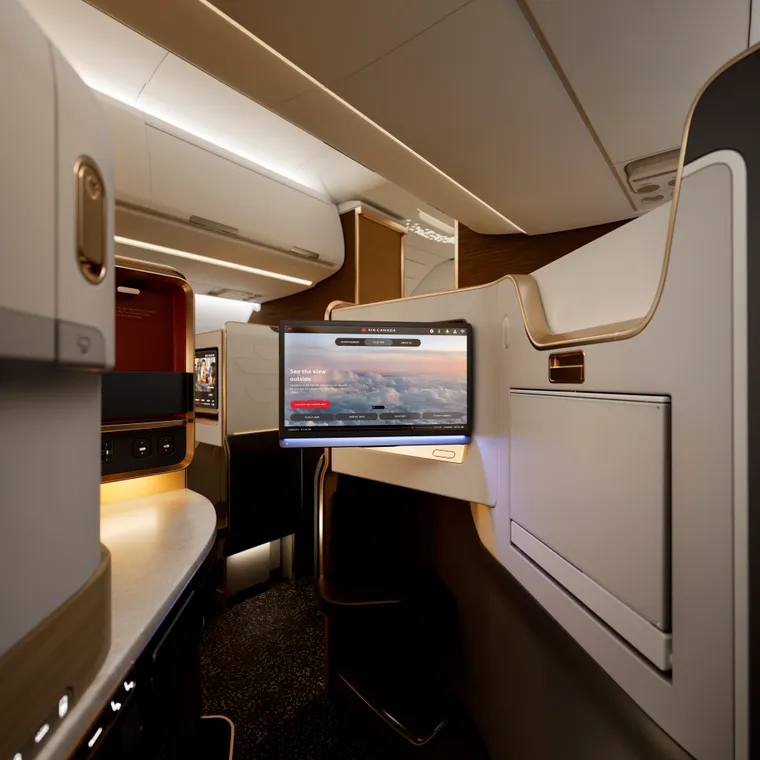
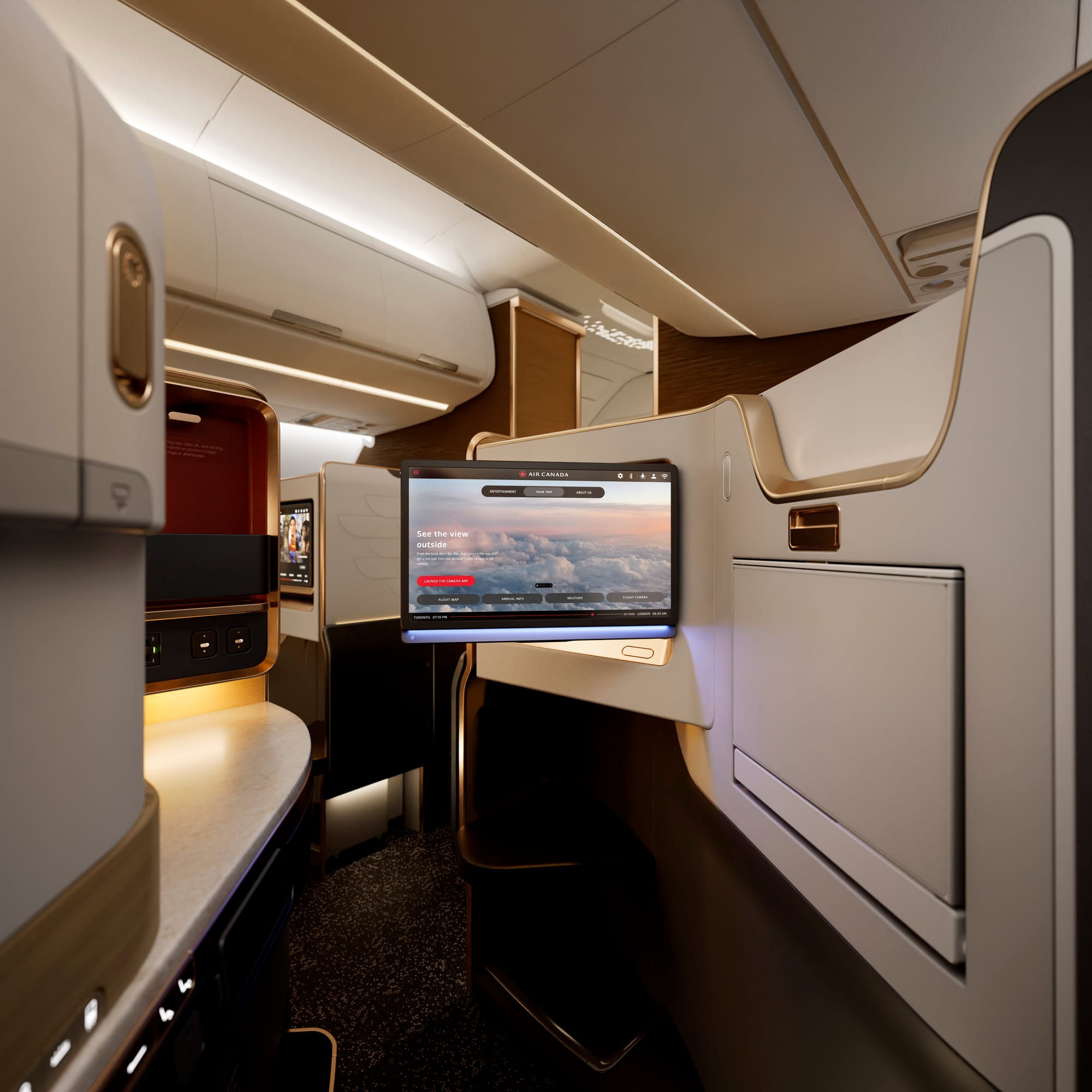
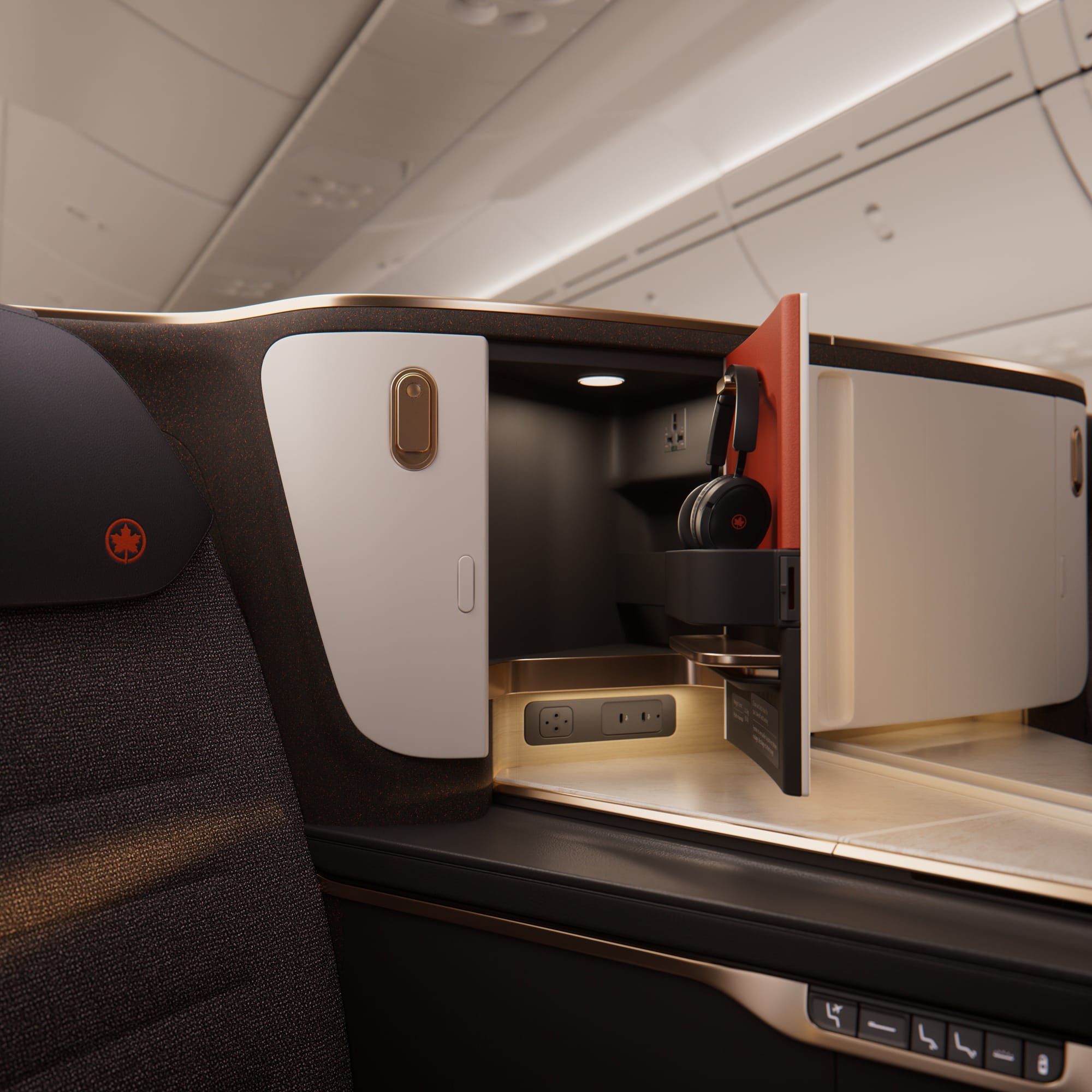
That design language draws from Canadian identity, and so of course it includes the signature red from Canada’s flag, together with a series of warm and inviting woods, leathers and metals, bronze effects, grains and textures.
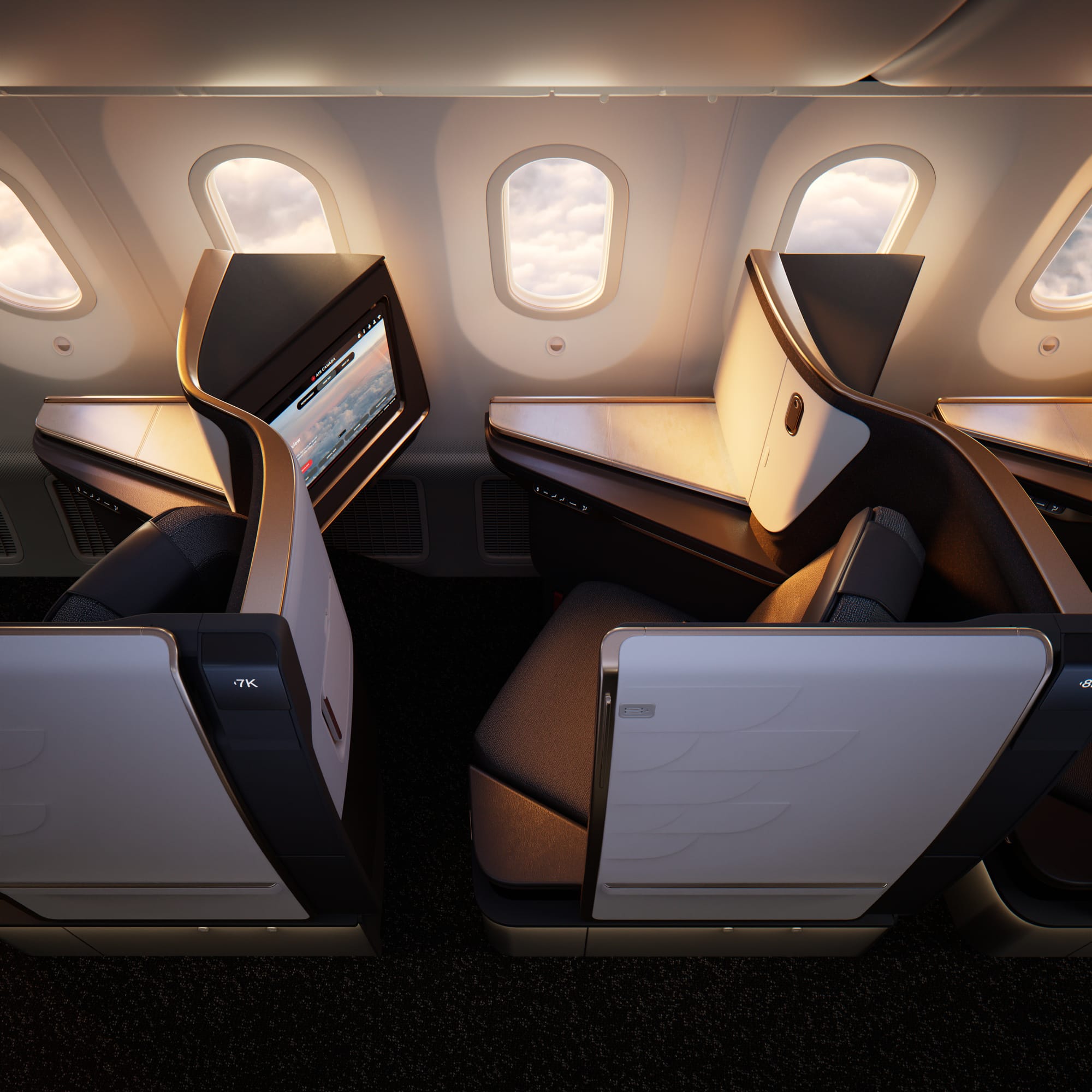
It’s a properly impressive approach to CMF, with layered natural elements that are a genuine departure from the previous generation of experience, particularly in the seats.
Glowing Hearted is encapsulated in the A321XLR cabins shown off to great effect by the airline at this year’s Aircraft Interiors Expo, which managing director for onboard product John Moody told The Up Front in Hamburg is the “launching pad for this new product design standard”.
To come later this year is what the airline calls “the end-to-end hospitality experience”, which it promises will be “distinctly Canadian” in its service, food, beverages, and amenities.
There are, of course, many different opportunities and constraints across all these elements, and indeed in the back-of-house areas from which onboard and ground staff deliver them.
Just from the passenger side, the way that an airline designs the modern passenger experience at its airports (bosth hubs and outstations) and onboard its aircraft needs to have some kind of golden thread running through it.
A design language can help here, but that has to be created within the context of the spaces in which it will be implemented — and those spaces come with space and other constraints.
“That’s the hardest part of the job,” Zunic says, “especially when you also work on lounges: it feels like opportunities in the lounge space are infinite, and then you move into the aircraft… we can’t do this and we can’t do that. And so it becomes a little bit more narrow in focus. But I’ve always believed that a good sandbox doesn’t prevent creativity from happening — it just has to make you a little bit more focused.”
Air Canada’s evolution at the front of the aircraft: from Executives to Signatures to the Glowing Hearted vision
Let’s wind back slightly, not just to where the Glowing Hearted concept came from, but when.
Nasr puts the airline’s work into context as what he calls “tracks” of changes, which run largely in parallel. The most outwardly visible of these is the 2017 update to the 2004 “frosted leaf” toothpaste light green-blue livery, with the rebranding of much of the airline’s identity alongside it.
The next track: updating the fleet, with new order milestones coming alongside converting existing options and purchase rights into top-ups:
- 2013: 737 MAX
- 2016: A220 (then the CS300)
- 2022: A321XLR
- 2023: 787-10
- 2026: A350-1000
Switching onto (and off from) this track is the 2024 initiative to swap the Air Canada 737 MAX fleet to low-cost subsidiary Rouge in exchange for the LCC’s A320 family fleet, creating consistency, commonality — and the potential for improved belly cargo operations since the A320 fuselage can handle containerised cargo and the 737 cannot.
Another track: the Signature branding for its international business class and services from 2017, succeeding the Executive concept. A related track: the Signature Suite lounges in Toronto, also from 2017, followed by Vancouver in 2020.
Running on these tracks, however, are a series of cabins, seats and other passenger experience elements from the early 2010s, many of which feel like an entirely different era for the airline — and the global and national contexts in which it sits.
Back in 2014, Air Canada took delivery of its first 787, featuring the Super Diamond away-from-aisle-facing herringbones from the seatmaker now called Collins Aerospace, previously Rockwell Collins and before that B/E Aerospace.
At the time, the airline called it “a contemporary, sophisticated cabin design in a palette of slate grey and neutral tones with accents of Canadian red and celeste blue”, but these accents were barely used in what was at the time “International Business Class” with their almost exclusively monochrome “Executive Pods”.
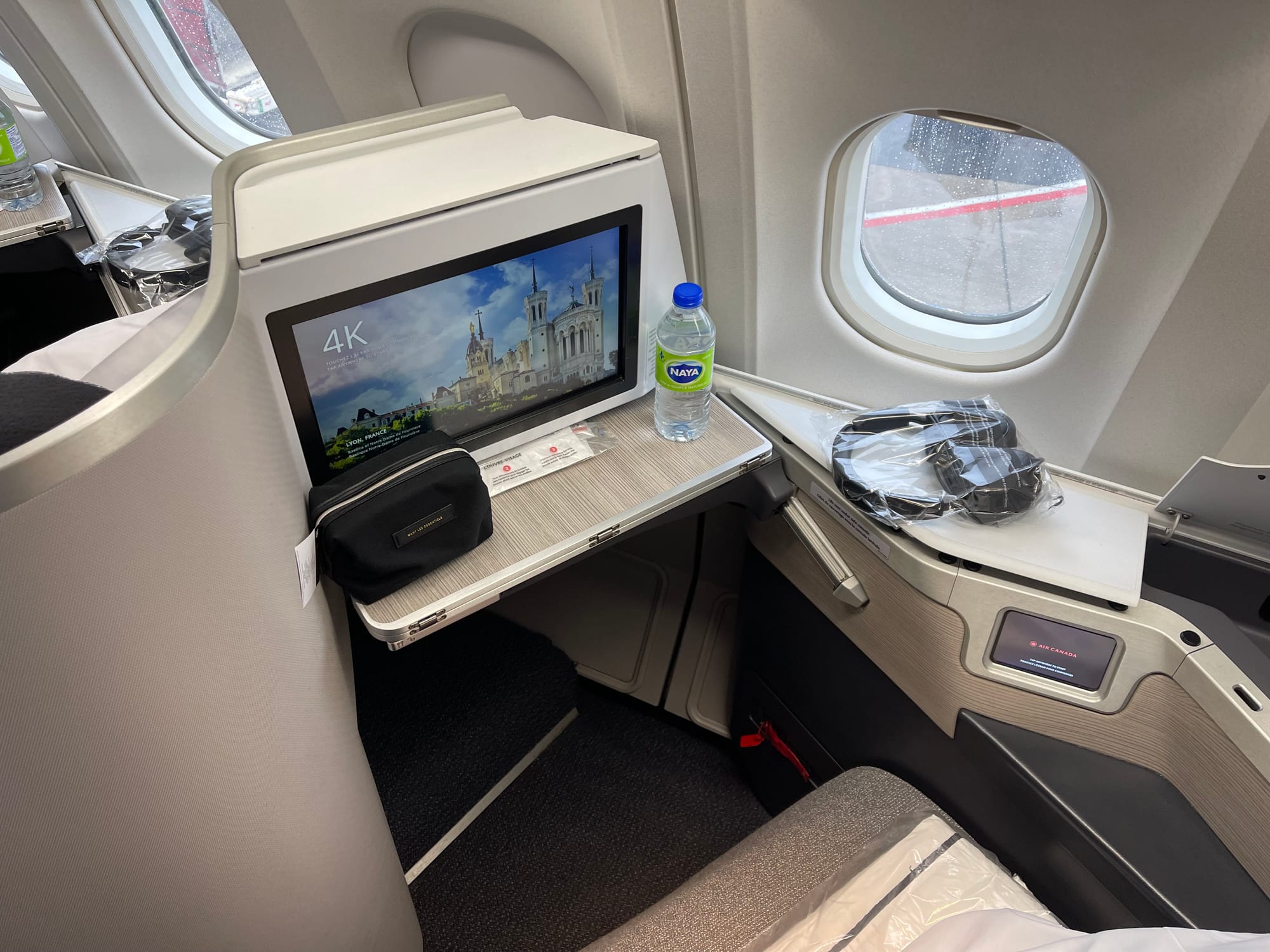
It was, frankly, rather boring and generic, and quickly eclipsed in look, feel and experience by many other carriers, whether from friend (like United Polaris) or foe (like the Qatar Airways Qsuite or the Delta One suite).
At roughly the same time, Air Canada consolidated its 777 product to Super Diamond, upgrading from the 2000s’ Contour Solar Eclipse aisle-facing herringbone (of Virgin v Contour fame/infamy) and a later brief higher density flirtation with Thompson’s original Vantage product.
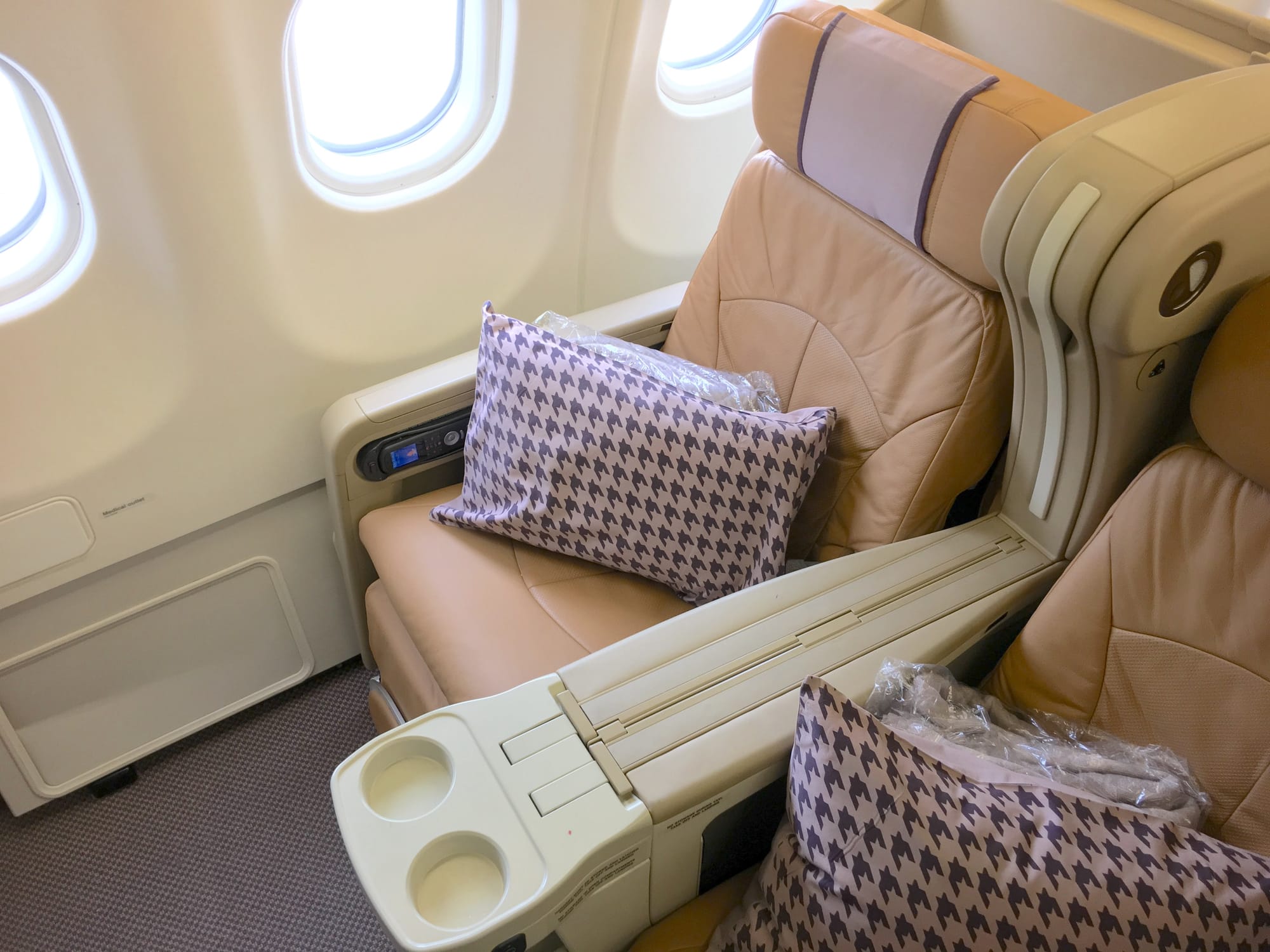
Its A330s followed with Super Diamond, although the airline has since acquired used ex-Singapore Airlines models with older Weber angled lie-flat seats (the model 7811, I believe) that the airline markets as premium economy when flown longhaul — frankly, one of the industry’s best front cabin bargains.
I flew Air Canada’s Super Diamond in its A330 version back in 2022 from Lyon to Montréal, and even then the seat struck me then — and even more so now — as fine, but bland, both in terms of space and in terms of aesthetics.
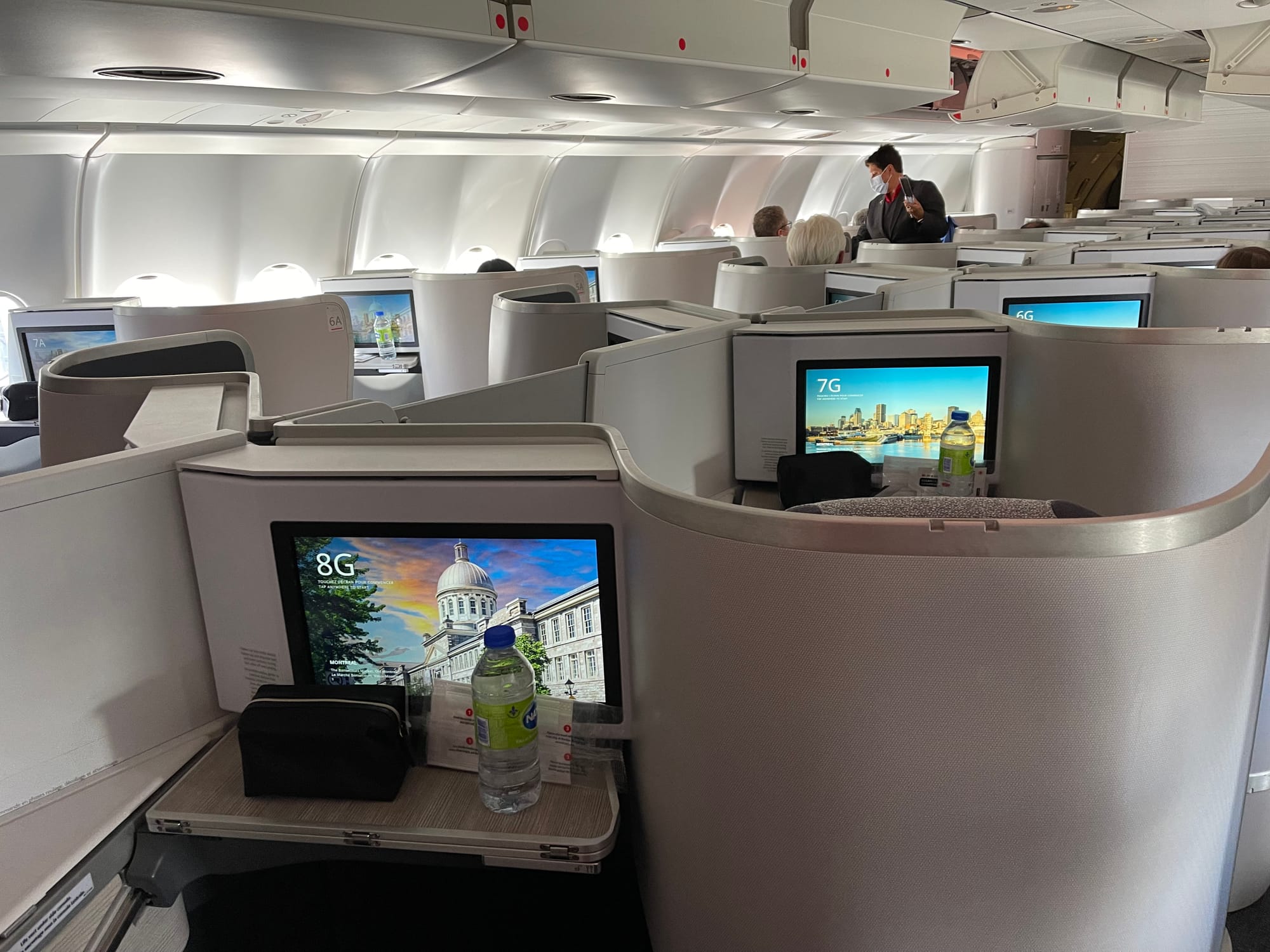
It’s all very monochrome grey, very “business class for business people in business suits”, very middle-of-the-road verging on milquetoast, begging for some colour, materials and finishes to bring it out of the realms of just being a generic business class.
Some heart, and a bit of a glow up, if you will…
The Glowing Hearted vision goes beyond new seats on new planes, and has more than 300 aircraft in its sights
“The fun bit, certainly for us,” onboard product supremo John Moody tells The Up Front, “has been executing on that vision, starting with the XLR and then deploying that to the 787-10 — as well as essentially every other aircraft in the fleet.”
It comes as the airline knuckles down to implementing a major fleet renewal, new aircraft deliveries, and retrofits of a large fleet of existing aircraft spanning everything from 777-300ERs to Q400s, including aircraft from Airbus, Boeing, Mitsubishi and De Havilland Canada. (Three of those aircraft types, the A220, CRJ and Q400, were at one point also within the Bombardier stable before that company exited commercial aviation.)
“We went from generations where we had consistency from our smallest regional aircraft to our largest widebody — and that’s the plan again this time,” Moody says. “The XLR and the -10 were the impetus to get moving on that. But we have plans in the works to both retrofit Glowing Hearted to the rest of our fleet and also install it on new aircraft that will be coming to Air Canada in the future”
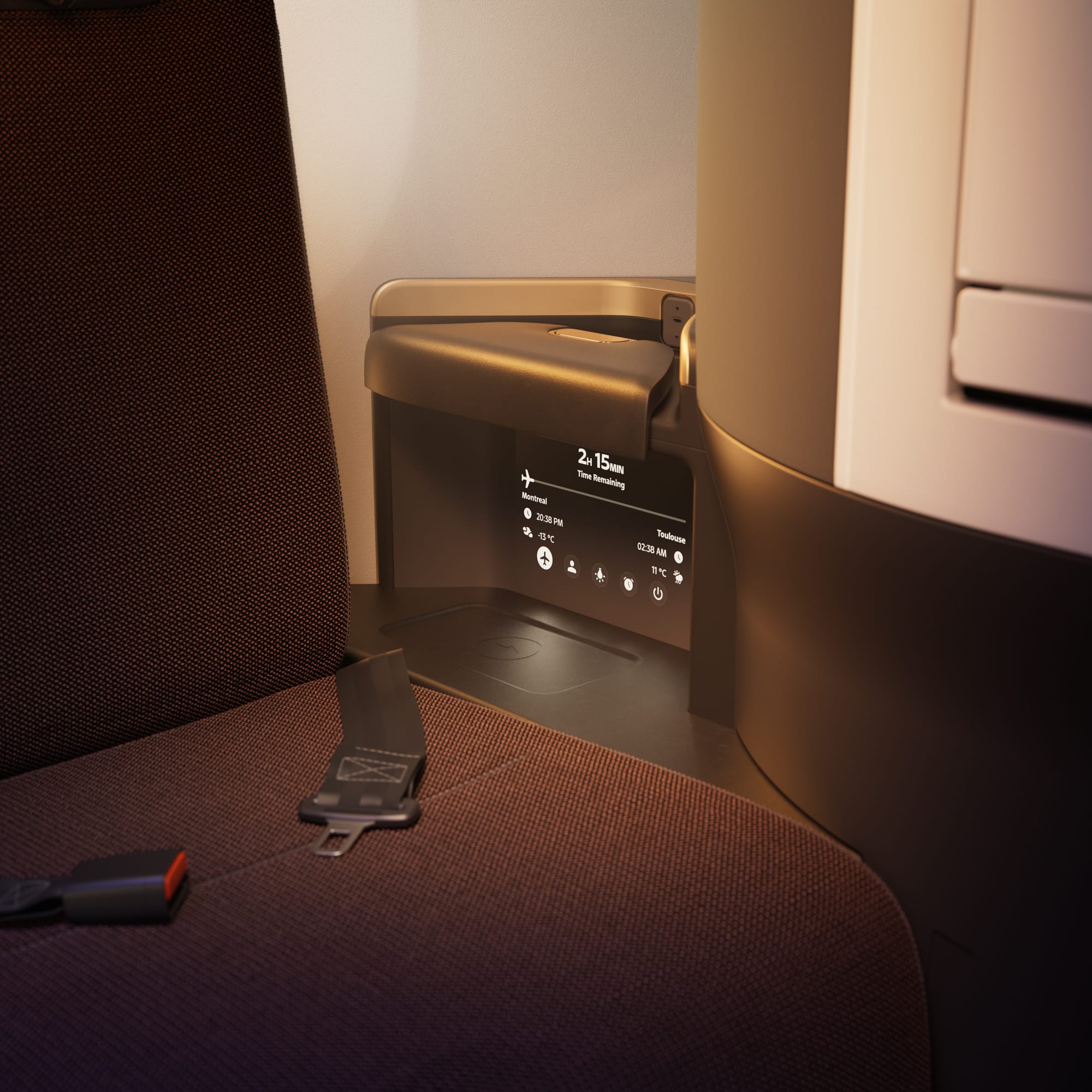
That plan is, of course, helpful in an era when an airline can never be entirely certain of when a new airplane type will arrive in its fleet, nor whether the seats on board will be certified in time.
Indeed, Moody notes, “our first Glowing Hearted aircraft flying in service is actually a retrofitted A321… that is flying with essentially the products that made up our Dream Cabin generation, our previous generation. We took the opportunity with our A321 retrofit program, at one point, to say: this is the last aircraft in our previous generation that we’re going to deliver, and then the next aircraft is going to be in this new standard.”
Notably, this first A321 was one of the jets transitioning from Air Canada Rouge back to the mainline carrier’s brand and operations, enabling a refit.
“Our first A321 aircraft, FIN 468 is flying with that cabin standard applied to the [Collins Aerospace recliner] MiQ, applied to the [Collins economy] Meridian, which we’ve been flying for a period of time,” Moody says. “We’ve upgraded it in targeted ways: a full refurbishment when it comes from a cabin and material perspective, a full refurbishment when it comes to IFE — it was our first [Panasonic Avionics] Astrova aircraft to fly.”
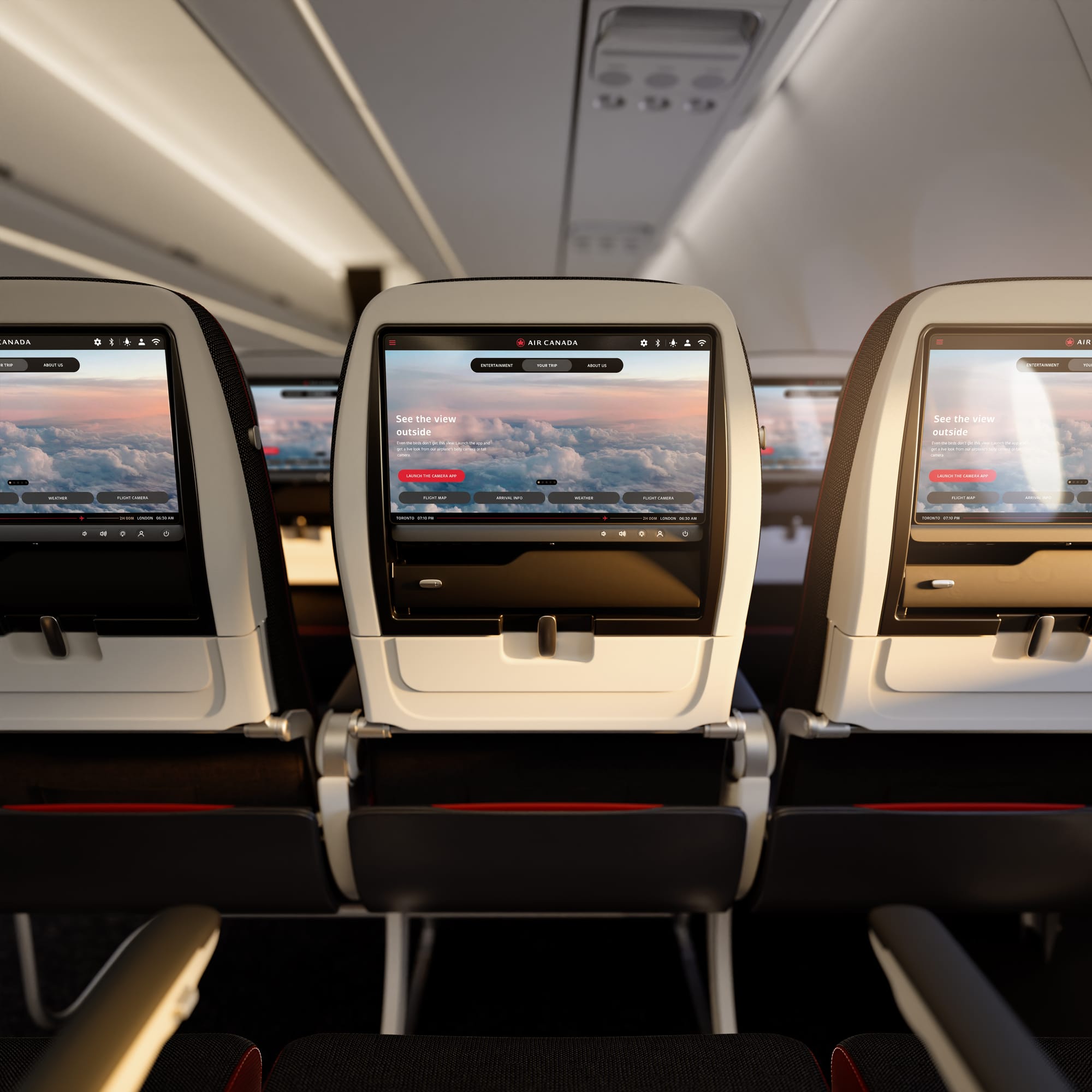
Figuring out how and where to most judiciously apply a cabin standard is one of the complexities for airlines right now, with delayed aircraft, cabins, and seats.
“There are challenges on every program we have, based on when the program launches,” Moody explains. “Certification, these days, changes relatively quickly, so what was certified last week isn’t necessarily going to get certified this week. We have challenges from airframers. We have essentially all of the OEMs within that fleet space.”
At the end of the day, Moody says, “it’s definitely not, you know, designing brand and design guidelines and apply a cookie cutter to every fleet type. Every fleet type requires revisiting of that standard to see how it applies to that aircraft.”
Navigating the technical — and sometimes commercial — constraints between design and implementation requires finesse
Indeed, notes Zunic, from the brand perspective, “one of the — candidly — challenges that we had is multiple programs running at the same time, so we were making early decisions without necessarily knowing, two programs later, what is this going to look like and what is this going to mean.”
“You don’t always get it right,” she admits openly. “You try to strive for 95% satisfaction from a design decision perspective. We started within the weeds of the industrial design: from a Glowing Hearted perspective, as it relates to design language, we really just wanted to soften things up.”
Obviously, that means changes to CMF: the colours, materials and finishes that make all the difference to what a cabin looks and feels like to passengers and to crew.
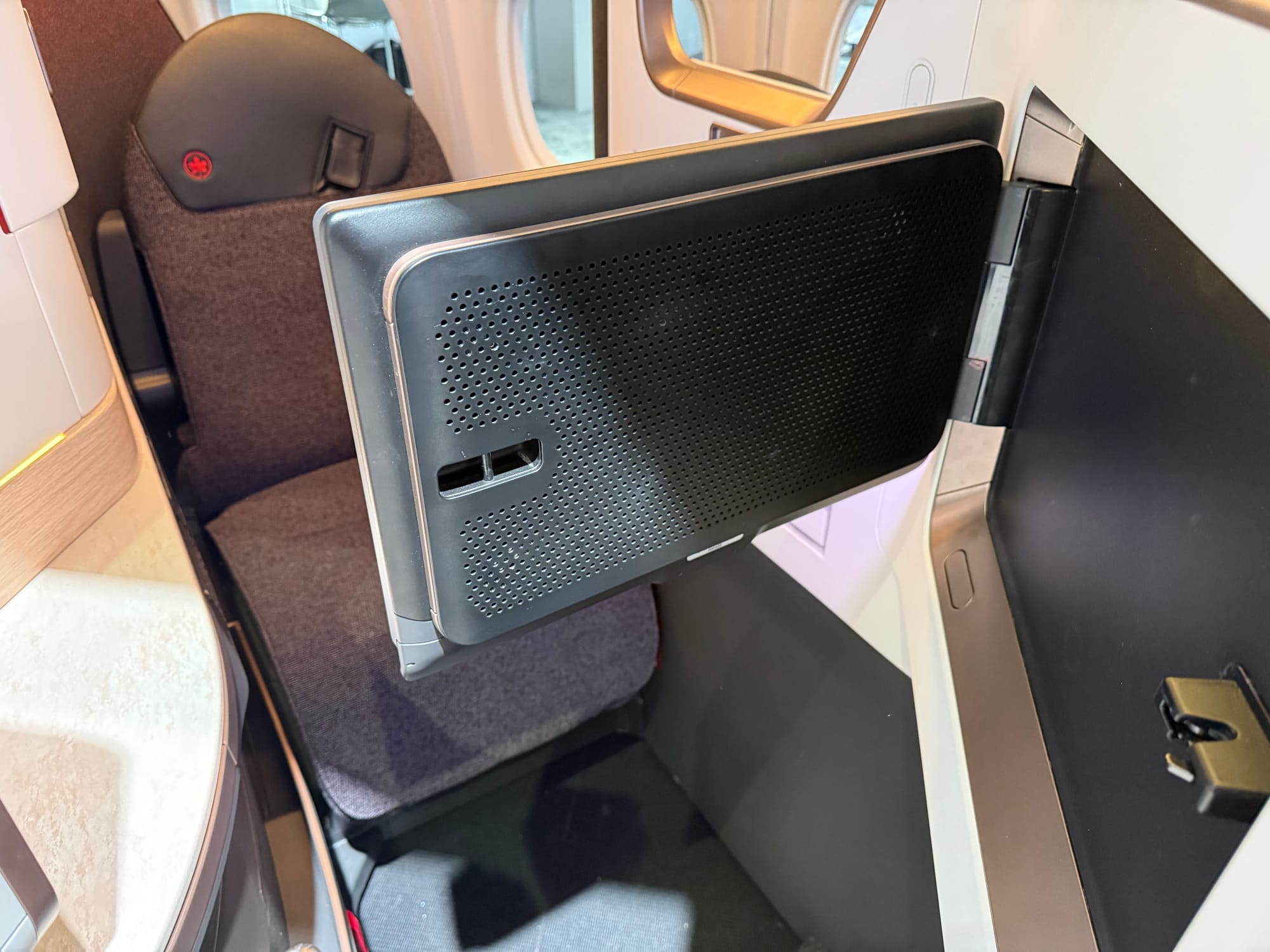
Zunic recounts a fairly common story from any designer or airline dealing with a seatmaker these days.
“When you’re coveting a seat and you’re talking to the suppliers, they’re like, yes, we’ll give you this, we’ll give you this — and then you actually start designing it,” she says. “You start to hit the bumps in the road and you start to have to manage your own expectations: certainly that happened from an industrial design perspective a little bit. I think some of the details that we were able to embed into the overall result is still really good, and we’re still really proud of that — and we’re very excited to continue to evolve that, as better timelines allow.”
There are, of course, many considerations when it comes to translating a design vision into the certified — and certifiable — materials that can be implemented within the cabin environment, including flammability, toxicity, heat release, smoke, static and dynamic crash testing, head injury criteria, plus the new criteria regulators are increasingly scrutinising.
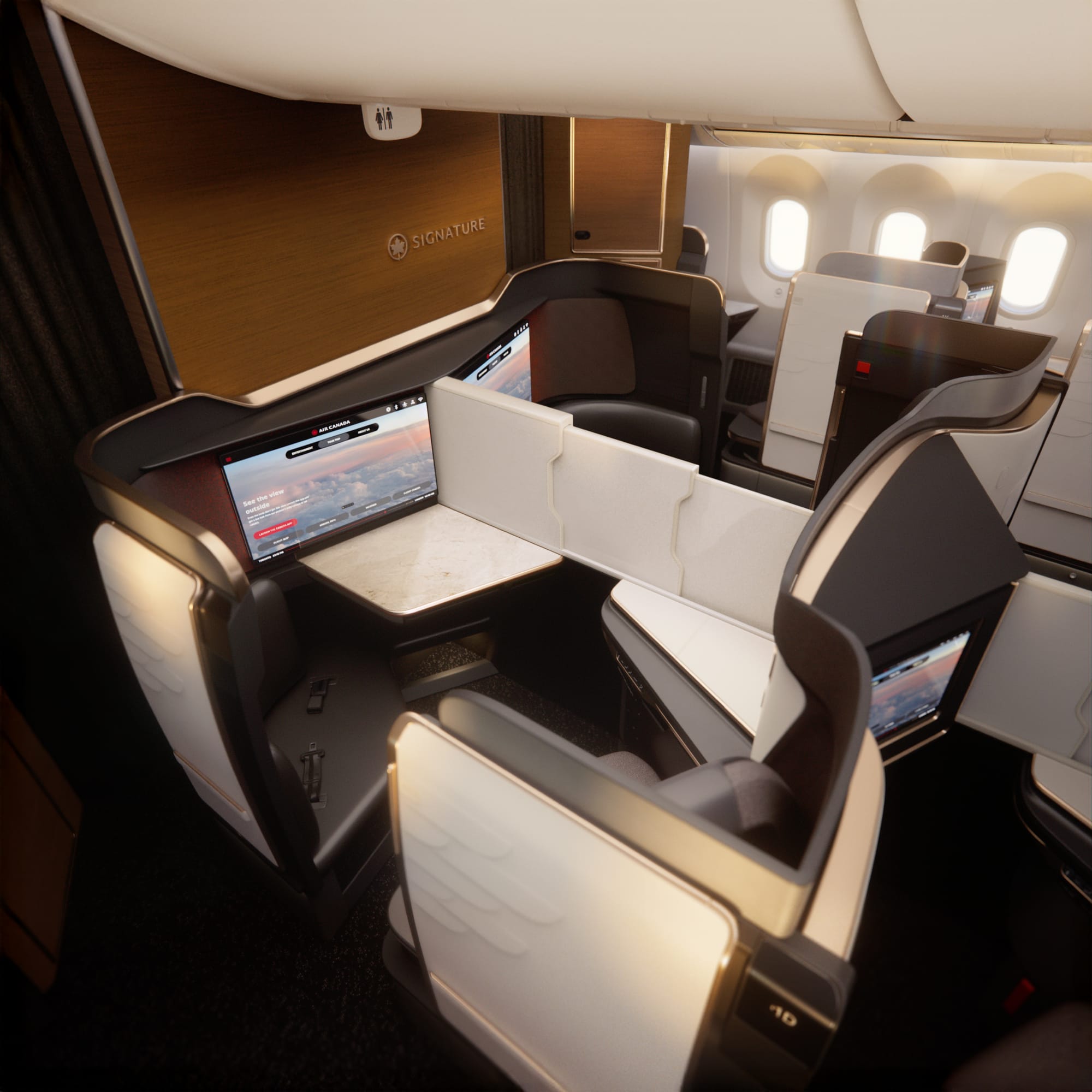
The approach to these issues varies not just between regulators in places, but between original equipment manufacturers, whether of airframes, seats, monuments, or other cabin elements.
“Appreciating all of those technical considerations that you mentioned,” adds cabin product development manager Carlo Spano, “we’ve got the Boeings, we’ve got Airbus, Embraer, we’ve got just so many different complexities that lead to an almost impossibility of translating directly.”
Zunic adds that, “for the rest of the materials, this was my first time certainly going so deep in cabin design, and to all the things that become real restraints. It was a significant learning curve. So, ultimately, we really just focused on: what Canadian story do we want to tell?”
Designing within a “web of complexity”: the CMF glow-ups within Glowing Hearted
From that story, Spano says, “it was key for me to get a set of key pillars to translate into the cabin — Dzeneta touched on the materiality being probably the top pillar that would allow us to really have that consistency and commonality throughout the fleet.”
Even as the Glowing Hearted vision is translated into its first aircraft, that consistency and commonality is implemented in considered and conscious ways.
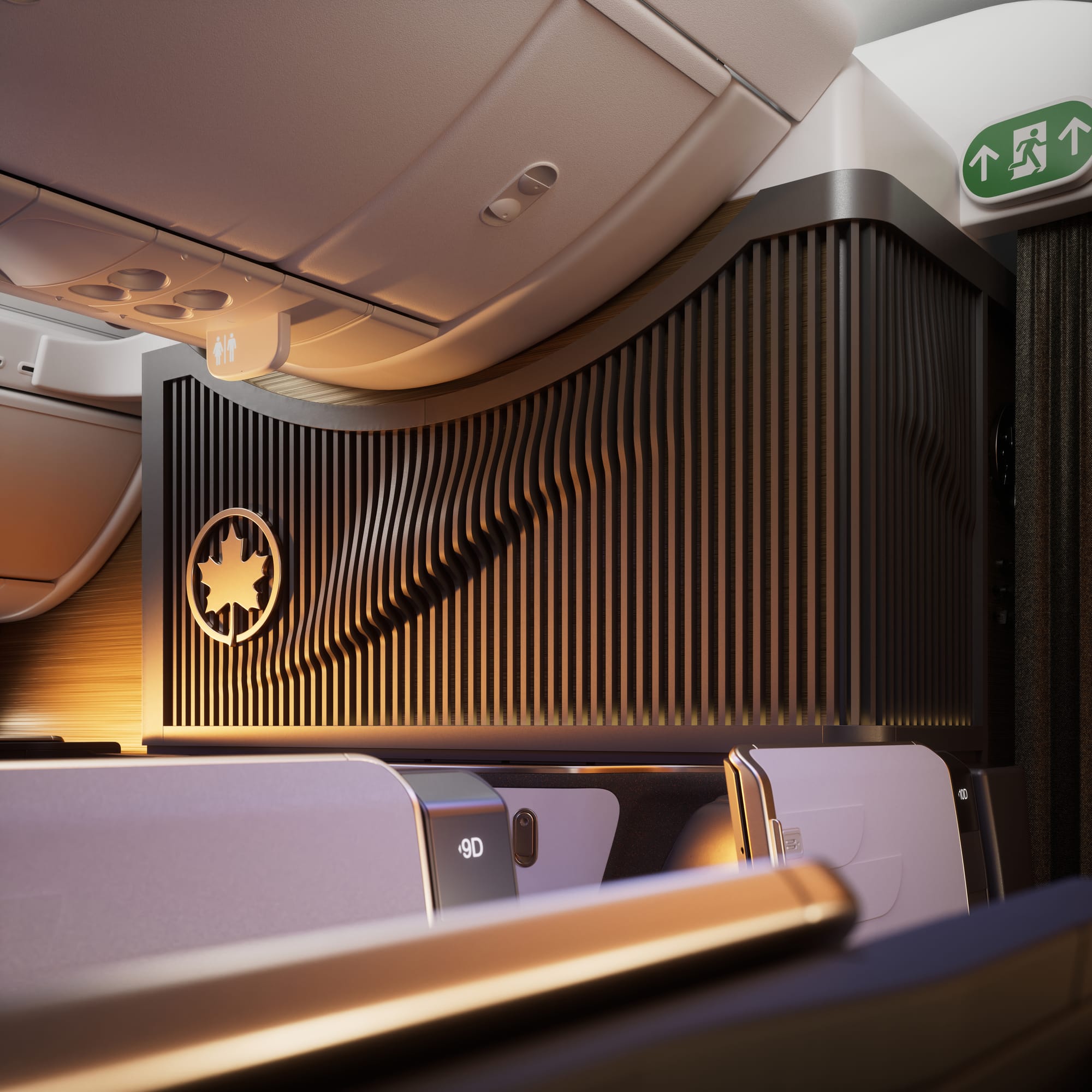
As one example, the rear centre wall of the 787-10 business cabin features a striking undulating monument with a wave motif, which feels very much like a luxury hotel lobby feature wall.
The A321XLR, however, doesn’t have a centre wall at the rear of the cabin, so it comes with an attractive — and impressively tightly integrated — monument, and one of its signature Glowing Hearted elements is a backlit canopy of maple leaves as customers board.
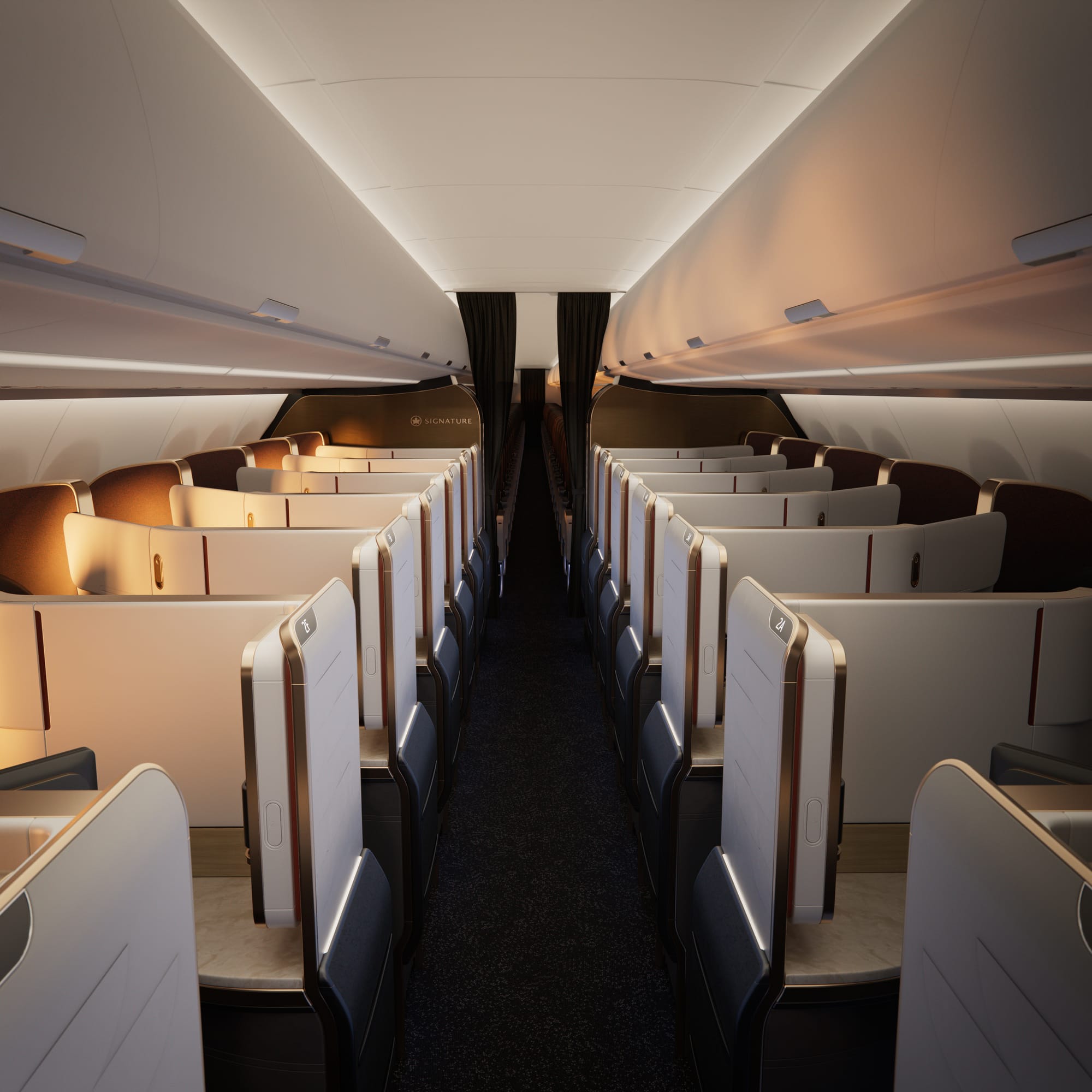
Air Canada understands that it’s absolutely fine if every Glowing Hearted element isn’t found on every aircraft, and indeed has designed the vision’s implementation to that end.
“It also boils down to even the mission of the aircraft,” Moody says. “I’ll give you an example. Within the industry, there’s been a consistent, long-term discussion about leathers versus fabrics, natural materials versus synthetic materials. We at Air Canada have said we’re going to make the right decision for the right mission.”
“So,” he continues, “for the long haul, we still believe in fabric dress covers. We believe in the breathability of those materials, that people sitting there for a long time require the breathability that a fabric dress cover will bring. It’s why in our Signature Class, you still see the fabric dress covers. Even in economy on a long haul aircraft, you would see that.”
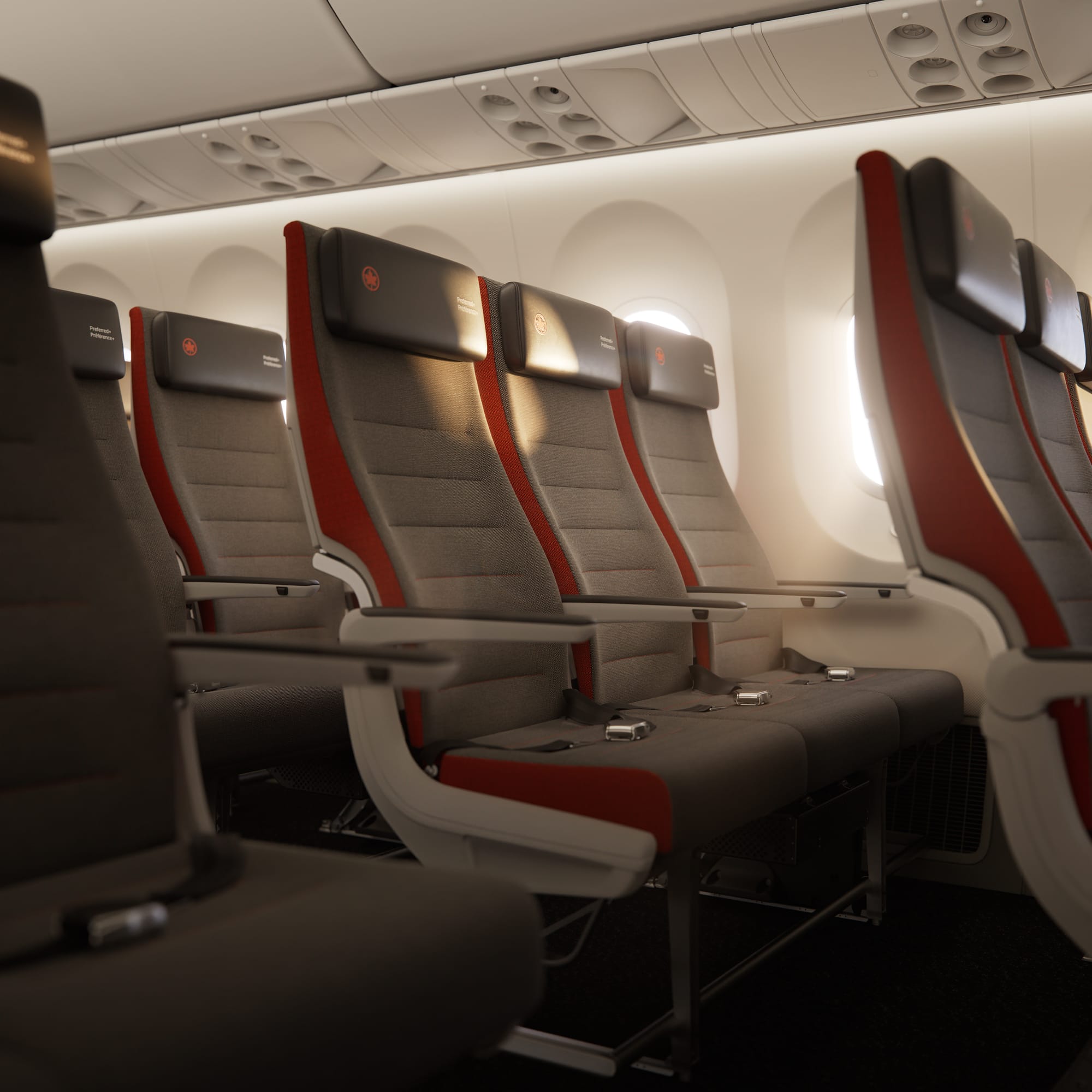
By contrast, Moody says, “take two aircraft that are nominally the same, but different missions. We have the A321XLRs, which are going to be flying significantly longer missions than the standard A321, where the economy dress cover is fabric. And on the A321 that I just mentioned, the one that’s going to stay within North America, we’ve gone to leathers within those cabins — and that’s okay. We’ve designed it to say it is still Glowing Hearted, whether the material is leather or fabric, and it’s designed in a cohesive, consistent way.”
Air Canada also acknowledges the reality that different suppliers are certified and approved for similar applications with different airframers and different seatmakers, and is carefully navigating that within the Glowing Hearted CMF palette.
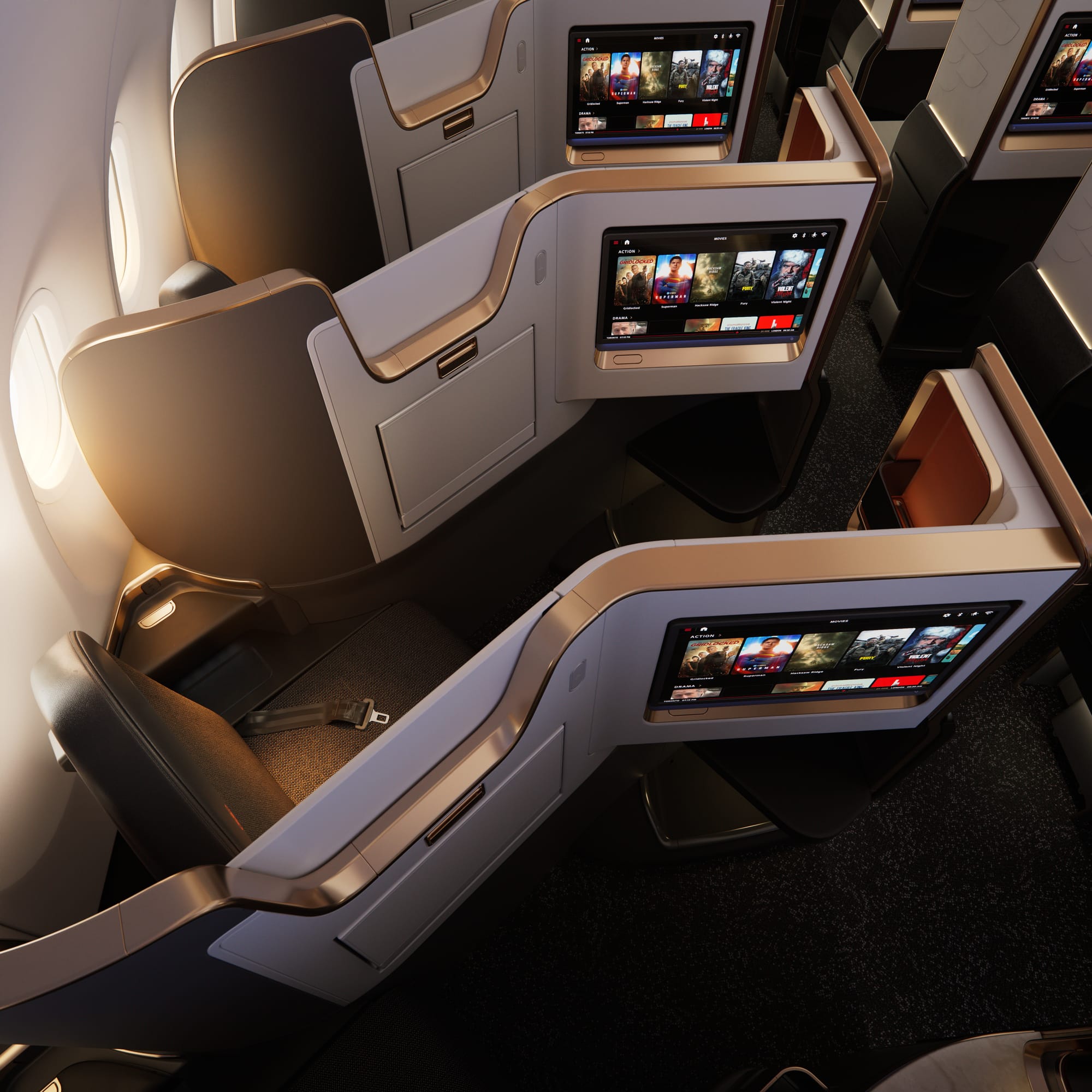
“We may have a preference,” Moody says, “but we’ll have designed very similar things in Schneller and Isovolta, whether it’s Kydex or Boltaron, whether it’s Tapis, real leather or some other material, depending on the application — and also different vendors have different preferred suppliers, so we all work through that web of complexity to deliver consistency.”
Zunic jumps in with another example: “for our business class fabric, we actually developed two. It’s exactly the same construction with a slightly different grade of warm gray to cooler gray. And so, for example, we use one on the XLR and we use the other one in the 787-10, because context matters, actually.”
“Honestly,” she says, “the environment at which that seat and that dress cover sits and then how the rest of the elements — the proximity of them, the simplicity of the environment behind them — means that one looks better over the other. So, as long as there is logic and cohesion and relationship between these things, we think having a slightly deeper bench from a creative materials perspective is just going to give us more variety and more range and timelessness out of it.”
Upgrades — both to existing cabins and to the new Signature Plus studio class on some aircraft — are a key part of Glowing Hearted
Will a design and materials update fundamentally fix the core issues with, say, an existing Super Diamond seat that, for all its popularity, is now over a decade old — and, on the narrower fuselages of the 787 and especially the A330, rather inherently compromised in terms of space and angle? No, of course not, and the sooner that Air Canada can get its new Elevate Ascent seats retrofitted onto as much of the fleet as possible, the better.
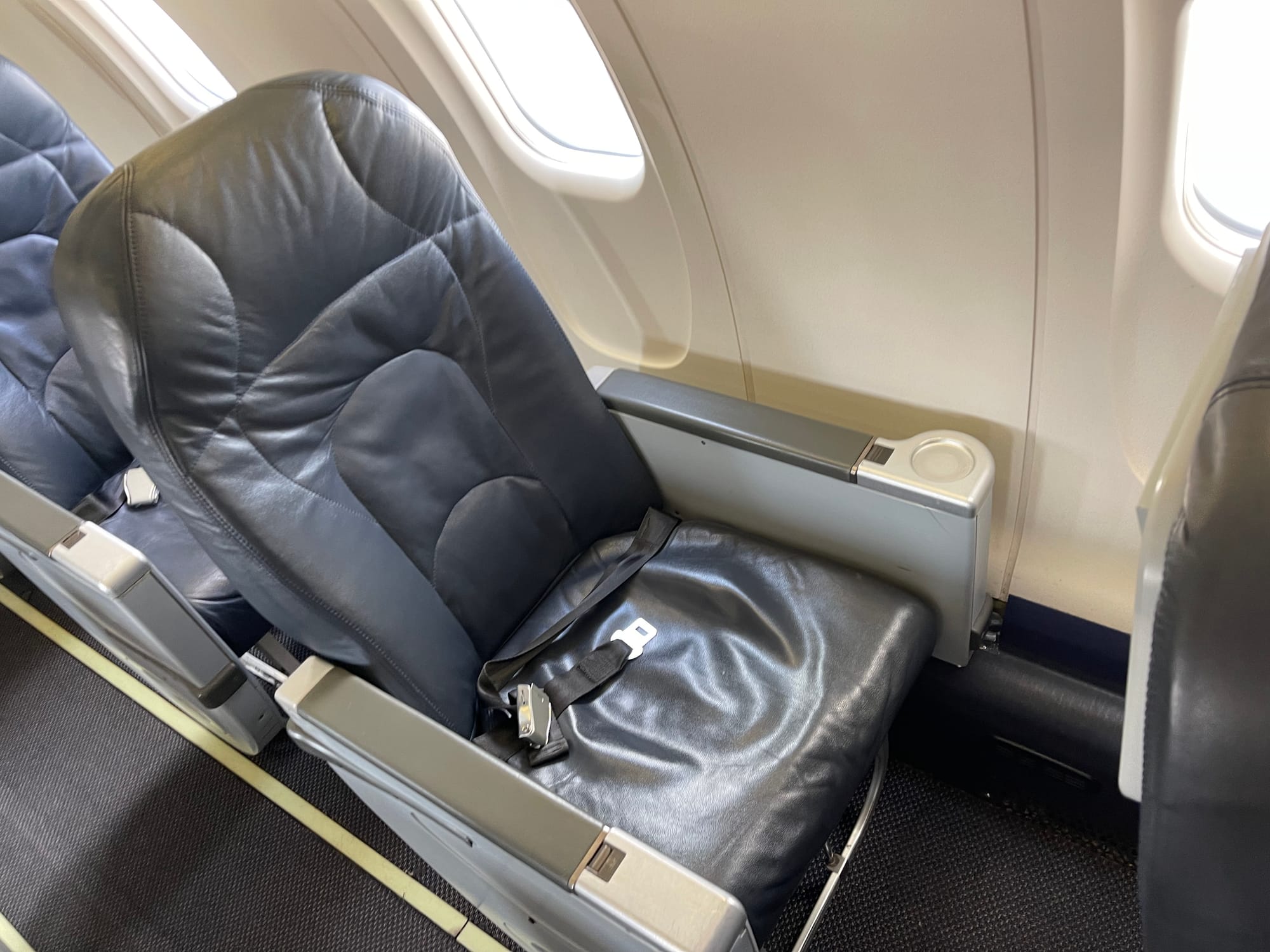
But there is certainly an argument for updating some of the semi-soft product on board — seat covers, perhaps a bulkhead wall or two, perhaps some of the more easily replaceable and high-touch elements like tray tables — to leave less of a hard gap between, say, the austere, office-like 2014-era Executive Pods era and the 2026 Signature Class with its Glowing Hearted aesthetics.
Updating the soft product, too, will be inherently welcome. A Glowing Hearted duvet set, pillow, convertible bolster/blanket affair, and generally more warmth and tactility makes a lot of sense.
It will be fascinating to see how this all works across such a disparate fleet.
But that won’t add Air Canada’s new studio class front-row product across the hundreds of aircraft on the list, nor is it throwing itself into a barrel and tumbling across the Niagara Falls of ultra-segmentation.
“We’re introducing Signature Plus on our 787-10s,” John Moody says. “That is, I would say, our first dipping of our toes into optionality within the cabin. But we're by no means heading down the Lufthansa path of infinite choice and complexity.”
Inherently, he suggests, “as much as customers like choice, choice sometimes means that some customers don’t get exactly what they want because there’s limited inventory. Whether it's herringbone or reverse herringbone — different products — we believe that, as much as possible, our customers are going to see that those are both Signature products and that, from a value proposition, they’re very, very, very similar.”
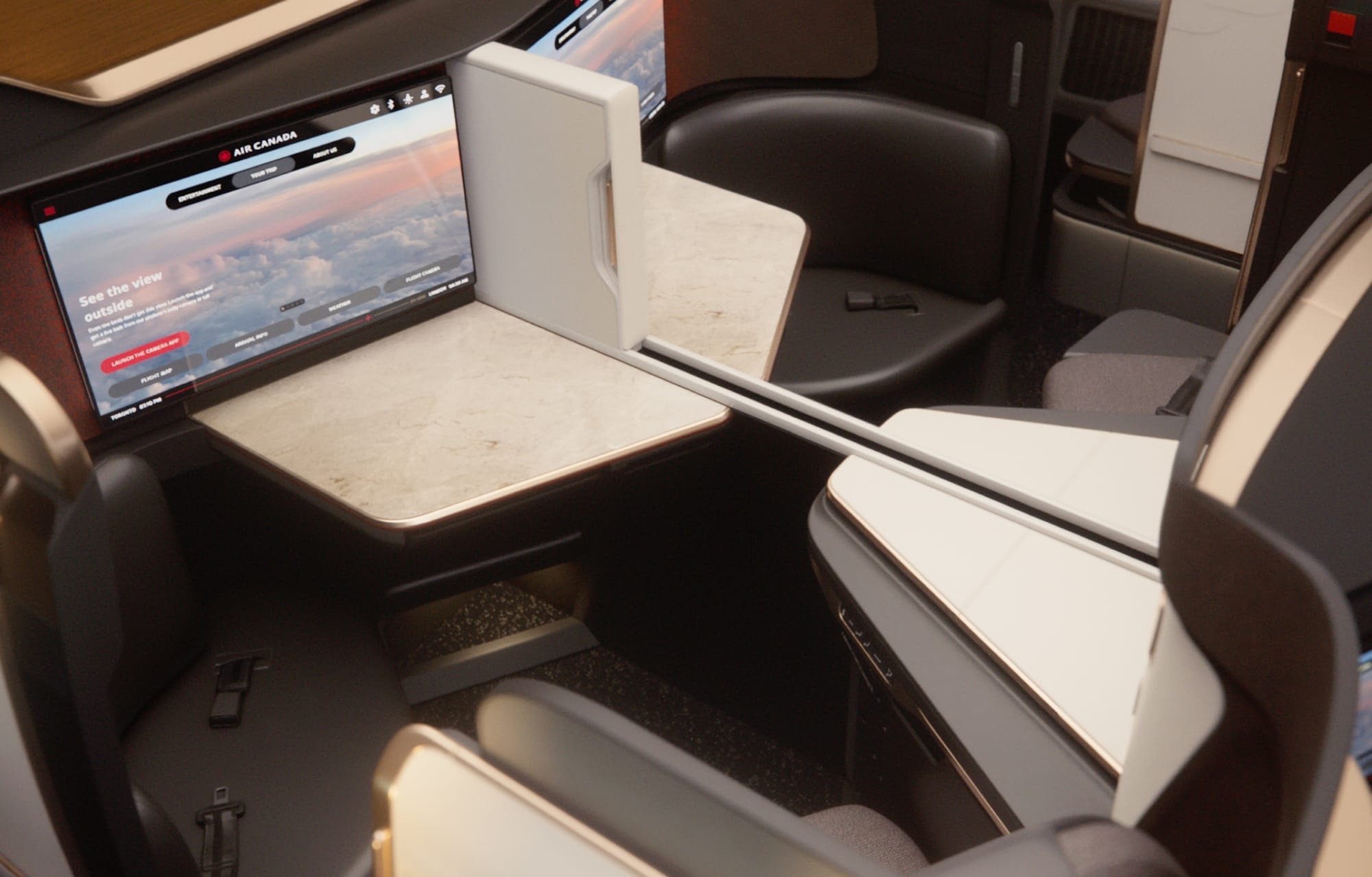
There will be touches of upgrade for Signature Plus, in addition to space: natural quartzite stone elements, for example, that for weight reasons are not continued down to every other Elevate Ascent seat in the cabin. But it feels like passengers in “regular” Signature are unlikely to feel hard done by either.
A few days after our discussion with Air Canada, Airbus announced — with Canadian Prime Minister Mark Carney playing a major role — the sale of 150 Mirabel-built A220s to AirAsia, with the promise of another 150 if the airframer builds the much-mooted stretched A220-500 version.
Altogether, it feels like Canada is having quite the moment, with a real sense of a revitalised nation not just adjusting to a new world that surrounds it, but keen to capitalise on it. Air Canada, as the national carrier, seems equally keen to play its part.
