Listen now:
Read the episode transcript:
John Walton: I’m The Up Front's editor-in-chief, John Walton, and today I am joined by…
Christopher Eyser: Christopher Eyser, from Lufthansa Technik.
John Walton: And also by…
John Inman: John Inman from Simona Boltaron.
John Walton: What a show! What a show we've had. We say this most years, that it's been a show to remember, but more than most years I think it's been unusual.Christopher, what have you seen at the Lufthansa Technik? What's been going on?
Christopher Eyser: For me it's always nice to have the show here in Hamburg, because I live here in Hamburg and my work is also here in Hamburg. It's being home, but also to meet all my customers and so many people, and presenting my products at the booth and had so many conversations about the product and to get different perspective from different people. It's always very nice for me.
John Walton: It's always funny for me that we all have very different shows. I... We in the press are running around all the booths and seeing all of you at your individual booths. And sometimes you don't get to see as much of the show as we do, which is funny sometimes.
John Walton: John, how about you? What's, what have things been like here at the Simona Boltraon booth where we're recording?
John Inman: I'm extremely lucky to have been to every one of the Aircraft Interior shows, apart from one. I missed 2005. But for me this has been one of the most successful ones. We've continued to expand our presence with the booth and the investment we're putting into it, and I believe it's paying off.
We've had some great meetings and really, been really good. And I think also it's lovely to be amongst friends. It does feel that you get to know so many people in this industry, and you... and catch up with them again once a year, and it's lovely.
John Walton: It's great to walk by and see people talking to other people you kno, even if it's just giving a wave as you go by at speed. Really enjoying that feeling of being all back together as one big, but also quite small industry sometimes, it feels… There's a line I often use where this sometimes feels like the world's largest cottage industry. Even the large volumes within supply chains that we talk about here are not enormous when you compare it with something like automotive.
And I think that's actually one of the things that people have been discussing this week when we talk about supply chain. It's been fantastic to hear so many people saying, "Oh, what you said on your podcast about the this or that element of supply chain is exactly what we're hitting."
And I think one of the problems that we may be facing in aviation, and one of the things we want to really make sure with the supply chain, is that as the automotive industry changes and where we share suppliers or where we may be dual sourcing suppliers, we do ensure that we have that supplier network in the event that automotive doesn't recover. It feels like there are a few people out there starting to talk about there are suppliers for whom automotive is, let's say 75% of their work and aviation is 25% of their work.
What happens if, for example, the current energy crisis means that we have an influx of internationally built EVs into Europe, for example, and therefore European suppliers into automotive, that demand profile changes? Certain models are no longer produced that are more gas guzzling, should we say, and that affects suppliers who we deal with who then have to rely on aviation for more of their — well, to remain in business. Lots of interesting discussions like that that we're having, I think.
John Inman: I think the other thing that we need to keep remembering is that we are dependent on the success of the airlines, and I think that's really come home this week, because so many of those airlines have cut their delegations to the show. So they've still come. We haven't had any meetings missed by an airline, but in the main it's been five people rather than 10 people, for example.
Christopher Eyser: Yeah.
John Inman: And the shock they've had with the jet fuel pricing going through the roof, if that then means they're going to now spend less money on their interiors, that can affect us. I don't think it's happening yet, but if we, if this carries on for longer, that could be a significant shock to us.
John Walton: John, when you see those smaller groups coming in, how does that affect the seniority of people that you're seeing? Is it more the working level people who are coming or is it the more senior people who are coming?
John Inman: I think it's been both, John. I haven't noticed it just be the senior people or just be the working people. I think it depends on the airline.
John Walton: So it's not just the CEO is staying at home with their oil price spreadsheets, as a trend?
John Inman: No.
John Walton: I know I've been seeing a lot of people at various levels who I know from this, from the Paris Air Show, from Farnborough, from media events at Airbus, Boeing, or wherever. I haven't been able to spot “all the CEOs are at home” or “all of the people who are... I don't want to say junior working level, but who are not the EVPs and above are at home”. I don't know if you've seen-
Christopher Eyser: Yeah, I also see a mixture, I would say, with people from all levels. I don't see any trends there.
John Walton: One of the things I am noticing is people are talking much more about ensuring that they're able to secure spares much more easily and perhaps stocking more spares, stocking more backstop for production as well.
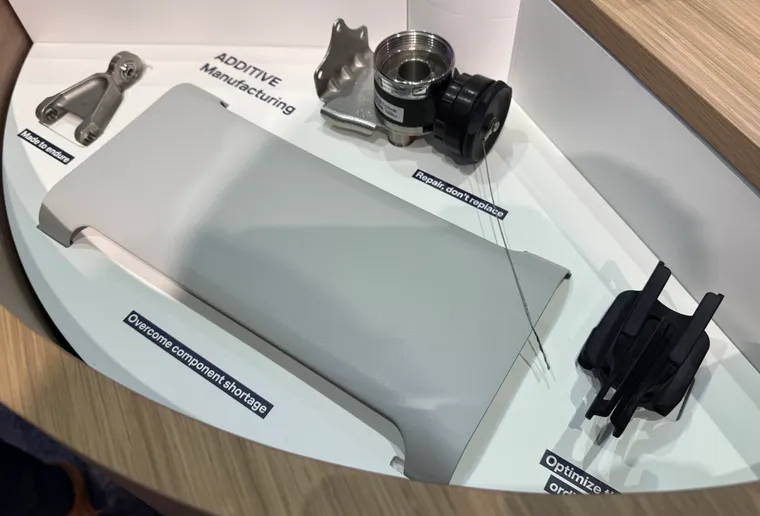
I was interested to see that, at Lufthansa Technik, additive manufacturing is becoming a really big topic, cross not just the cabin, but into the operations side of things. AM for metals, for example, to AM for plastics was was the early option there. But can you tell us a little about how that's affecting what you're doing
Christopher Eyser: Yes, sure. That's actually my daily business. I have to say I'm product manager for additive manufacturing at Lufthansa Technik. I'm leading this product now for almost one and a half years.
We have a lot of experience in additive manufacturing. We have a dedicated engineering for that, and we jump into the whole Lufthansa organisation, and even get in contact with other airlines to identify use cases where we can step in with additive manufacturing. And one of our opportunities is we are very flexible with production, so we don't need any toolings or something.
We can just produce parts in very different dimensions and so on, and don't need so [much] time to prepare something. We can act very fast. We dedicated — or we found out different cases. All use cases [are] very different compared to the other ones, let's say.
But I think supply chain is becoming more and more important for the airlines because, the most extreme use case we had, was that an airline has to block seats because an seat cover is missing. And then you are not able to sell the seat, and then it's really an alarm going on in the airline, right? Because you have missing revenue when you're not able to to sell the seat anymore.
We jumped in to this project, and created a new alternative path for the seat cover with using additive manufacturing, tobring this to the organisation and solve the problem. actually.
John Walton: There's a lot of people at this show talking about making things more repairable, more easily repairable. Perhaps splitting the pieces into smaller elements. to be able to repair individual pieces. I don't know if you're seeing that on your side, John, in terms of that.
John Inman: I think what we see is a desire for design for manufacturability, so that we want to get engaged early in the process and try and make sure that the design intent is achieved. And also, you're designing for sustainability as well, so for disassembly, which is a bigger discussion this year than maybe in previous years.
John Walton: I think that disassembly doesn't just have to happen at end of life. It can also happen within the life cycle so that you can replace pan end cap rather than the entire armrest. Part of a seat back rather than the entire seat back. In a suite, an element of a suite rather than the entire doors or whatever it happens to be.
John Inman: Yeah.
John Walton: And I think that seems to be permeating much further than it did. I think back to day one of the show, which is approximately 314 days ago it feels like. But you were looking at, gosh, even day zero. It was a Monday afternoon and we were at Recaro.
Violina Mikova was showing us the way that one of the seat cover suggestions that they have is introducing a zip underneath the headrest to enable them to replace just the headrest part, but not the bit from shoulders down. Because what they found is the most often damage is things coming out the overhead bin, damaging the headrest part of the seat cover and then them having to replace the entire thing.
So what happens if they have an option to much more easily replace just the top bit? Part of that discussion, of course, is well, that then introduces a security risk, because that's a pocket that somebody can stuff something inside, for example.
That’s why it's so important to bring this stuff to the show, because people can say “oh, there might be a problem.” And someone else says, “Ah, but actually what one of the solutions might be to hide the actual zipper, the moving part of the zipper in a certain way,” or there may be a solution to the problem comes up. And that sort of collaboration, that cooperation is really what I think we are at the show for.
John Inman: Yeah. I value very much the meetings we have with the design community, and they have been here in force. They're pushing what they want for the future, and I feel a lot of our job is to listen to what they're looking for the future, interpret it in our materials, design evolving, as we say, and give them those options. That's what we have to do.
John Walton: Yeah, absolutely. It's been fascinating for me to watch the CMF community at work. It really is a community. I don't think there's a single seat that just has your products on it, John, or some of the other providers of plastics or of other materials —
John Inman: Yes.
John Walton: — now we're looking at woods, and stones, and it's fascinating to see how much, how many different suppliers [there are] into a single product these days.
John Inman: Yeah. I've just been talking to the Counterpoint team before meeting with you, John, and they were saying that they felt that there was an appeal to all the senses now, whether it's smell, touch, and then typically with plastics, we've been looking at what it looks like and what it feels like.
But they're wanting it to go more soft touch, and homely feel and this sort of thing.
John Walton: I was just over at Formia this morning, at WTCE, the World Travel & Catering Exhibition, which is the partner show to AIX across the road. They now have pajamas which have a built-in lavender scent.
John Inman: Wow.
John Walton: So that you can feel especially relaxed and calm as you go to sleep. Now I had to stop smelling the pajamas because I was feeling a little snoozy before my third cup of coffee this morning on the stand.
But it's so interesting that the touch, the sight, the... and again, the feel. Lots of people saying, "Go have a feel of this. What does this feel like?" "Do you like this more velvety leather feel?" Velvety leather. I can't... When you say it I can't even imagine what that might feel like.
But you're getting these many different types of, of your products, John.
John Inman: Yeah.
John Walton: They feel different. They behave differently. For example they're smooth and things will slide on them, or they're not. They're almost sticky to keep a glass or a cup or a laptop or a phone in place.
It's really interesting to see people doing all this material science and really complex material science.
John Inman: Airlines have different views on it. So we are able to, say, making a wood grain, we can put a texture in so it feels like wood. Yeah. But some people may say it's artificial, it’s plastic, so they don't want it to feel like wood. And yet others do. And I believe our job is to do what the designer wants and the airline wants. And that's what we have to do.
Christopher Eyser: I see another thing into it I have to say, I think sometimes it's a challenge. I think customer experience and what you explained, like materials are so important for the airlines in the cabin to ensure a good customer experience. On the other hand, we are talking about supply chain issues, right? And if you have obsolete parts in the cabin airline, airlines see the solution.
And we are going more and more in into this alternative parts that we come into with additive manufacturing, even on other production methods to provide alternative parts to the cabin. And there I also have the challenge to have a short time to market to bring in a new part when there is a problem existing. Then I think the challenge is just to match this with the customer experience.
John Inman: Do you mind if I ask you a question? Do you have issues then with speed of certification for those things?
Christopher Eyser: That’s always a challenge. We are still working in an aviation and we are not just able to remove one part and put there another one. We have the whole certification into that. And most of the time, especially for additive manufacturing, that's the longest part to bring in a part. We can produce faster, but we need approximately maybe 12 weeks to do the approval for the parts and get the certification
John Inman: We have to really focus on getting on a program at the start, and then you get certified. Changing a part way through is so difficult for certification. And I find it quite sad in one way, particularly with we're trying to introduce our Terreform sustainability range, where people are liking [that] we’re now offering it in lots of different colors, lots of different textures.
So you can have it really as though it was non-recycled content material. It looks the same. But somebody can say to me, "Ah, but I can get the existing one through on similarity. I've got to recertify to go to the sustainable option," even though it's passing all the regulatory requirements. And I think that, that's holding us back from actually improving things. There's a bottleneck.
Christopher Eyser: Yeah. Yeah.
John Walton: I think what's pretty interesting about what you're saying, John, around the the need to be certified, need to recertify things is that the industry is also producing options for airlines. I was up in the Panasonic booth, and they have this updated system called eXneo.
So you remember the old eX3 — eX1, eX2, eX3 — series from Panasonic? It’s two or three or something, there's four generations older in terms of IFE. And this is probably what we were installing mid 2010s sort of time. So you know, roughly 10 years ago now.
It's incredibly difficult to- for an airline to say, "Yes, we're gonna recertify this entirely new in-flight entertainment screen, which is a new size, to put on our existing seats," right? That's just not a thing you do. You would swap the seats if it. That’s obviously expensive, and seat production is incredibly difficult.
So Panasonic has basically got a new screen and a new system which fits in the exact space where the old system was. So out comes the best that you could put on a plane in 2014 or whatever it was, and on comes the best screen and system that you can put on today, but within the same bezel. They put it in the same slot that the old one came out of. And it's got all the new computer brains and everything, right?
So it's got the chips, it's probably got a new CPU on there. It's probably got a lot more RAM. One of the things that Panasonic does that's really interesting is they put the old one on the wall and the new one on the wall, and they start doing things at the same time. And some of the things, some of the games you can play on the new systems won't even load on the old systems.
And if they do, the graphics look… to the extent that an airline would never say, "Yeah play this game on the old system." They’d just take it off . But just in terms of the sheer user abilities, the ability to go back and just update your IFE to something that looks and feels like a device from today, I think is incredible.
It really reminds me of what they were doing with Virgin America, if anyone remembers that one, about, so about 10 years ago, where they pulled... They did the same thing, but for a different generations. They pulled off the old screen, put on a new screen, and it the response was incredible. "Yeah, this is great. This feels like an entirely new entertainment system."
And I think that, in this supply chain crunch, in the fact that OEMs of whatever the M is that they're OE-ing — no, whatever the E is that they're OM-ing! Whatever that happens to be, people are having to actually go, "How can we extend the life of this program?” And I think that could be — AM is gonna be a big part of that as well.
So, John, is looking at, okay this 2012 seat, this 2014 seat might perhaps aesthetically look a little bit like it remains in 2012, 2014. Yeah. How can we update it with certified materials that will, that we can essentially wave through because they've been certified elsewhere?
John Inman: Yeah.
John Walton: Is that a set of conversations that you're having with airlines in terms of the the seat world the retrofit world?
John Inman: I'm finding that customers are wanting to go new rather than replacement. So to put something with a different design is going onto a new seat. Not very much is being put onto a retrofit seat. I’m trying to work out in my mind why that is, though. I wonder if it is because of nervousness about certification.
John Walton: Might be. Might be. Is the low-risk option to go for a newer seat, that comes in a unit rather than having to work back on something. Are you seeing that on the AM side of things, people are coming back and saying let's do this as part of a retrofit, or...?
Christopher Eyser: Maybe what you describe with the display is maybe a thing that you don't need to wait until a retrofit is coming, and you have to change, or you have the opportunity to change the whole thing.
You are even able in the cabin to have a look at single parts, if you're not happy with the armrest or something you are able to implement a new armrest with a new material or something on it. That's maybe more, getting more and more flexible I would say.
John Walton: One of the things I really liked on your stand was, I don't remember which aircraft it was, but one of the aircraft on the flight deck didn't have a hook for the headphones,… the pilot headphones, those very expensive pilot headphones. And so a lot of them were being damaged because there wasn't anywhere to put them.
And so by literally 3D printing a hook —
John Inman: Wow!
John Walton: — to go on the wall for the headphones, you save thousands and thousands a day, because the headphones are not falling off the… wherever they are, and breaking.
Christopher Eyser: Yeah, that's really a nice story. So I like it when parts are having a story, right?
That was one thing that one customer from the airline came to me and showed me some pictures how a pilot leaves the cockpit when he gets off the airplane. And there's no standard position to placing the headset, and the headset is down under the seat or behind the seat or somewhere else.
Sometimes they even take the cable and put the cable on a hook or something. But there's no standard attachment. And they had a problem that the remote control is getting damaged, or even the headphones. And they have to change them very frequency. They were asking us if we can develop something to do a replacement there or to optimise that.
And we developed a design for this headset holder, and there you see also the things are changing. You can place the headset holder on an existing tie holder.
John Inman: It’s so clever — just spotting that problem and fixing it. It’s great
Christopher Eyser: And then I think requirements are changing. And the cabin are not changing so fast sometimes, right?
John Inman: Well done.
John Walton: Sometimes it's those little touches that I really appreciate. Whenever I fly Lufthansa, there's always that little spot to hang up my glasses. There's a little glasses holder. And I believe, though I can't confirm this, I believe that's down to Ingo Wuggetzer when he used to work at Lufthansa. He specified that for a seat many moons ago now, because he's been with Airbus for quite some time. But yeah, I think that was originally an Ingo specification for Lufthansa, which has continued all the way through the modern premium cabins.
Otherwise, where am I going to put my glasses where I can be sure they're not going to fall off or get lost behind the side of the side of the console or anything?
Those little things really help. Another one of them is I was in the Air Canada the first A321XLR cabin, or the first few seats there the business class cabins. And at the door opposite the flight attendants seats were two coat hooks because it's Canada, and of course the flight attendants are going to need coats.
John Inman: Yeah.
John Walton: For Canadian winters. If you're operating in the middle of the winter, the coats have to be there, and so you want a coat hook because especially if if there's snow and rain blowing in, you definitely want to keep your flight attendants warm and dry. Many airlines — I’ve never seen a coat hook next to the front door.
Both of you, thank you very much indeed for joining us. We've gone from big picture to tiny coat hook and glasses holder size picture today. Interesting conversation for sure. Where can folks find you to continue the conversation? On LinkedIn perhaps, Christopher?
Christopher Eyser: Yes, I have a profile on LinkedIn. Next week I will be on the MRO Americas also in Orlando.
John Walton: Fantastic. And John, are you on…
John Inman: Yeah, I'm also on LinkedIn, yes. You can find out more about SIMONA Boltaron on our website as well of course.
John Walton: Lufthansa Technik, I think people can probably figure out how to get in touch with you, but I see here lufthansa-technik.com. That's Technik with a K.
We at The Up Front are also on LinkedIn. I'm John Walton, and you can find us at theupfront.media. And we will see you again for another episode of The Chain very soon.
Business intelligence across the aircraft interiors supply chain - powered by SIMONA Boltaron. Learn more about SIMONA Boltaron at boltaron.com.