If you were at the Aircraft Interiors Expo this year you might remember that Lufthansa was badly hit by strikes, the result of its seemingly unquenchable thirst for creating and then destroying subsidiaries whose staff have cheaper salaries, and thus worse terms and conditions, than Lufthansa mainline.
I was due to fly Hamburg-Frankfurt-Lyon — perhaps my least favourite routing option, but the only one available at time of booking without an absurdly long connection or deeply unsociable departure/arrival times — and, like many others, my flight was cancelled.
Lufthansa’s automated rebooking system, with which I am very familiar as someone whose home airport is a non-hub European one and who therefore flies the airline a fair amount, kicked into gear very well indeed.
It offered me several relatively decent options, including one on Eurowings with a 55 minute connection via Dusseldorf instead of my 1h40 connection via Frankfurt.
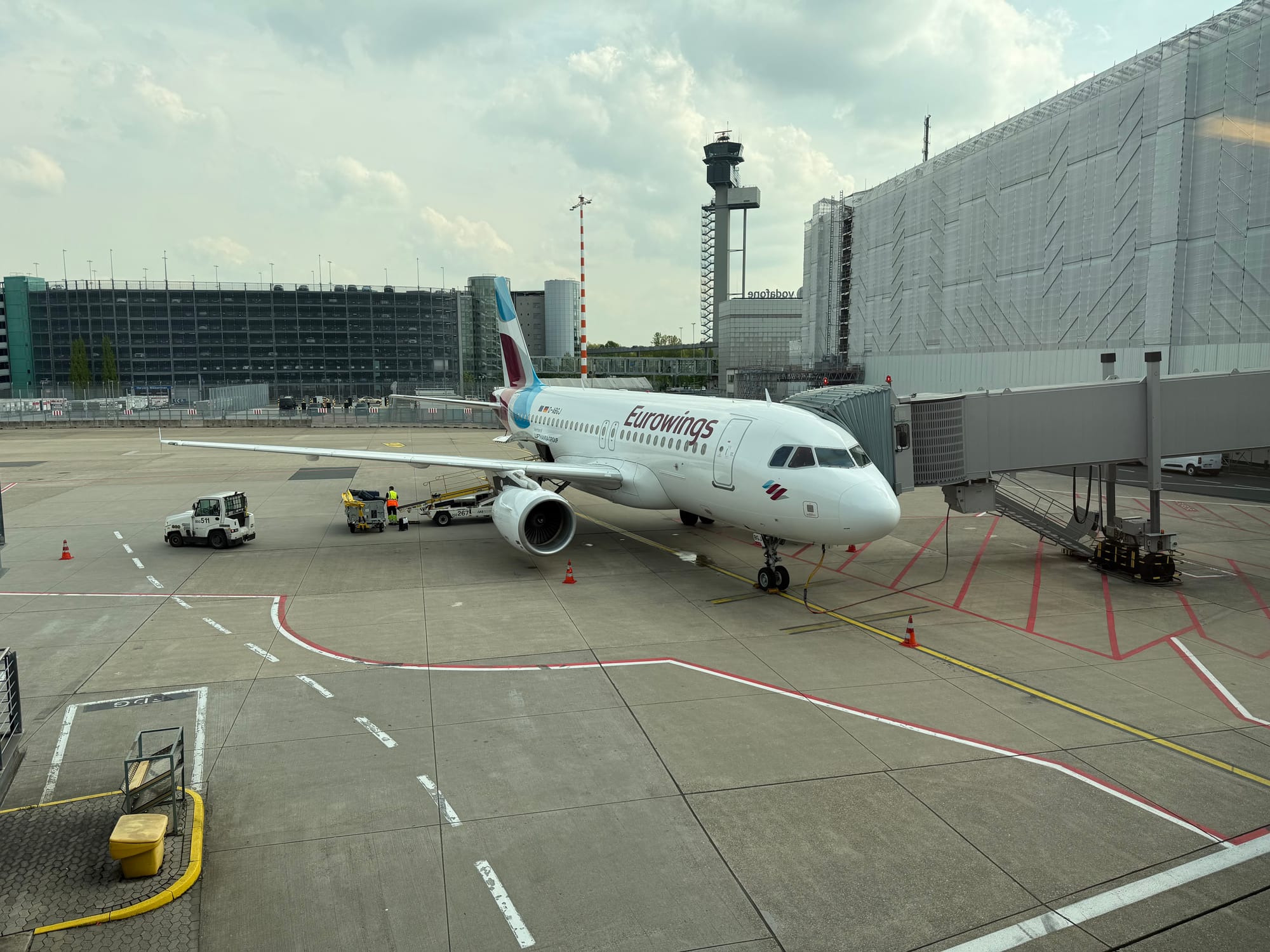
I jumped on it, for several reasons. First, it was a better timed flight, and cut my connection time significantly, getting me home an hour earlier than my Frankfurt connection. Second, Eurowings is a key focus in the Lufthansa Group’s strategy, both as a leisure carrier from all of Germany and as the group’s offering for point-to-point from airports that aren’t Frankfurt or Munich, and I wanted to try it out. And third, and perhaps most importantly: I got to avoid Frankfurt Airport, which is a major passenger experience win in my book.
It was an absolutely fascinating experience, and following Eurowings’ blink-and-you’ll-miss-it rebrand this week — essentially, it seems, an upgrade to the corporate font — it seemed like time to unpack the differences.
Eurowings’ airport experience(s) matched Lufthansa almost exactly, except with the bonus of Dusseldorf over Frankfurt
At Hamburg, the only difference from the Lufthansa experience was the bag drop zone is in the northern end of the terminal building rather than the southern end.
Pleasingly, online checkin, seat selection and servicing through the Lufthansa app worked really well, even though it was a Eurowings flight. Lufthansa deserves real praise for its app and indeed its rebooking system. It’s the best of all the European airline groups, and works consistently across the airlines: you don’t need to download the Austrian or Brussels apps if you happen to be on them instead.
The business class checkin and bag drop queue in Hamburg took a while (mainly because there was a UK flight departing at the same time with the concomitant passport issues) but no longer than I’ve had to wait at the Lufthansa queue at the other end of the terminal building.
Hamburg security was just as surly flying Eurowings as it is with Lufthansa — not under the direct control of the airlines — and the airport itself is still as mediocre, unloved and unimpressive.
Eurowings uses the Lufthansa Business lounges in both Hamburg and Dusseldorf, so the experience there was identical in Hamburg and even better in Dusseldorf than I was expecting in Frankfurt.
The lounge design is similar, but the scale of the Eurowings operation in Dusseldorf is so pleasingly compact that the lounge is right above the gates, rather than being a hefty hike around Frankfurt’s interminable corridors. The Dusseldorf lounge was also much cleaner, neater and tidier than the comparable lounges in Frankfurt ever are when I pass through them.
It certainly was convenient that there were Lufthansa lounges at both airports on this trip, though, and I did wonder just how the provision of these lounges from Lufthansa to Eurowings is accounted for, since the LCC uses these lounges rather than the airport-operated ones.
In theory, an airline pays another airline (or an airport) a negotiated fee for the use of its lounges, but I am curious exactly how this fee is calculated in the case of Eurowings, a Lufthansa Group subsidiary, and whether it is on a full or partial cost recovery basis.
In non-accounting terms: in an airline group where Lufthansa-the-airline is always pointed to as the unprofitable part, is Lufthansa quietly subsidising Eurowings here?
Indeed, one of my suspicions about the group’s intended creation of Lufthansa Group-branded lounges is that there is some strategic accounting gymnastics going on here.
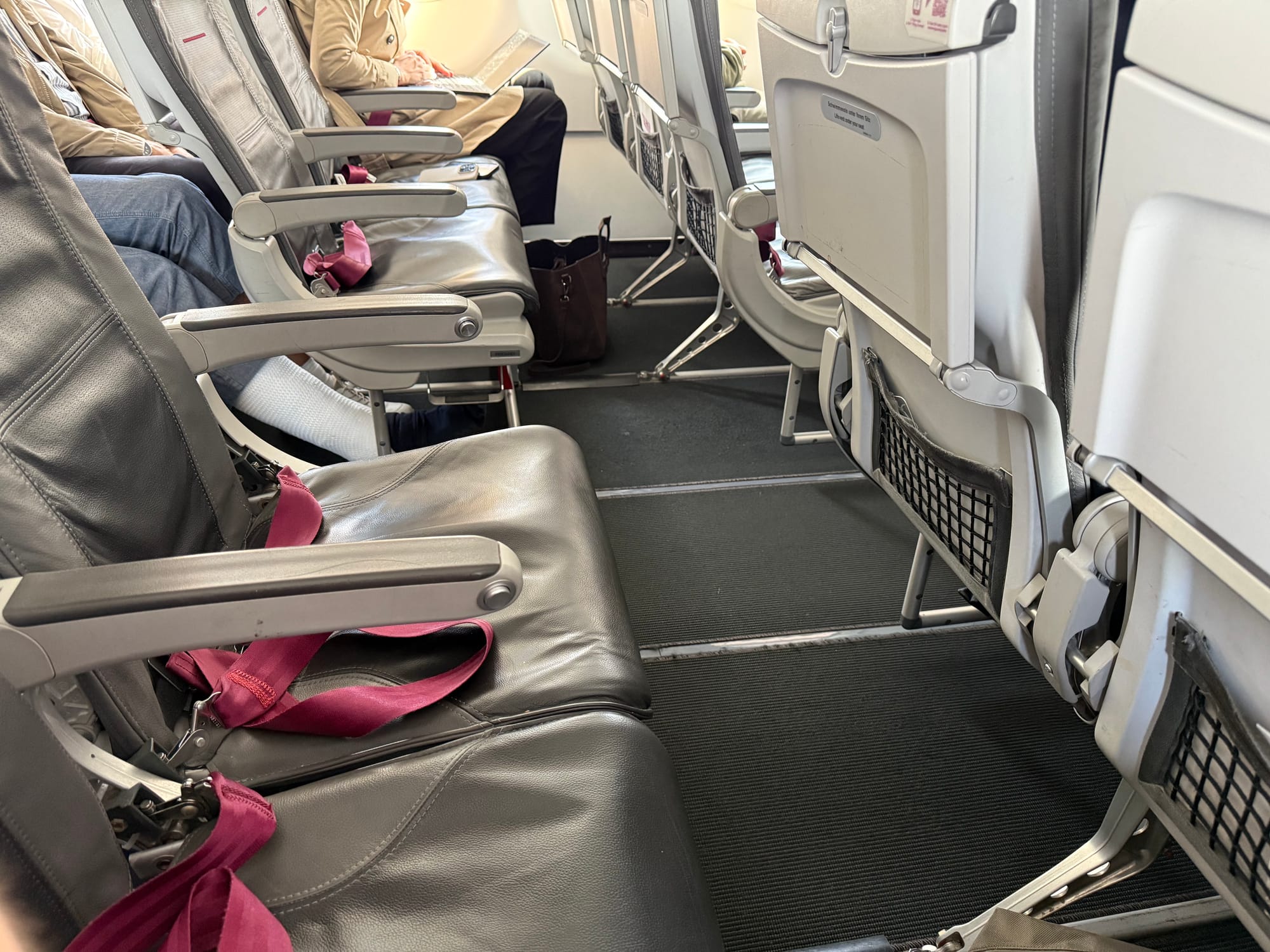
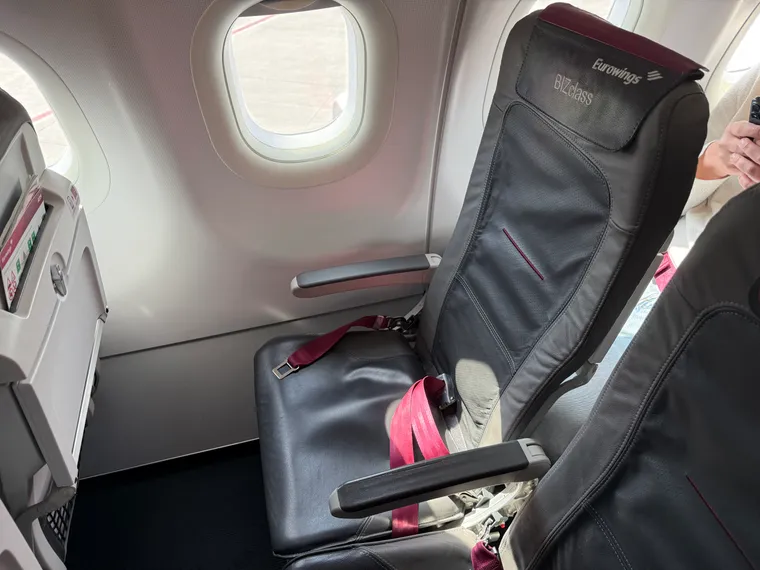
The seats on board: Eurowings basically feels like every other Lufthansa group airline, just a different colour
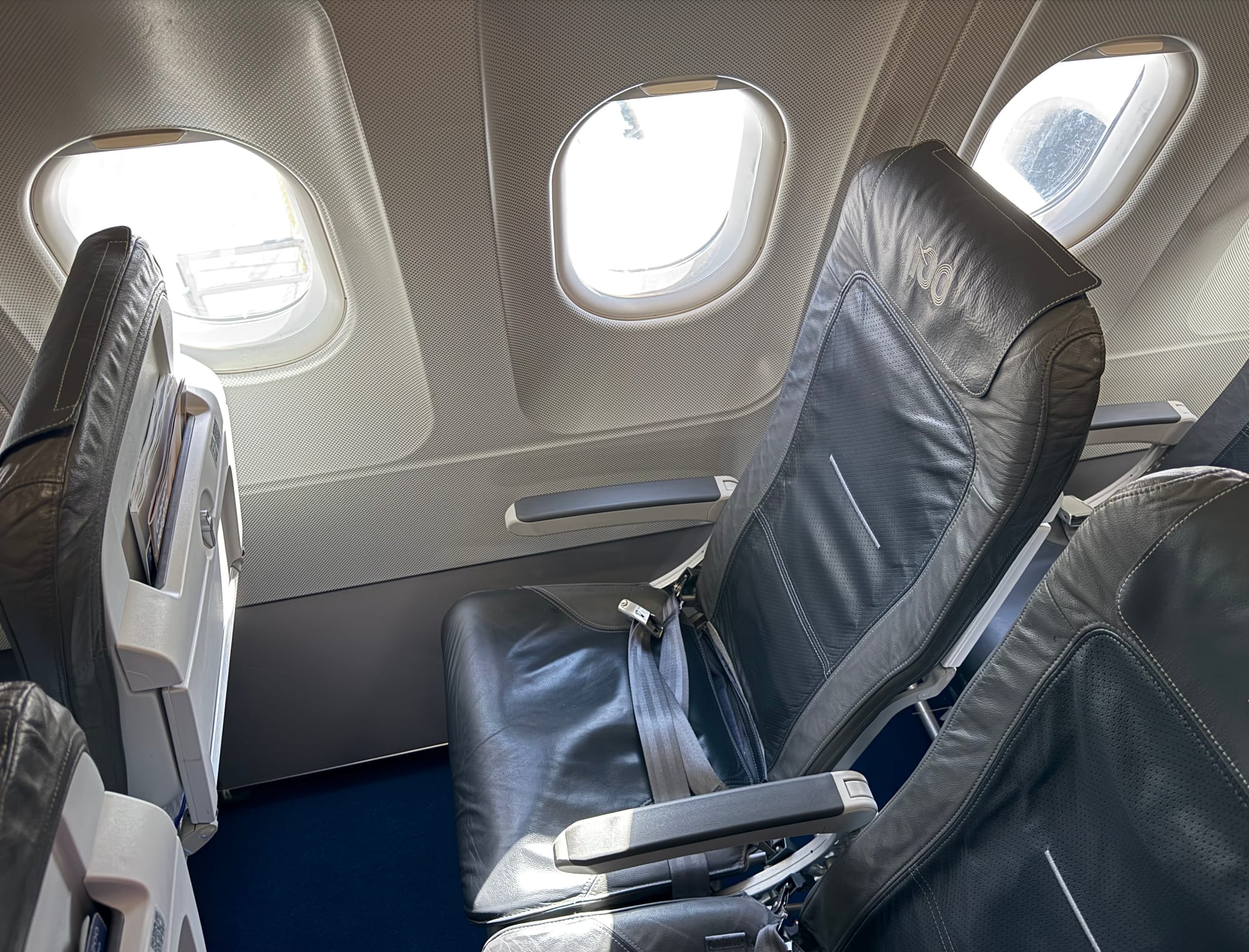
On both my flights, the seats on board were the good old Lufthansa NEK, Recaro’s BL3520, now more than a decade and a half old but still a seat that set a standard for a generation for good reason.
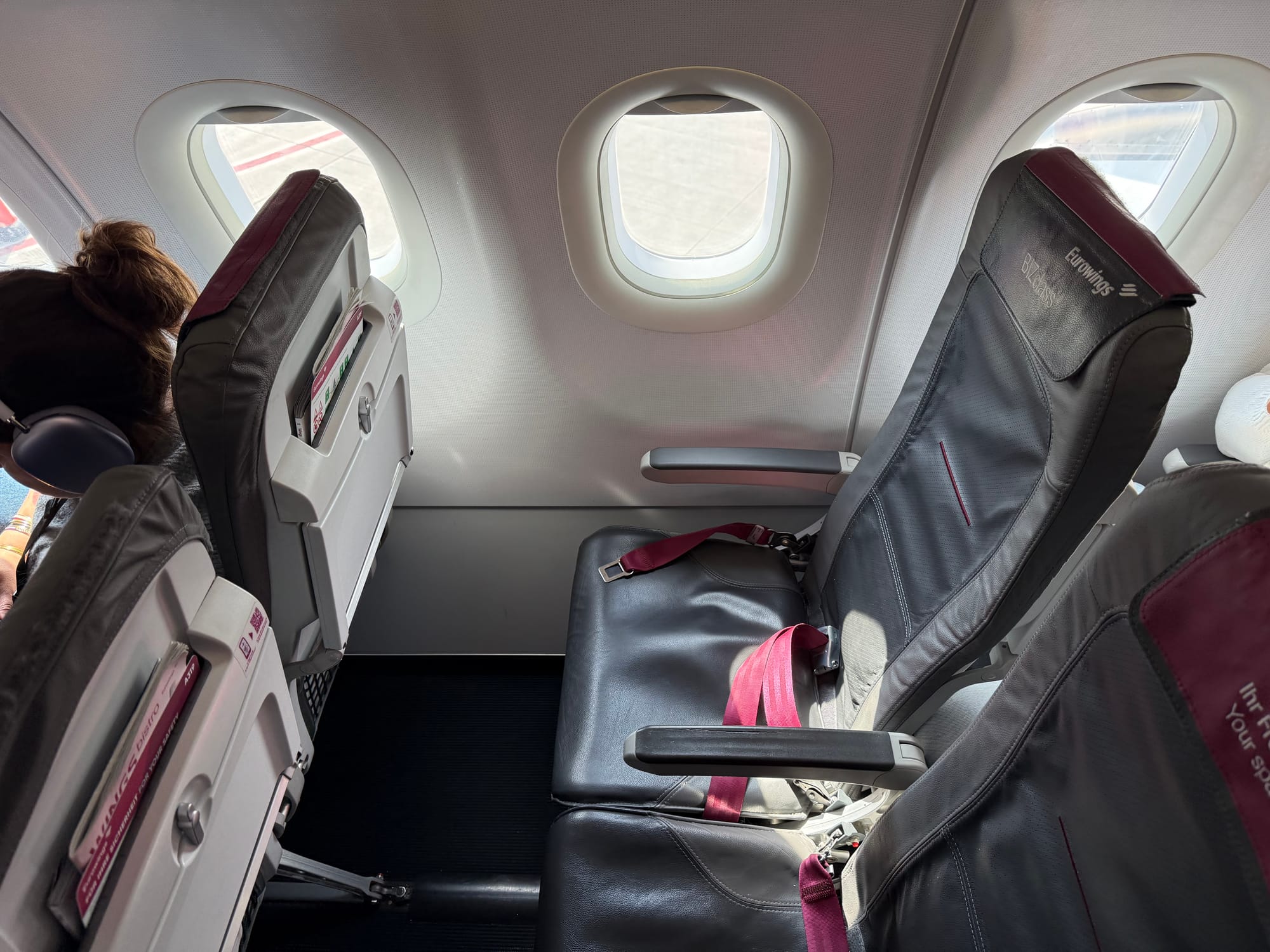
I’ve flown these on pretty much every carrier affiliated with Lufthansa at this point, and they’re still better than many others out there.
Seat pitch felt the same as Lufthansa or any of the other group airlines with the seat, and really the only difference inside the aging Eurowings A319s in their late teens compared with their Lufthansa Airbus narrowbody equivalents was the colour of the stitching on the seats, and the different monument at the front of the cabin.
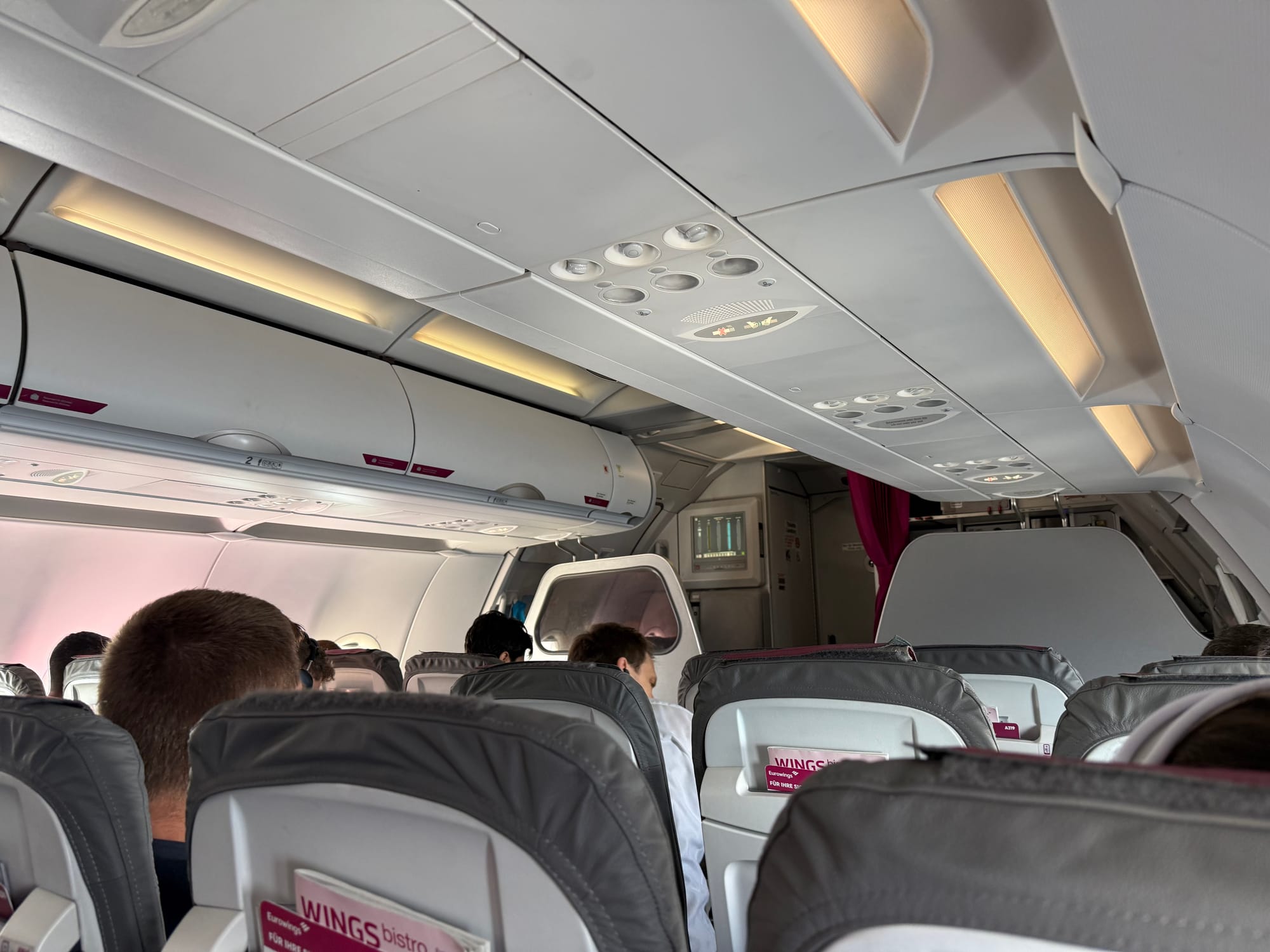
Other than that, there are neither bells nor whistles in either airline’s practically identical Eurobusiness cabins. One of the Eurowings flights had wifi — Inmarsat GX Ka-band satellite — which for such short legs I didn’t even bother with, instead watching some videos I’d downloaded to my phone.
Food and drink: free choice from the trolley is a Eurowings win
The biggest change to the passenger experience between Lufthansa and Eurowings in Eurobiz is the catering — and, I’d argue, on two very short hops like this one, Eurowings comes out ahead.
The Lufthansa offer is very standard and predictable: a tray, usually with a chilled starter-sized dish, a bread roll, and one of those strange airplane desserts that seem to be made mainly of an extruded sweet foam or some form of gloop.
It’s usually… fine. Better than what you get in North America in terms of quality, and you can make a decent enough meal out of it. The starter salad is usually mostly edible, but you have absolutely zero choice apart from the kind of bread roll you want from the basket.
With Eurowings, the offer is essentially free range of the inflight trolley: sandwiches, snacks, sweets, and drinks, generally of a higher quality on the bar cart than Lufthansa’s complimentary catering.
That’s understandable, of course: Eurowings needs most of its passengers to purchase its catering, so the quality is decent. Lufthansa’s is part of the business class ticket, so if the meal isn’t up to snuff (or indeed you happen to react badly to one of the ingredients) that’s just tough Kekse.
On longer Eurowings flights, you can choose their hot food — including Currywurst and fries — but on this pair of short flights (the first timetabled at 55m but in the air for just 39m, the second scheduled for 1h25m but airborne for 1h09m) I went for a sandwich, a packet of Haribo gummy bears, and a tomato juice.
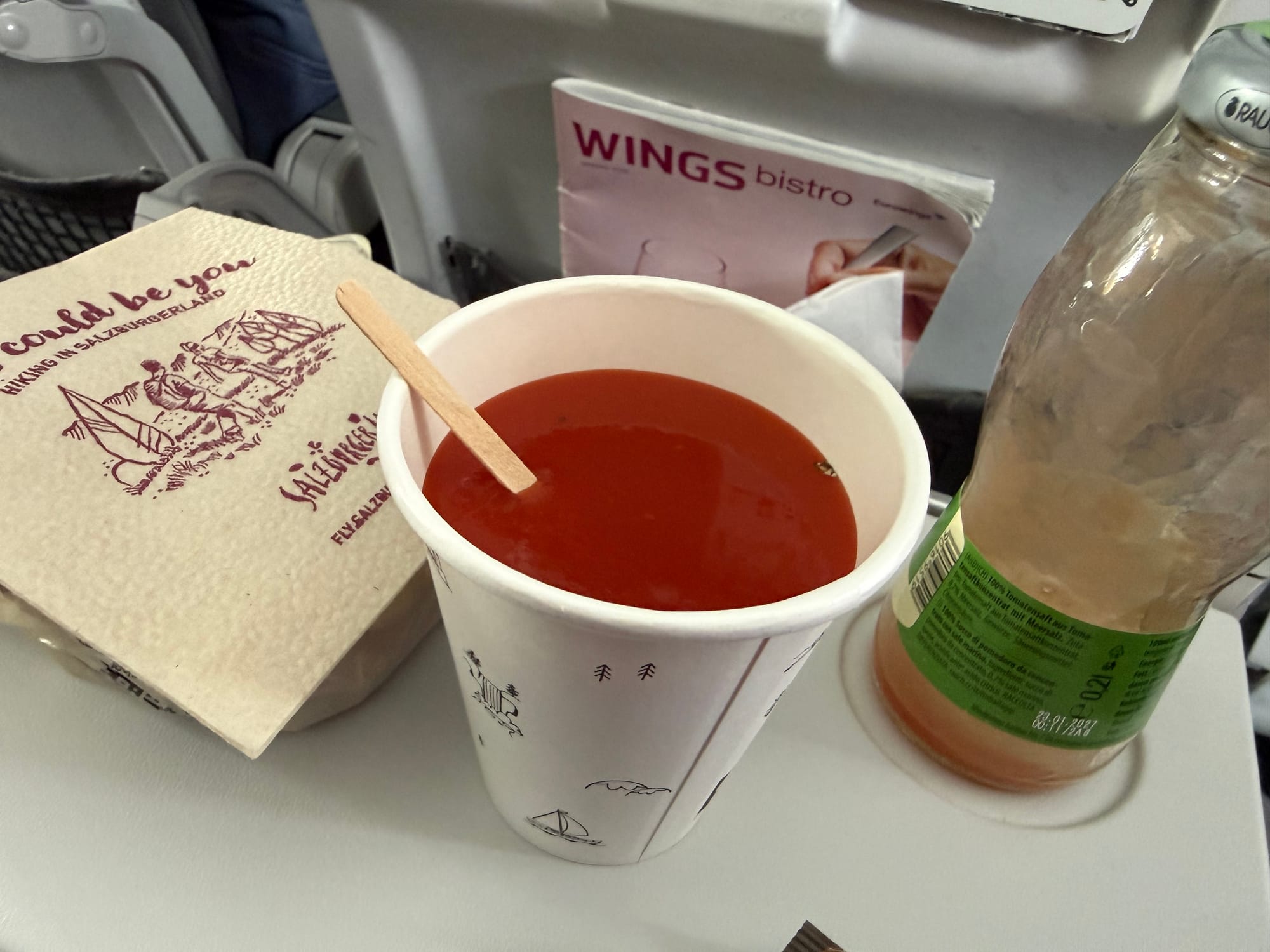
Even better, the trolley was rolling down the aisle at lightning speed after the 10,000 foot ding, and I was munching on tasty turkey salami on a chewy, cheesy roll much faster than I would have been on a comparative Lufthansa flight, with all the assembly of the trays, drinks runs, and so on within the cabin. Again, a big plus on a short flight.
The crew came by several times to offer something else from the trolley, and I genuinely appreciated being able to snag a Snickers, a cold Coke Zero and a bottle of water to slip into my bag for my drive home. The marginal cost of that to the airline is just a euro or two, but it meant I didn’t have to stop on the way home after a busy week — priceless to me as the traveller.
As I drove home from the airport, and as I’ve travelled around Europe since, it was striking how strong the experience on Eurowings was compared with other Eurobusiness options.
That said, so much of the Eurowings business experience depends on Lufthansa existing, having lounges, having an app, and so on — and I wonder how much of a leg up Eurowings is really being given there.