Listen now:
Read the episode transcript:
John Walton: Hello, and welcome to The Chain Live, a special limited-run podcast — from the Aircraft Interiors Expo, focusing on the supply chain in the interiors industry — from The Up Front, the home of in-depth, independent aviation journalism at the heart of the passenger experience.
We dive deep into the often creaking seats, cabins, and interior supply chain, sitting down every episode with industry experts from companies making up key parts of the chain.
Today, as you might be able to hear, we are at the Aircraft Interiors Expo here with…
Elizabeth Payne: Elizabeth Payne, AVIC Cabin Systems UK CTO.
John Walton: And also with...
Michael Robinette: I’m Michael Robinette: I'm the vice president of value added services for SIMONA and SIMONA Boltaron.
John Walton: So Elizabeth, what are you showing at this year's show?
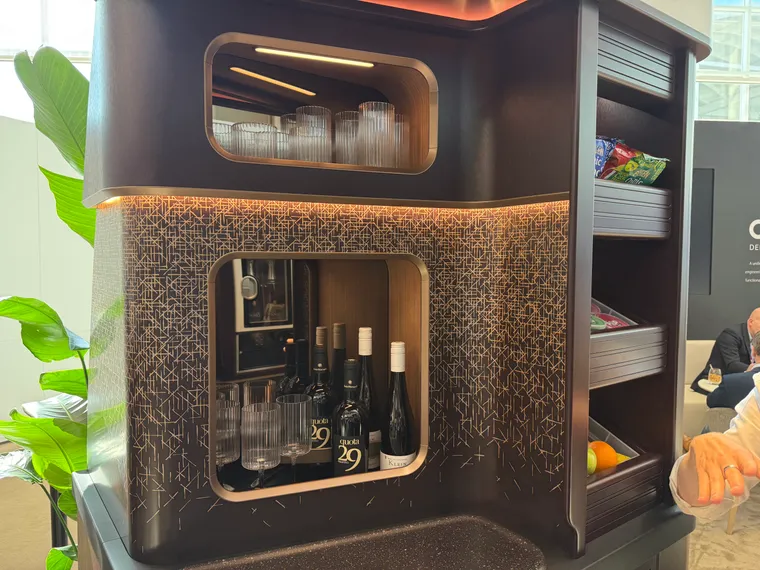
Elizabeth Payne: We are showing a integrated galley complex with an integrated FRM [front row monument], and it's also got a self-service area with some independent lighting. We've tried to cram as much in in one area, where we try and make it look simple, and we try and show that you can integrate different products within the aircraft.
John Walton: It looks great. We've just come from there, and I really like the different materials that you've got on there. You've got some natural wood, you’ve got higher durability materials in key places. The latches look elegant — I didn't see a quarter-turn amongst them! Bless the quarter turn, but we don't have them in our homes. People who are flying in business class or first class don't see those. That's not something that we ever experience as part of the idea of luxury or a premium experience. So it's really interesting to see all the parts of the supply chain that you're pulling in there.
So you're working one of... with one of the wood suppliers, weren't you, for that?
Elizabeth Payne: Yes, Novem, that we're working with on that. It was a story of making sure that we were certifiable with the product because, as we know, natural wood is something that we've steered away from in the past, but now we seem to have hit the jackpot with this particular company.
Michael Robinette: That's very cool.
Elizabeth Payne: So we're delighted to integrate it into our product to bring something fresh.
John Walton: It's really great to see some of those natural materials coming into the cabin. One of the things that you at Boltaron have been doing for a while is replicating those in ways, in places where that won't be possible. So what are you showing at the show?
Michael Robinette: We're showcasing our broad innovation of materials that are unique to the market, and separate ourselves from the other manufacturers. We have so many different diverse capabilities at Boltaron. Of course, we do extrusion, and we do two other processes at Boltaron, calendaring and press lamination.
Calendaring gives us the ability to produce materials that have enhancements such as metallics or pearlescents — true metallics and true pearlescents — because that's a process of mixing the plastic in a mill, shaving off a ribbon, and it goes through a roller system that flattens it out. So the press lamination's the final, manufacturing capability that brings the two different disciplines together, and we can layer those up to create monolithic, thermoformable or fabricated sheet.
And it really gives us a lot of capabilities in terms of — in the translucents especially, we can do a lot of graphics, so we can embed those graphics inside the materials because we’re producing those prints on one layer. We put that inside and we cap it with translucents on the outside. So it gives us the ability to do depth, multi-depth, using several different printing capabilities, because we can do the press lamination, we can do printing both in dye sublimation, we can do digital printing, and we can do screen printing.
And why screen printing's important is because with screen printing, we can actually introduce metallics into the ink, and we can get very vibrant colors this way. So we're here to show these premier materials that we offer.
Elizabeth Payne: And of course, that would give each airline a signature look.
Michael Robinette: We definitely are very focused on customisation. So those signature looks come with our ability to customise your vision.
Elizabeth Payne: One of the most difficult parts is all about taking a product and a material and getting it through certification, to actually go live on an aircraft. So having the layers adds an, a further complexity into all of that. Yeah. But I am absolutely sure that we're at a stage now where we know how to temper those to get the right FST value.
Michael Robinette: We do. We have a lot of experience doing this. But of course, everything's internally tested before we send it out for third-party testing. So we're pretty sure it, it will pass this way. As far as customization, getting back to your discussion of woods and organics, of course, we try very hard to match those situations. But they're never — I love the idea that you're using the real wood because that's really beautiful. We can also do wood grains but it's really hard to get that perfect match. So, you know, in situations where you couldn't use real wood, our wood grains are, are very, very realistic looking.
John Walton: One of the things I find really interesting is that some in the industry are very happy to take obviously artificial, but imitation surfaces — clearly imitation wood. It's far too shiny, for example, to be natural wood. Others are starting to sort of scale that back quite a bit and to sort of add in different natural materials, things like the linen effects that we're seeing on some products. Or also really leaning into, I guess, the material science part of it and looking at translucence within the cabin, and so seeing how the light plays on that.
And I know that you were, at ACS, Elizabeth, you do your own lighting systems within there, which I find really fascinating because there are lighting suppliers in the industry. What do you find beneficial about doing it yourselves rather than sort of working with others in that?
Elizabeth Payne: Well, as Michael just talked about testing, prior to releasing something, it means that we've got confidence that we can actually, uh, deliver to customers' expectations. So we have an ability to do some testing internally, tweak accordingly, and then present. We can do it in a bespoke way, so we integrate a design in such a way where the light will flow with the design, with the materials, and the surface of the materials.
Michael Robinette: Yeah. It's interesting how lighting does affect — even with the various — we do dozens of different textures, and we can all be in the same exact colour. If you look at the backside of our sample, they're exactly the same colour. You look at the front side of all the different textures, and the lighting really effects the colour. And there's no way to really know how that's going to effect until you've done the sampling.
Elizabeth Payne: Correct.
Michael Robinette: So you have to have a very fast and robust sampling process as well. Yes. Which I'm sure you guys have.
Elizabeth Payne: Absolutely. Yeah. And of course then you've got the durability and being able to clean the surfaces as well. So you start to think about the full life cycle, recyclability of the materials that we're using. So the lighting plays a prominent feature in what materials you will select because of the release of the materials that you have and the way it absorbs light, or reflects it.
Then, also thinking about the afterlife of this material or the in-service life of this material as well. So that is foremost in our minds whenever we choose something.
John Walton: It's always struck me how the industry is — airplanes fly up in the sky where the light is very different to anything that we see on the ground. It's much brighter, but it's also coming through these, tiny windows. Increasingly large windows, with a nod to our airframer friends, but, you know, they're much smaller than windows that we experience anywhere else except I guess if we're in a porthole of a ship, right? The French word for airplane window is hublot, or literally the same word as porthole.
I find it fascinating how theflow of the lighting into the cabin, um, combined with the way the airlines try and control that, so since the 787, for example, with the crew selectable dimming switches. Airbus was just saying that an increasing number of airlines are choosing to have the electronically dimmable windows in all or part of the aircraft, so whether that's just up front, so to speak, or further back as well. Jamco are doing some very interesting things around controlling those, so, looking at the premium experience. One single button to control what might be an increasing number of windows.
So if you think about the new Air France first class cabin, which if memory serves is Stelia and Design Investment’s design, they have five windows to control. And you just want one button doing that. You don't either want yourself to have to be — in fairness, this is a lovely problem to have. "Oh, I have too many windows in my first class seat to close myself. And my diamond tiara is too tight and my crystal shoes are pinching." But genuinely, this is one of those things that, that people are paying, uh, large amounts of money, and they want to be able to say, "Oh, actually, no, this, this is something that works well for me.” You don't want the crew to have to be manually adjusting five separate windows and all that kind of thing.
But I find it really interesting when we're talking about lighting and surface and everything, we come back to certification, which is such a massive topic at this show this year: from the seatmakers, but even beyond the seatmakers.
I think we can't really talk about a supply chain podcast without talking about certification and some of the issues that we're all facing.
What are some of those challenges right now in both of your worlds around the certification?
Michael Robinette: Obviously, the materials, we’ve found some challenges with certification in terms of the restriction of the labs that we are able to use.
Elizabeth Payne: That's exactly — agree with you, totally, on that.
Michael Robinette: What's interesting about these materials is, is different labs have such massively different results. So that's a challenge in itself. So a lot of the labs that we’ve — certain airlines have now handpicked their labs, and getting used to working with those labs has, has become just a learning curve, I guess. Not so much a challenge, but a learning curve, yeah.
Being able to do the testing in-house even though it's not — does help a lot to, to.
Elizabeth Payne: At ACS UK, we've chosen to go down more of a vertically integration with our testing, so that we can do the development testing and the certification testing within the time frames that we've got.
So, but to get the approvals from the different NADCAP, UKAS, plus all the OEM approvals, it does take time to convert that into a very usable predictable flow of work through the factory and the new product introduction as certification being important for the DDP.
John Walton: Absolutely. Obviously seat makers are seeing a lot of issues at the moment. Regulators are getting very tight on an increasing number of criteria, some of which people thought had been whatever the equivalent of settled case law is in the certification world.
Looking from more of a material supplier and as more of a monument supplier, I presume you're working much more in the 9g world than the 16g world.
Elizabeth Payne: Yes.
John Walton: How can you help perhaps seat makers in this? What, what role can you play in sort of easing this in some way?
Michael Robinette: Part of my, my responsibilities are the value added services, right? So I look at services beyond just our material offerings. So a part of that is our technical support and we really try to get with the customer in advance to talk about design for manufacturing. We support the customer early. We like to get there in the grassroots, so it's all about minimising risk.
That's where my department, my role has the greatest impact on that. So minimising risk, which can decrease cost. It can decrease lead time, an most impactfully, it can decrease the program delays that come downstream.
Because you’ve worked out the details, you’ve worked them out in advance. You've done it in a very proactive way. We like to get with the OEM and the airline and the design houses and really look at all those —when they selected our material, we wanna make sure that all the unique things we can put into our material, which are very, very broad, that will follow through into the finished products, and we get that perfect design intention into the finished products.
Elizabeth Payne: That's really important, because it does help de-risk the whole development process and customisation process that we see with our customers, especially in the BFE world or even in the SFE world when you're starting to choose all of your materials for hundreds of products in the SFE world it becomes a higher risk.
When you get all of that underpinning development certification data or technical data provided, it then makes you feel very comfortable: then you can start to go from a flat surface to a curved surface, a double curvature, and then you can start to really look at fatigue.
You can start to really push the boundaries of the design. A lot of our design is double curvature or single curvature —
Michael Robinette: — or mating components that may have different draw ratios —
Elizabeth Payne: — exactly! —
Michael Robinette: — that, when the designers are envisioning this, they're not imagining those draw ratios and how they're gonna affect the finished look.
Elizabeth Payne: Absolutely. Absolutely correct. And allowing you to get some really tight patterns as well. So, horses for courses on the materials you use. But to be able to deep draw something successfully is quite important. So to be able to have technical data to de-risk all of that, even composite panels, for example, doing a phenolic prepreg, it's just having that technical data to give you some sense of: this is gonna work, this is not gonna work. Can we dual source it? Can we go around the world? Where are we manufacturing? Can this go and touch base very quickly if there is an issue?
For example, the Straits of Hormuz at the moment, the geopolitical issues that we're seeing. Is there a secondary source that goes directly to the independent factories that we have or our current factories? All of that goes through your brain when you're selecting all of these materials.
Michael Robinette: And from my side, because I'm obviously very oriented on the manufacturing side, the, some of those design for manufacturing, like you were discussing, the deep draw ratio, a lot of the fabricators may not be used to deep draw or understanding how to form FST materials that don't have the same characteristics as commodity materials.
So I do a lot of just looking deep into how they're designing the molds and their processing parameters because mold design is probably the number one place that I see most failures happen.
Elizabeth Payne: Agreed.
Michael Robinette: With a thermoform mold, you have to think outside where the finished part is going to be, outside the trim line I call it, with the scrap areas of the tool, because those are very key critical areas in a tool to design: because you have to still create geometry out here to create proper material distribution.
Elizabeth Payne: And the springback accordingly, if it's asymmetric. So all of that consideration and having a supply base that is fully knowledgeable in these fields, really make it a much shorter journey to get it to market.
And a lot of our materials are becoming stale. A lot of our functionality is actually looking old. It's '70s, '80s technology in some cases. The more we can get the supply chain to provide this baseline information to us —
Michael Robinette: — Agreed —
Elizabeth Payne: — the more you'll see on flying products. So just be brave and actually do some groundwork
Michael Robinette: To your point, I've always found it fascinating that there's not more kickoff meetings that include all the invested parties in it, because everybody kind of stays in their lane. You ask Boltaron for pricing and lead time, and of course, we're going to give you that.
Or, or you're selecting — a design house selects some material, of course, we're going to sell you that. But what's really important is to know that we're selling the right material for the right application, right? And what we don't get included in, like Elizabeth was saying, is we're not included in those baseline parameter or data and characteristics that are, that are required.
So I've always found it interesting that there's not a kickoff party, or a kickoff meeting I should say, that includes all the people, all of the companies that are involved in that product from the sheet supplier to the fabricator to the OEM to the airline, and everybody get on the same page right away, and we can identify those risks and eliminate those risks.
Elizabeth Payne: Exactly.
John Walton: Is that supposed to be ITCM? Certainly, we've talked about that quite a bit on the podcast so far, in terms of, you know, should we be involved pre-ITCM? Should there be a pre-ITCM meeting? Is that what ITCM is supposed to do? Or is it supposed to — do we need something beyond that? Do we need to change the structure of these meetings?
Elizabeth Payne: What, what I see with ITCM is, it's the top-level contractual parties coming together. You will have the programme management, the technical supply chain in some cases. But it's not probably not fully supported by an IPT.
And then if you've got a significant risk on a supply chain item, then why not bring them in, to really talk with excellence and specialty knowledge rather than someone second-guessing.
Michael Robinette: A very good way to put it.
John Walton: For people organising the ITCM, right, so whoever's leading that part of the program, what should they do differently to what they do now in order to, I guess, bring more of the family together before the big meal, as it were?
Elizabeth Payne: Well, I'm thinking the first thing that springs to mind is really engaging in a culture that actually says, "It's okay to bring your significant suppliers in." Anything with a long lead item is a significant supplier.
Michael Robinette: Yeah.
Elizabeth Payne: It can make or break your product. So if you have this very collaborative engagement and a culture of family at the ITCM saying, "We're about to embark on a journey. Our core role, our aim, our goal is to get this into a flying aircraft and in service," regardless of who you are and what company you're with, and what the contractual basis is, it is really about saying, "We've got a common goal."
Michael Robinette: Yeah.
Elizabeth Payne: And if you start to bring in the key people in that common goal, the momentum, you don't have to wait — a phone call, you start to have a single step heartbeat and a pulse going through the development cycle.
Michael Robinette: And you may identify improvements in lead time once those key elements are aware of the requirements, and know all those idiosyncrasies of the program.
Elizabeth Payne: Exactly.
Michael Robinette: — or have something else to offer that could improve —
Elizabeth Payne: Break out parties. We don't pass ITCM until we've got the high-risk supply elements absolutely buttoned down. Otherwise, the ITCM doesn't move forward. Because you always end up just making do with what you know.
John Walton: Are there any programs or projects you've been involved with that you thought, "You know what? That worked extremely well." This is a time to sort of praise some people you might have worked with before, or some colleagues who do this particularly well who you might like to talk about — and say, either this airline program with this aircraft worked really well. Does something like that spring to mind doing this?
Michael Robinette: The design houses, I've worked with all of them — and they're all brilliant — I think some embrace this idea more than others. Years ago we did the privacy panel for the United Polaris program, and it was very challenging.
The decorative trim pieces on top: it was a very challenging program. There were so many elements that had to be kind of ironed out because it was a thermoform part, but it had a print inside of, of it. It was a translucent print, and that print couldn't distort. So how do you thermoform something without distortion?
But everybody — they got me involved. They got our team involved. The airline was involved, the design house was involved and we actually ended up fabricating the part, so that eliminated that loose risk variable, I think, because, because the translucent materials are particularly difficult, especially if you have prints that can't be distorted.
So we came up with a process of how to form those parts, and that all went really smoothly because it had to be ironed out. Everybody had to be involved. I had to, to introduce the technique or the finished product from the technique, but also discuss the aesthetic. We had to loosen up the aesthetic requirements just a little bit, and everybody was very good about that.
Sometimes you can't be so strict and to not understand your fabrication limitations.
Elizabeth Payne: You start with perfection and then realisation comes in, and a realism ends up which is pretty much perfect. But it's still a delivered product.
John Walton: Elizabeth, any, any particular programs that strike you as, as you think back?
Elizabeth Payne: I've been with ACS UK for five years. And I'm in the CTO role. If I listen to my head of design there's a couple of programs that we're currently working with BA, and that has started very well, from what I understand, the feedback I'm getting. But that’s about collaboration, joint definition, really coming together and talking and sitting across the table, doing all the field trips, you know, that type of thing.
And the other side of the world is New Zealand. So Air New Zealand and our New Zealand engineering, the two of them coming together, it's like old family coming for a reunion. And so you get the sense that it's all about camaraderie, cheerleading, wanting success.
But it's all to do with collaboration, being open. Don't hide, just get it there, roll your sleeves up together, and make it happen.
John Walton: That's sound advice.
Thank you both for joining us on this special episode of The Chain. If folks want to continue the conversation with you, Elizabeth, where can they find you? Where can they get in touch?
Elizabeth Payne: ACS UK. I'm on LinkedIn as well, under Elizabeth Payne, ACS UK. So that's probably the easiest way to get in touch with me.
John Walton: And Michael?
Michael Robinette: I'm also on LinkedIn, um, Michael Robinette. I guess my contact information would be michael.robinette@simona-group.com.
Elizabeth Payne: And, uh, my email contact is elizabeth.payne@aviccabinsystems.com — quite a long one!
John Walton: Longer than mine, which is john@theupfrontgroup.com, and you can find us on theupfront.media, along with every other episode of The Chain, our other podcast, 40,000 Feet, and everything that we're writing from this year's Aircraft Interiors Expo. Thanks very much indeed for joining us.
Michael Robinette: Thank you very much, John.
Elizabeth Payne: Thank you for having us.
John Walton: Pleasure. We'll see you on the next episode.
Business intelligence across the aircraft interiors supply chain - powered by SIMONA Boltaron. Learn more about SIMONA Boltaron at boltaron.com.