
Listen now:
Read the episode transcript:
John Walton: Hello and welcome to The Chain, a special limited run podcast focusing on the supply chain around the 2026 Aircraft Interiors Expo — from The Up Front, the home of in-depth independent aviation journalism at the heart of the passenger experience.
The Chain delves deep into the often creaking seats, cabins, and interior supply chain, sitting down every episode with industry experts from a company that makes up a key part of the chain.
I'm The Up Front editor in chief John Walton, and today we have a special three-guest episode with Mirus Aircraft Seating.
Mirus, hello, would you please introduce yourselves?
Ben McGuire: Hello, and good afternoon. So starting out of the three of us, I'm Ben McGuire, CEO of Mirus.
Marcus Williams: Hi, I'm Marcus Williams and I am the sales and marketing director here at Mirus.
Adam Challenor: And hello, I'm Adam Challenor and I'm the technical director here at Mirus.
John Walton: Thank you very much indeed for joining us. Now we are normally just a one-on-one podcast, but with your enormous win with easyJet just before AIX — for which congratulations — we thought we'd dive in a little bit a little bit deeper still. So for those who haven't yet encountered you at Mirus, what do you do, where are you in supply chain, and who selects your product for inclusion within the cabin?
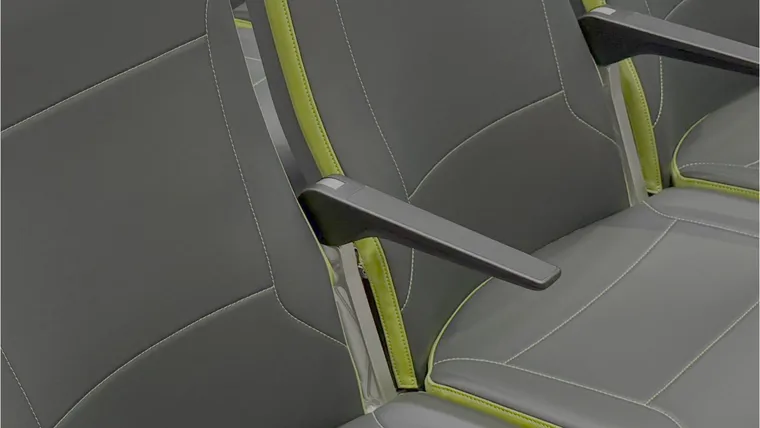
Marcus Williams: This is Marcus. Mirus Aircraft Seating: we design and manufacture economy aircraft seats. We are several places in the supply chain ultimately: when an aircraft is either looking to perform a cabin modification or refit, or if they're selected new seats for new aircraft, we are relatively high up in that initial decision making process.
In terms of who we talk to at the airline, it's very cross-functional actually. So we can work with with the fleet management team, passenger experience team, engineering, procurement, right the way through to the finance team at the end. Often it's not unusual for the CEO to get involved as well: the seat is one of the very few parts of the aircraft where the airline can communicate with its customers directly. The CEO can play a pretty active role on many occasions too.
John Walton: When you are having those discussions, how do they change between the fleet planning, say, procurement, and CEO? You can imagine what sort of questions each of those parts of the business might have. But is there anything that surprises you? Is there anything that stands out in terms of the asks?
Marcus Williams: I think what stands out in my mind is actually how active the exec team of an airline, right up to the CEO himself does, does get intimately involved. Whether it's it's participating in the seat demos that we do, where we take seats out to airlines for them to look at through an RFP process…all the way up to putting requests in that they want to see this on it or they want to say that. It’s probably around that activity of the very senior person at the top of the airline and how involved they are, versus many other parts of the aircraft. I've worked in previously.
John Walton: And who are your suppliers in terms of the pieces that come into the seat? How much of it do you do So you create yourself from raw materials or is it all parts coming in? What's the ratio there?
Ben McGuire: This is Ben McGuire. So from our supply chain, we only manufacture the carbon seatback frame or shell, as we call it. Everything else is bought from various suppliers across the globe. So we range from east to west as it were: China, all the way through to suppliers in the States — albeit with the turmoils in the world at the moment, we are very much focusing on bringing our supply chain, our suppliers closer to home. So metals come from China, UK, Spain.
Covers: we have suppliers in the UK and Europe, towards Eastern Europe. We find the covers don't travel well, it's a high cost part. So whilst you get benefits from lower, cheaper labor costs if you go further afield, they don't travel well, and that is such an important part of the seat we try and keep that close as we can.
The States, we have suppliers, some of specialist plastics, some from the States, albeit we injection mold [in the] UK, Europe, and we have done China, albeit we’re trying to come out there. So yeah, it's international. We consolidate and we assemble, we put the Form 1s [EASA Authorised Release Certificate] on and we ship from here, predominantly.
John Walton: And you do your manufacturing in Norfolk, in the east of England
Ben McGuire: So yeah, everything here — our HQ is here, as you know. So here we design and we certify, we market, we sell, we are a one-stop shop. We have an office in China, which helps us manage some of those suppliers and, for those unique customers, which we're looking for, we have an office in Malaysia. Supporting us with sales and again, any suppliers that are there. And we have an office in the States, albeit that's pretty quiet at the moment. So we are globally faced, but headquarters are here in the UK, east of England.
John Walton: And so in your part of the supply chain, what is the state of play right now? As we record, we're on Wednesday, the 8th of April, where we are in terms of the Middle East crisis at the moment. But what is the current state of play?
Ben McGuire: We're all waiting for inflation to hit. We are feeling it on our logistics costs already. We see logistics up about 27% where they were prior to two months ago. So it's hurting. We are seeing surcharges being imposed on us. We try to manage it, but you can't with fuel prices: they are what they are and so they wash through. Part cost wise at the moment is okay, but I think that's only a matter of time. Clearly we had some good news yesterday or last night. We've had hopefully peace coming forward now. But who knows? I think it's all about the Middle East at the moment. It's all about stabilising inflation, bringing some calm to the world. And then, everyone can plan and get on with what they do.
John Walton: Beyond those sort of macroeconomic externalities, what does, what did the supply chain look like two months ago, as it were in, in terms of the aviation things that we've all been discussing around that: in terms of your own supply chain, in terms of the way that you supply airlines — trying to look away from the right now into a more strategic medium term view.
Ben McGuire: So if we look at the downward supply chain, so post-Middle East, shall we say, coming out of COVID, it's a long time ago, but the ripple effect is still there. Coming out of Russia, Ukraine, we still had longer supply chains, longer lead times, than perhaps we had pre COVID. So that was, I wouldn't say hurting us, because the costs were getting back towards normality, but time was more.
We saw lead times from suppliers greatly increased for them to manufacture the components. So that's their lead times to get the raw material in, as such, and then the time it takes to get from the supplier to us, again. So I think prior to Middle East, our biggest issue was lead times, managing those lead times so we could commit to our customers as we did, without having to carry huge stocks. Which clearly is a cash burden.
So that was the fine line we were balancing, I think we saw that getting better. But yeah, it certainly wasn't back to pre-2020 when everyone was a bit more agile, a bit more nimble. It felt there was more material floating around so people could react faster. So even now in 2026: still the fallout from that pandemic.
John Walton: Yeah. Certainly a common thread throughout our series of The Chain has been the fact that the lean production line, as it were, put on a bit of weight, needed to, or a bit of muscle mass to be sure, in terms of not quite running as just-in-time as it used to. What does that mean in, in sort in brass tacks for you as a seat maker?
Certainly with your very large 230 shipset A320neo family order coming up, how are you going to change what you do in this current context around the supply chain?
Ben McGuire: I think for that one actually that's an advantage because when you are getting production, and you have a nice regular cadence of that kind of volume, you can really sequence parts in from our suppliers. We can plan for it far better, we can get the most cost effective means to get the parts in into us. So actually the easyJet order and orders of that magnitude help.
Prior to that where you are supporting ones and twos and bits and pieces, that's really hard to plan for. And I think if I handed over to Marcus, and he would say: we are having to push through those increased lead times to the airlines, whereas previously we might be able to be really nimble and give one or two month turnarounds.
You just can't even touch that now, so the turnarounds through to our customers, the lead times are longer, and if that's a lessor, who wants to spin something around, it just can't be so nimble unless you want to carry a load of stock. You can bet your bottom dollar, whichever one you're carrying is the wrong one, so it gets tricky.
John Walton: Absolutely. When you are looking at that, does that translate into, for airlines anyway, into a desire for more consistency in part number? Does it for the, what you call the ones and twos? So the smaller ship set orders is it offering fewer options in things like arm caps, the pieces that you would ordinarily be happier to change in terms of look, feel, some slight structural or shape change.
Does this essentially mean that we're going to see more consistency in seats, less customsation, do you think?
Marcus Williams: This is Marcus. I think the market for airline economy seats is probably still a little bit fragmented, in terms of the buckets of airlines that you would have. So if you are an easyJet, for example, and you're ordering vast quantities of planes, then they'll have an expectation of a certain level of customisation, and, as a supplier, that's our job to, to accommodate that.
When you are looking at some of the smaller projects then yeah, I think there is a desire generally —and that's again, to make things, cost competitive, but also time competitive as well. But I don't think that's fundamentally changed. What we see is still airlines really wanting a pace of project. Just because lead times for suppliers are increasing, the airlines ultimately still want quick turnarounds. They want the benefits of, be it the weight saving or the refreshed cabin, they still want those as quick as possible.
Again, that's our job to to balance the expectations with carrying some stock as well as we can, or maybe, partially built up stock, and good forecasting and being close to airlines to understand what it is their future demands might entail.
John Walton: Is the current crisis or the sort of longer term industry supply chain crunch, encouraging airlines to have conversations with you that, that include things like, we're happy to take slightly less customisation to improve the supply chain, or do they just expect you to manage that no matter what size of order that they're putting in?
Marcus Williams: Yes I think it's the latter. Airlines have still got a, a reasonable expectation. They're spending a lot of money. They're refreshing their cabin. So they do what they want. That said, I think overall the level of customisation of an economy seat is substantially less than what it would be for a premium economy, for example, certainly a business seat.
So I still think there's that blend. The range wasn't perhaps beyond some of the trim and finish. It probably wasn't that great to start with, in a real sense. Again we are able so far to manage that quite well, particularly when we've got a long range program where we can plan to it.
John Walton: Moving slightly above you in the supply chain. So you deliver, I presume, directly to the airframers for linefit and to an MRO location for retrofit. Is that right?
Marcus Williams: That's right.
John Walton: What are the challenges that you are seeing at the moment in terms of that — both in terms of getting the products to where it needs to go, and also in terms of any organisational structural issues that you are seeing in that part of the supply chain around programme management, around the logistics and so on.
Marcus Williams: I think probably the main one, and this probably isn't dramatically different due to the Middle East situation, is it's still around airlines being able to find MRO slots at suitable times, for their own operations. I think that probably is remaining the biggest logistical challenge.
And it can mean, if seats need to go out this week, and ordinarily maybe they take eight weeks to ship somewhere, maybe they take a little bit longer. And then airlines have to plan those MRO inputs around it. Dramatically, not changed in terms of what it is, but the detail, yeah, certainly it adds a little bit into it.
John Walton: And how far in advance do you know where you're going to be shipping your seat for an MRO location, for example.
Marcus Williams: Generally we know about when we've received the order: we will have a pretty good idea these MRO slots are baked in, with the airline further ahead, in most cases. So we generally know where they have to go to.
John Walton: Okay. So you can build that into your timescales from the very beginning
Marcus Williams: We do.
John Walton: Interesting. And then below you in the supply chain, Ben was outlining a lot of the the global nature of the supply chain. Where are the current challenges around that and how are you dealing with them?
Ben McGuire: This is Ben again. I think the current challenges are all around the Middle East. Other than that, if you take, significant orders, like easyJet, that's the one that's out there. And it's that order of that type of magnitude allows us to revisit our supply chain. There is an element of certification required in that seat.
So it allows us to maybe change some of the suppliers. There's a kind of broad strategy. I think we're trying to bring our supplies closer to home where we can commercially. Whereas previously, you would've had the advantage to have a longer supply chain, China or wherever. Logistics were manageable. The logistics were cheaper. The cost to get the components in was competitive. So you'd get the advantage of a low cost country with a low cost supply chain.
Nowadays you still have the low cost country, albeit quite frankly they're not as low cost as they once were. But the logistics is is becoming really expensive now and we’ve seen significant increases post COVID, which have just stuck.
So I think, when you look at the total cost, our strategy is where we can now is to revisit and just bring stuff closer. A, it gives us reduced costs when you look at the total cost, but it also starts to bring back some nimbleness to our supply chain so we can react to these customer orders that want the faster turnarounds.
From our perspective, and I don't think we're alone, I think where there was a trend to extend your supply chain go further afield for that ultimate bond price. I think the trend now is bring it closer to home, wherever you can.
John Walton: That's definitely something that, that we're hearing a lot. For you, with easyJet being a UK seat maker for an airline that has UK and European AOCs, purchasing EASA-certified aircraft, how does that all fit in terms of your supply chain, in terms of working with the regulators? For example, EASA-certified suppliers, is there an opportunity for that to make your supply chain easier or is that less of a factor?
Ben McGuire: I think as long as — there’s not many parts that we ask to come with, Form 1s, because a we take parts and approved suppliers and certify them into our seats. And then for easyJet in particular, which you're referencing there, it's a line fit operation.
So Airbus via its own STC will then certify that seat into the aircraft. So having EASA approved suppliers is not a thing really.
John Walton: So no sort of CAA-EASA certification woes at the moment? I know that there were some of those when the CAA first started taking back some of the responsibilities from EASA for the UK, but is that, what's that situation looking like at the moment?
Adam Challenor: This is Adam. So yes, certainly at a seat level there's lots of challenges from a certification perspective. Post Brexit, we have to now work with the CAA as our regulator. When we're testing and certifying a seat, we work with them and they will certify the seat, and then we have to go and validate the seat, or the CAA on our behalf then go and validate the seat through EASA. Because actually most of the airlines that we work with want an ETSO, not necessarily a UK tier, including easyJet. For this particular program, we can work directly with Airbus, and Airbus will help certify the product onto the aircraft.
So that makes it a bit more straightforward. But yeah we've still got the CAA-EASA challenges that have been going on now for a few years, since Brexit.
John Walton: Any bright lights at the end of the tunnel, or is that an oncoming train?
Adam Challenor: Ha. No we're still pushing our end There's a number of things that we're looking at to try and improve the situation, but really it's about building that relationship with the CAA and encouraging the CAA to do so with EASA as well. I'm sure in time, once they've built up their experience, things will start to improve. But at the moment, yeah we're struggling, like all of UK suppliers of seating.
John Walton: No plans to set yourself up a little European subsidiary somewhere that's easy to get to?
Adam Challenor: It's certainly something that we've discussed along the way over the last few years. It comes with its own challenges, though, unfortunately.
John Walton: It's been interesting to, to observe that as it goes along. Folks have criticism of EASA for sure. Folks have criticism of the CAA, and it does seem that it hasn't yet achieved a happy equilibrium in that process, around that.
Adam Challenor: A hundred percent. And not helped by the fact that. We know EASA have capacity issues in their own right. Even seating companies in Europe are struggling to get throughput of projects through EASA. And of course we, via the CAA are just in that same queue and maybe sometimes at the end of that queue based on our situation. So yeah, you also have some challenges that they need to fix and improve.
John Walton: You're not the first to, to say it, and I suspect for the short to medium term won't be the last for sure.
So I was doing some maths about around your easyJet order. So 230 shipsets by 200-ish seats per shipset. That's 50,000 seats. In terms of that sort of volume, what are the complicated elements in terms of managing that that ramp up for you? How can the supply chain help? How can an airline making an order that big help you to make your supply chain work better?
Ben McGuire: This is Ben, so to answer that one, yes, it has its challenges, but also: orders of that magnitude, if you get over the kind of the operational element, if you've got a lot of seats processing through the factory, that’s a challenge. You need to keep the throughput, you need to make sure you build right first time. So there's an operational challenge.
But to the supply chain, that magnitude actually turns as turns into to advantages, as I said, because you can give real long term, quite accurate forecasts to the suppliers. And I think what a supplier wants really is that stability, that cadence, that they know they're going to do X per week.
What we need to do is to really — we will — ask our suppliers to do that. We will try and stay ahead… we won't try, we will stay ahead of the curve, so we're delivering X amount per month. We're drawing from stock rather from just in time, because it only takes one wrong part and you're in trouble.
There's things we need to do at that volume to manage our risk. There will be errors with parts, there will be quality issues. That's life. So we just need to make sure that we manage that so we give ourselves enough headroom to be able to deal with life when it happens.
These are the precautions we'll be taking. But from a supply point of view, you know, repeating myself a bit, that volume, that cadence, is an advantage. It allows us to drive price down. It allows our to drive price down, it allows our suppliers to book far in advance raw materials and things. It's a positive and the fact it's going to Airbus, which is a pretty robust cadence as well, that regularity is a big advantage.
So whilst the numbers are scary, actually it's really helpful. What we really want is more of those. It just would make our lives much easier.
John Walton: Industry supplier: seats, consolidation in industry, news at 11. Yeah, absolutely. So when you are delivering to Airbus, I imagine you are delivering to both to lose and to Hamburg with the A320, A321 program. Is that right?
Marcus Williams: This is Marcus. The programs we have live today are primarily going to Hamburg. When we start looking at the easyJet program, then yes, the the delivery locations will be much broader and potentially even into China as well, maybe.
John Walton: How does that change your work in terms of your part of the supply chain? Does it just increase lead times or does it change the very way that you deliver those seats?
Marcus Williams: It's more around the time. So it's the planning. So again, if we're going to Toulouse or Hamburg, probably not much difference. Obviously if we're going into into Asia or maybe even potentially at some point into the US, then yes, we would just have to bake those transit times into the lead times.
But again, obviously with a linefit program, this is a schedule that you do know about, mostly quite far in advance. So it can be planned for.
John Walton: That's one of the the questions I've always had about the Airbus supply chain is the difference in terms of getting the seats or the elements to the disparate Airbus production locations — it can be tricky, as I understand it, at times.
Marcus Williams: Yeah. It can at times, but ultimately it's not like Airbus have a set of seats delivered on a Monday and install them on a Tuesday either. The seats are typically arriving into their logistics centres, quite considerably in advance of of the installation anyway: how they did de-risk their own programs.
We don't envisage too many long-term challenges on that. It's more about the planning side.
John Walton: Are you seeing airframers, not necessarily just Airbus, are you seeing them looking for early delivery of seats in order to try and manage their supply chains and potential disruptions better?
Marcus Williams: Very much particularly on new programs, or first of seat type programs. I think seat companies are maybe one of the supply chain for Airbus and beyond that maybe haven't done such a great job of getting parts there on time. So I think the airframers do try to compensate for that to some degree by by de-risking and having those seats delivered earlier. As I said, particularly when it's it's a head of version or a first of type, something like that, which can be, many months before the aircraft actually goes into delivery to the customer.
John Walton: Now, changing tack slightly, one of my favourite questions within The Chain is this: wave a magic wand and resolve one problem with the supply chain. What is it, and what gets fixed?
Ben McGuire: This is Ben. That's easy. You just sideline Trump. That will fix a lot. Whether it be tariffs, whether it be conflict, he's got a lot to answer for, quite frankly. So: flippant answer, but true. What we all want is stability, and he doesn't equal stability.
John Walton: That's a short answer, but it's certainly one that rings true this week. As we go into AIX, I suspect that will be a significant topic of discussion and how to mitigate that, and how to, in some way defend against it across the industry.
Thank you to all three of you for joining us on The Chain. What a fascinating episode. And where can The Up Front’s readers and listeners find you to discuss more?
Ben McGuire: We'll be coming up on AIX. We are in Hall 6, 6A78 is where you'll find us. We welcome everyone to our stand.
John Walton: Fantastic. We look forward to seeing you there for sure. Listeners readers, you can find more of The Chain and all of our in-depth independent aviation journalism, focusing on the passenger experience at The Upfront on theupfront.media. We'll be back with another episode of The Chain very soon.
