Listen now:
Read the episode transcript:
John Walton: Hello and welcome to The Chain, a special limited run podcast focusing on the supply chain around the 2026 Aircraft Interiors Expo — from The Up Front, the home of in-depth independent aviation journalism on the passenger experience. The Chain delves deep into the often creaking seats, cabins, and interiors supply chain, sitting down every episode with an industry expert from a company that makes up a key part of the chain.
I am The Up Front editor in chief John Walton, and today I'm joined by David Lawson. David, for those who don't know you, would you please introduce yourself?
David Lawson: Yeah, certainly. Thank you very much indeed for the invitation. I'm the marketing director and design director at Botany Weaver Mill. We're the leading supplier of aircraft upholstery, fabric, curtains, carpets, and vertical surface material.
John Walton: Fantastic. And in terms of where that goes in the cabin where do people use your products?
David Lawson: On the seats, on the floor as curtains and in business class in the inside of the shells, to give a softer surface. It is very, very visual.
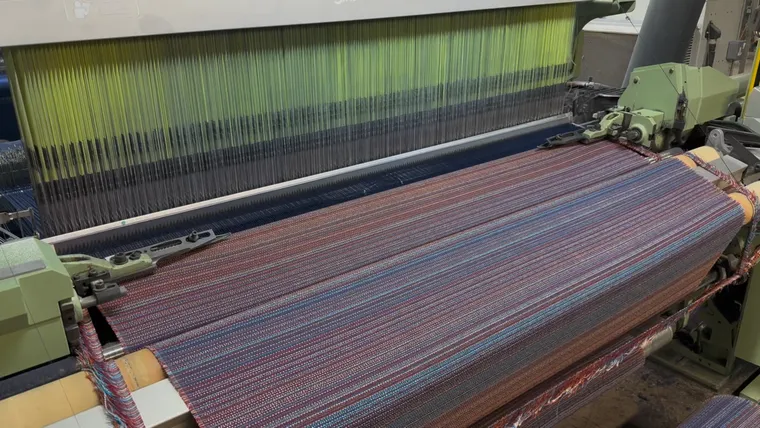
John Walton: It is, and as it happens, I’ve visited you in beautiful Dublin where I believe we talk to you now, and toured the incredible weaving looms that you've got in the incredible facility there. It's absolutely fascinating to see how it’s all made.
Now in terms of where you are in the supply chain: who's above you? Who's below you? Who purchases your products, and who selects them for inclusion in the aircraft cabin?
David Lawson: Oh my goodness, that’s going to be a long answer, but the people below us would be the yarn suppliers and dyers, and we own a dyeing facility. So really it's the yarns that are used to weave the carpets or to weave the upholstery fabric. So that's below us. And above us are the either seat suppliers or the airlines if they're cut-and-sewing themselves. Or the airframe manufacturers if it's a linefit project.
John Walton: That wasn't that long, David, in fairness. So, okay, so for, for people who might not be familiar with how cut-and-sew works and all that sort of thing, so how do you get from yarn, which I assume in the aviation context is made up of very specific materials, which have been certified and are performance materials, to bolts of fabric and then to, let's say, a seat cover. How does that process work?
David Lawson: Let's assume that, that it's a repeat order. So the, the product, whether it's fabric or carpets, is already defined. And so we will receive the order; we will have to calculate how much yarn we need to weave what that order is. We would then already have ecru yarn, white yarn that we would then have dyed up, brought into the mill, woven. Whether it's a seat fabric, we would then finish the fabric and ship it to the cut-and-sew operation, or if it's for carpet, we would weave up the carpet up in Donegal, and ship that to whoever's going to be making up the carpets for the aircraft.
The-cut and-sew operation can again be for the airline itself, and they may have their own facilities or their own preferred suppliers or it would be to the seat manufacturers’ cut-and-sew operations and, they can be anywhere around the world.
John Walton: So, when it leaves you, is there anywhere — where does it go now? Does it go straight to the seat maker? Does it go — as you say, you know the cut-and-sew can be anywhere, but are those usually sort of co-located. Or are we in a situation where the fabric goes off to someone somewhere else, which then goes to somewhere else to be installed into the seat, which then moves on to be installed into the aircraft. How does that all…
David Lawson: It's changed over the years because now rather than going to the seat manufacturer, it's going to one of their subcontractors.
It’s becoming more extended. So rather than going straight to the airline who before would've looked after everything, they're now passing the jobs on to the seat supplier. And the seat supplier is asking us to ship to their cut-and-sew operation. So it's becoming a lot longer operation, but actually no different to how it was before.
I suppose the hardest part is ensuring that the certification or the certificates are still controlled by the airline because they need to ensure that what goes on to the aircraft is airworthy?
And that it continues to be that way, of course.
John Walton: Yeah. In the last year we had a situation where one airline wasn't able to prove that it had its seat covers had been washed the right way, and that the — what was it, was it the flame retardancy, I think? — was going to be the same. One of those sort of very critical bits of performance.
It's the kind of thing that, perhaps, we wouldn't necessarily think about, but is all part of that chain of getting and keeping the seats on the aircraft.
David Lawson: Yes, it's it's very important. Even the dry cleaning, once the seat cover's in service, you still have to keep the cover clean, and that's whether it's leather or fabric. There's no difference, because the passenger sits in the seat, there's perspiration. The salts are getting onto the material, and that can nullify the flame retardancy. So the seat covers whether they’re leather or fabric have to be cleaned to bring back the product to being safe.
And it has to be safe, because you remember what happened with the the Manchester. Air disaster: it was smoke and toxic gas that was the biggest problem, not the flames themselves.
John Walton: Yeah, absolutely. We talk a lot in this podcast and of course on The Up Front in general about certification and the issues that we're having with it. It all does come back to the industry learning lessons from incidents.
I know that the seat makers, in particular, are having issues around the sort of battery of new criteria that they're having to work on. But it there's reasons for that.
So looking at where you are in terms of your yarn suppliers and in terms of the seat makers or the operators who you are sending things off to, and the airlines above, I guess, what's the state of play? Is the supply chain looking good? Is it — red, amber, green, what sort of traffic light are we looking at the moment?
David Lawson: We are very fortunate that what we do is very simple. There's nothing complicated to weaving, whether it's carpets or whether it's fabrics. As long as we've got the ecru yarn coming toward us and we are very careful about our ordering, and we always have raw materials that will be converted into a coloured yarn coming towards us.
For the carpets, the fibers come from Britain. So they're British wool, and there's always going to be sheep in Britain. So there's always going to be wool, and we'll always have our yarns coming for the carpets and we weave in Ireland. There'll always be some hiccups but nothing too disastrous.
Also for the backing of the carpet, again, that’s fairly simple. We're not getting it from any far away non-European source.
For the seat fabrics, much the same. The wools are made off offshore, but we get containers every week, and so there's a whole series of containers coming. We might be delayed a week or two weeks, but because we're ordering so much we don't have a major problem. And again, we have our own dyeing facility, which is close to us. And again, that's coming to us where we weave in, just across the — well, you've seen us in the centre of Dublin, near the Guinness factory. It’s all very close. So I would say it’s a nice shade of green… being Ireland, of course, it has to be!
John Walton: I'm not sure I'd agree with you, David that it’s all so simple! I've seen those fascinating machines at work, but I suppose the ecru yarn to coloured yarn to patterns, to fabric part of the chain, your part of it is incredibly complex, but your raw material feedstock, I guess, seems to be relatively stable, right? Which is great. You're not waiting for a bunch of things to come out of the Strait of Hormuz right now, for example.
David Lawson: Exactly, exactly. Because it's a natural product. We’re not associated too much with petroleum based products. Maybe some of the carpets, yes, but most of our carpets are, are wool-nylon anyway so we're not worried, shall we say?
John Walton: Absolutely. So when youlook above yourself in the supply chain, so the designers, the airlines, the seatmakers who are selecting you: is your chain to get your things delivered to them looking good at the moment? How does that look?
David Lawson: We sell “ex works”, so the onus is on the purchaser to make sure that they get their goods. We're not washing our hands, but we just need to make sure that we've got the goods ready on time, which we tend tend to do.
Our deliveries into Airbus, for the linefit, we have to ship and have the goods in Airbus by a particular date. And we have five days to have the product in Airbus by then. We’ve got a very good rating with Airbus, so we know what we do, we must be doing well.
I think because everything is woven within Ireland, within Europe, and we're not having goods produced offshore, it's far easier for us to control when there's a problem, and I think we're fortunate in being a family owned company. We're not controlled by having to ensure that there's a strong profit, and therefore looking at different ways of trying to save money.
So I think that, because of that, again, we are fortunate. If we see a problem in terms of capacity, Jonathan Hackett, the owner of the company, has bought looms or bought the machinery that will ensure that there's no production problems.
John Walton: Fascinating. And so I assume your stuff your product is essentially shipped, sea shipped, over to Hamburg, Toulouse, that sort of route? Is that how that works?
David Lawson: It's trucked, yes. It'll be trucked and then sea. But for our customers overseas, sometimes they prefer to ship it themselves as cargo.
John Walton: Helpful if you fly to Dublin, I should imagine.
David Lawson: And there's a lot of airlines, more airlines flying to Dublin. Ireland's becoming a popular place.
John Walton: Yeah, just pop something in the belly cargo every time you stop in.
David Lawson: Absolutely. Yeah.
John Walton: I find it really fascinating that a lot of people within the aviation industry have been talking about nearshoring, which is reversing the offshoring trend that happened sort of 10, 15 years ago.
It sounds rather like you never started with offshoring and so you don't need to try and undo some of that — that you've done previously, as it were.
David Lawson: Yes. If you're talk, talking about historical changes, Botany was over a hundred years ago — in fact, since you were here last, we've discovered more about the mill…
John Walton: …which was not a hundred years ago, I should point out…
David Lawson: …which was not a hundred years ago, but we've discovered recently that there was a mill here before, which was a vertical mill. When Botany became Botany it was just a weaving mill. And we outsourced the yarn, we outsourced the finishing. But over the years, we have become vertical again because we have been concerned about the finishing, we have been concerned about the dyeing of the yarn, because, as you know, in the UK textiles has gone down.
We've lost so many suppliers and it's important for us to have those. And so we have bought a finishing plant. We bought a dye plant, so we're going back, I suppose, in our own particular way, to nearsourcing.
John Walton: It is almost as if you’ve — before anybody was talking about it in that sort of way — you sort of expanded vertically down the supply chain in a way.
David Lawson: Yes, because we've been concerned for such a long time.Maybe it's because we weren't outsourcing. Maybe it's because we weren't looking globally for our subcontractors. We were always concerned that it had to be near at hand. And when we started to see that things were happening in Britain, we used the money that we had, and invested it in finishing and in yarn dyeing, and obviously in the looms themselves.
John Walton: Again, looking back above you in the supply chain, so to your customers, what are the challenges in terms of, I suppose, entering that supply chain in terms of maintaining, expanding, adapting to it? What are those challenges and how do you get round them?
David Lawson: You mean to working with the airlines or…
John Walton: Yeah, working with airlines, working with seatmakers, working with designers. Do you have situations where, for example, I don't know, designers choose something, but then it doesn't work on the seat when it gets the seat maker, or the airline decides that at the end of the day, it doesn't like what it looks like. And how do you sort of solve some of those supply chain end of situations?
David Lawson: Being proactive, making sure that if there's a problem, you don't sit on it, you work on it, to resolve the problems. You send somebody or a group of people to understand what the problem is and to make sure that the customer's not being compromised themselves.
If something has happened, resolve the problems immediately. You talk about the supply chain. Well, in a way we are we are being married to the seat manufacturer. The airlines are selecting the seat manufacturer. We have to work in harmony with them. And I suppose because of our size we know all the seat manufacturers equally. They know us.
It is with the airlines themselves often, we might have a new customer. Very rarely is it a big new customer, because we're working with them all the time anyway. So it tends to be the medium or smaller airlines who might not have so many people, might not have the sophistication of controlling the movement of the product where we start to get the problems.
John Walton: And then when it comes to do a retrofit program, for example, or an, the update to CMF or a rebrand, or a merger let's say, and an airline keeps the seats on board, but changes the seat covers and changes the carpets, for example.
How does that work? How does that work differently to factory fresh seating in that way?
David Lawson: Very little difference, because the seat manufacturer will be doing the recertification or the airline will be doing the recertification. All that we have to do is supply the fabric and make sure that it's passed the vertical burn test.
The carpets? Carpets are easy. They're not part of the aircraft. So again, all you have to supply is to prove that it doesn't burn. It's so very, very, very simple. We are very fortunate in that we don't have to have a complicated lab here. All that we need to do is ensure that the product doesn't burn.
John Walton: And so given all of that, at what point do you get involved in a program? Is it at ITCM, which, for those who haven't listened to any of the other episodes we've been talking about quite a bit. That's the initial technical coordination meeting. Do you get involved there? Do you even get involved there at all?
David Lawson: No. Again we're very, very, very fortunate. We don't get involved in these meetings our. Our job is either working with the assigned design house or with the airline themselves, or with Airbus, their design studio, or with Teague, the Boeing design studio.
We’re in such a privileged position not to be having to worry about certification because our product, the base product, the yarns are very simple. You weave it and you know exactly what you're going to get in terms of a technical product.
In terms of the visual product, that's something else. But that's another story altogether. Another podcast.
John Walton: Well, yes, sure, if we ever get to a point where we have an aesthetics crisis in industry, David, I shall come back and talk to you again about that! [laughter]
David Lawson: With you here there'll never be that! [laughter]
John Walton: So, the last question I usually ask folks on this is to wave a magic wand, and fix one problem with the supply chain. I realise it doesn't sound like your supply chain has a huge amount of problems, but if there's one thing that that you could fix in it what would that be?
David Lawson: Time. We have noticed that there is less time to do something, whether it's producing an order or whether it's developing a fabric.
It’s got shorter and shorter and shorter, and that's the biggest problem. And it means that the quality of work is potentially compromised. What we find is that we just have to work around the problems and send somebody to a dye house or send somebody to the design company to have face-to-face meetings; it’s resolved. We save time, basically.
John Walton: How far back does that sort of time crunch go? Is that a relatively recent thing or has it been a sort of long term time pressure that's just got sort of tighter and tighter?
David Lawson: I would think that it’s that — the COVID time, I think, up to that point people weren't being made redundant. I think the airlines took their time. But I think since then that's really when it started.
John Walton: So what's driving that series of time crunches? Is it that we lost expertise during COVID? Is it that people, that the industry has been so disrupted, and we still have so many delayed programs that it's the project management side, and they suddenly realise — I mean, I can't imagine you suddenly realise that you're going to need carpets for your new plane, which you ordered five years ago.
David Lawson: Yeah, I, think you are hitting it quite clearly. It’s the loss of experience. Now, Botany, again, has been very, very fortunate that in COVID or the time of COVID, we didn't let anybody go. We reduced the number of hours, their wages were reduced. The Irish government helped people get some money so we didn't lose any experience.
And so when COVID did finish, we had the people, and people knew what to do. But in other industries, people were let go, and you lost this whole layer of expertise — and people knew when, look, we need to be doing something now or we're going to have a problem. The people who came in didn't know that, and they missed the opportunity to not be late in, in whatever way it was.
John Walton: I don't wanna call it a lost generation. That sounds very dramatic. But that sort of lost generation of expertise during that four, five year period from 2020 to 2025 where people hadn't had the experience of running a program before, hadn’t had the experience of what it is that you need from them, in order to be able to produce the product for them and deliver it on time, wherever it needs to go so it can be transformed into something else.
I suppose that sort of at some point over the next few years, we'll have sort of recreated at least one round of that expertise in most airlines. Is there anything, while airlines are struggling to do that, is there anything that they can do for you or with you to sort of make that process of almost relearning these skills easier?
David Lawson: Well, that's the problem: because this layer of experience is gone, the people who are coming in are learning to do the job in a different way. And it's not to say it's the right way. And I think that's part of the problem, because there's an easier way of doing something, not cutting corners, but you can do things in easier ways, and people don't know how to do that.
And I also think that the world works in a different way. I also think that people who might be more attuned to particular jobs are going elsewhere and they're not going to the aviation industry. I think that's another story altogether.
And we — again, we're lucky. We don't have that. For me, within the design department the principal set of people are the designers, and we are very, very fortunate that we've got people who've been here a long time.
Now, during COVID, we did see that the quality of designer did go down because we have interns all the time and we found that the interns weren't able to work because they hadn't been part of a team for about two or three years.
Now the young people have gone to school, they've gone to college, they’re back to how they were in terms of education pre-COVID.
John Walton: That's really fascinating. It’s encouraging that we are backward to a point that we were in terms of that sort of level of design experience, the problem solving, project creation side of things.
It’s a little bit of a consistent narrative between some of the folks that I talked to, certainly in that sort of intersection between design and production is one of the things that was lost when everybody was on Zoom all the time permanently without anything in person, was that collaboration opportunity, really, and figuring out how to, how to sort of work collaboratively — to create products to go into the supply chain. David, I suspect is where that goes.
David Lawson: Our position again is unique because we're not producing nuts and bolts. We're, we're not producing something that's has to be a particular size.
We are creating a dream. We’re creating something visual but tactile. It's emotive. And we look at the world in a completely different way. The way that we work is completely different. We’re developing a textile and we're not just looking at it when we go on a plane.
You touch the fabric. How does it feel? How does it look? What does it do to the environment? And that's completely different from so many other things, like a seat, yes, has a certain styling, but a lot of it is the mechanics and which is a different mindset all altogether. It does help to improve the environment within the aircraft.
But it's the designers. It's the CMF people.
How does the stitching go? How does, how can we make the seat look more than it is? How can we make the seat different from the other project that we're working on? And I love this, that you've got these design companies who are working for all these famous airlines and still able to create something that has a unique handwriting.
And for us to be part of that is where I think that we're good at because we can help make those dreams or those ideas reality, and not get worried about supply chain or anything like that.
John Walton: A lovely position to be in for sure, I think.
David Lawson: Oh it is, yes.
John Walton: Yeah. David, thank you ever so much indeed for being with us on The Chain this time round. To continue the conversation and to find out more, where can our readers and listeners find you?
David Lawson: Oh, when it's not in a bar? [laughter] …being in Ireland! Aircraft Interiors is the place to go, two weeks time, and we're in 7D40, with everybody else.
John Walton: Well, we will certainly be seeing you there. I'm sure that people can find you — is it botanyweaving.com — online as well?
David Lawson: It's www.botanyweaving.com.
John Walton: Fantastic. And of course, listeners, you can find more of The Chain and all of our in-depth independent aviation journalism, focusing directly on the passenger experience at The Up Front on theupfront.media. We'll be back with another episode of The Chain very soon.
Business intelligence across the aircraft interiors supply chain - powered by SIMONA Boltaron. Learn more about SIMONA Boltaron at boltaron.com.