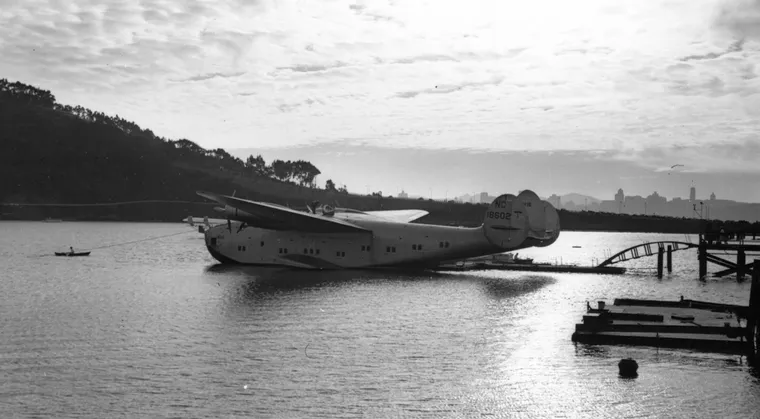
We continue our series looking at one of the most stunning, yet near-forgotten, acts of skill in civilian aviation history: the round-the-world flight of the California Clipper in December 1941. You can find the first part of this series here.
Security: Top Secret
To: Captain Robert Ford
From Chief, Flight Operations Pan American Airways System Chrysler Building New York City, NY
Diversion plans for NC18602
Normal return route cancelled. Proceed as follows:
Strip all company markings, registration numbers, and identifiable insignia from exterior surfaces. Proceed westbound soonest your discretion to avoid hostilities and deliver NC18602 to Marine Terminal LaGuardia Field New York.
Good Luck
The message was handed to Bob Ford, captain of Pan Am’s California Clipper, in the waiting room of the American consulate in Auckland, New Zealand.
It was the 14th December and Ford had visited the consulate every morning for a week. After blacking out their enormous aircraft and quickly moving off of their regular flight path, the California had arrived safely in Auckland a week earlier. This had completed the first part of the secret orders he had been given, to be carried out only in the event of a war with Japan.
Since then, his crew had been waiting nervously in Auckland to find out what they were meant to do next. Now he knew.
Ford would later recall that it took a while for him to realise what “proceed westbound soonest your discretion” really meant. It was only when showed the message to Bill Mullahey, the Pan Am ground station manager in Auckland that it truly sunk in.
“They don’t ask much, do they?” He remembered Mullahey saying, with more than a hint of understatement.
What Pan Am were asking of Ford, his crew and his aircraft was to do something that no commercial flying boat had ever done before: complete a circumnavigation of the world.
We are used, now, to the idea that passenger aircraft can complete journeys of vast distances non-stop. This wasn’t true in the propeller age. It was why Pan Am had needed to commission the Boeing 314s, like the California Clipper, in the first place. They needed planes that could go as far as possible, but also land and be serviced at the various small island bases and Pan Am stations scattered across the Pacific ocean.
Setting up that chain of stations had been an enormous logistical exercise and one fraught with danger. Experienced pilots, flying specially designed flying boats, had landed blind at isolated islands across the ocean. They charted the route for their larger passenger counterparts, with supply and fuel ships following behind. The presence of a single rock just beneath the surface could rip an aircraft apart. Creating a safe route from Los Angeles to Auckland for aircraft like the California had cost lives.
No Pan Am route existed between New York and Auckland. There was no safely-mapped path for Ford and his crew to follow. To get back to the US, the California would have to carve out an all-new route for flying boats from Australia to the East Coast of America. There would be no supply network on which they could rely. No ships following behind to help if they got into mechanical trouble. No one to tell them where it was safe to land.
To reach New York they would have to fly longer and further in a single trip than any Boeing 314 had managed before. They would be flying blind and have to push themselves and, more crucially, their plane well beyond the limits of knowledge and safety.
It was Rod Brown, the California’s Navigator who pointed out another problem to Ford when he broke the news to his crew.
“Skipper, we don’t have navigation charts beyond Auckland.”
A visit to the library
The librarian raised her eyebrows.
“Let me get this straight.” She said, “You want to see every single map, marine chart and atlas we have in the library?”
Her eyes passed across the four sheepish-looking men in Pan Am uniforms standing before her.
“Yes please.” Replied Ford, glancing uncertainly at Mullahey. He later admitted it was the station chief who’d suggested this particular idea.
“Also any geography textbooks. Stuff that might have information about winds or currents.” Added Rod Brown, helpfully.
“We need to work out how to get back to America.” Explained Johnny Mack with a smile.
In the era before GPS, aerial navigation was achieved through charts, careful measurement and reckoning, just as it was done at sea. This was doubly true for Pan Am’s clipper services. The Boeing 314 even had a navigation dome on top – a glass bubble through which its navigator could use a sextant to navigate by the stars at night.
The California had never intended to fly west of New Zealand. As a result, she hadn’t been issued with any ocean charts, maps or reckoning guides for flying beyond the country. Nor did Mullahey have much at the Auckland station. This was what had brought them to the library.
With the librarian’s help, the four men were soon busy at a table, poring over everything they had been able to find that might help them plan a route back. After several hours of plotting, calculations and guesswork a possible route began to emerge.
The first stage of the journey was relatively straightforward — head to the top of Australia. This was not without risk. It potentially involved taking the California Clipper across an awful lot of land, never a nice thing to do when your plane has no landing gear. It was the second stage of the journey that was the tricky one though, because it presented the crew with a difficult decision.
The more direct option was to make a straight run for Africa. This would grant the California its greatest chance of avoiding direct contact with Japanese forces. It also meant pushing their Boeing 314 to the very edge of her fuel limit. Just one bad piece of navigation, storm or headwind over the vast, open ocean and they would be lost at sea.
The second route would take them to the Dutch East Indies (modern Indonesia) then to India, over the Middle East, and on to Africa from there. This required long aerial hops but brought each leg within the aircraft’s safe operating range. In theory it also increased the chances of finding somewhere to refuel, rest and repair with friendly Dutch or British forces on the way.
The ‘in theory’ part was because this also meant cutting through an area that was now a war zone. They would have to hope they didn’t encounter hostile Japanese aircraft, to whom the lumbering Boeing 314 would be a sitting duck. They would also have to hope that the British and Dutch forces in the locations to which they were heading had not already been overrun.
Beyond the east coast of Africa, their journey would get no easier. For now, it was this decision – strike out west or head into the heart of the war – that was the pressing question, however. Ford refused to make the decision unilaterally or force any of his crew to sign on for the flight. Back at the Pan Am station, the options and the risks were put to everyone.
The Africa route was rejected. They would trust in finding help from the British and Dutch. The entire crew then signed on for the trip, stewards included.
A change of plan
Ford believed they would have at least a few more days to prep for the California’s long journey. The crew began stripping paint from the aircraft, to remove all markings. The plan was also to strip down a number of spare engines kept at the Auckland station for the crew to take as spares. It would likely be the only parts they’d have access to on the way.
It was not to be. The operation had only just started when a second, urgent message arrived from Pan Am. Concerned that the Japanese were advancing quickly in the Pacific, they wanted to evacuate the staff of the Pan Am station in New Caledonia along with their their families.
The only aircraft in the area with the range and capacity to do that in time was the California.
Ford was left with a choice: Refuse the request and leave the New Caledonia staff to their fate, or forfeit most of their preparations and head straight for the island in the morning. He decided to do the latter.
The next morning, the California departed New Zealand for New Caledonia, from whence they’d loop back to Australia. They’d managed to dismantle two engines and stow the parts from them. It was all they could do in time. They hadn’t even managed to scrape off the enormous American flag across the top of the plane. If the Japanese encountered them, it would be obvious now that they were a target. It was far from an ideal start, but rescuing their fellow Pan Am employees and their families had to come first.
The fuel problem
The evacuation of New Caledonia passed without incident, but the significant diversion highlighted a problem that would become increasingly dire as their journey continued: access to fuel.
The Boeing 314 was a masterpiece of aviation engineering, but its size and range came at a cost. At the time, most aircraft used regular 80 octane fuel – no different to that used by cars or trucks. The Boeing 314, however, was the first commercial aircraft that required richer, 100 octane fuel to run. Something that until then only high-performance racers and military aircraft needed.
Boeing had insisted to Pan Am that this was the only way they could create an aircraft that would meet the airline's needs. Richer fuel meant the engines could deliver more power for less mechanical action. The engines could run slower and colder, making them more reliable and economical in fuel usage, increasing their lifting power and range.
Pan Am were happy to agree. The clippers had fixed routes. It was easy enough for Pan Am to stock 100 octane at their bases and stations instead of regular fuel. But the California Clipper was now flying into the unknown. And as Mack and First Engineer ‘Swede’ Rothe discovered when they reached Gladstone on the coast of Australia, 100 octane was far harder to find outside of the Pan Am network.
It wasn’t available at Gladstone and they were left with a choice: try and fly the California on 80 octane, which she had never been designed to fly on, or use their remaining onboard reserves and cut over the Australian continent. With luck, they could find some at Darwin then head to Surabaya in the Dutch East Indies from there.
Despite the risks of flying over land, they opted for Darwin. Most of the Pan Am staff they had rescued from New Caledonia opted to stay behind in Gladstone. The exception were two flight mechanics they had rescued that Ford and Rothe persuaded to join them. If they had to make repairs at any point, then the two men’s experience would prove invaluable.
They departed, flying over land towards Darwin, on the 17th December 1941. It wasn’t all bad news. In addition to the two flight engineers, they’d managed to secure something even more precious before departing New Caledonia. It was now safely secured in the hold alongside the spares from Auckland: a spare engine.
Onward from Darwin
The California Clipper arrived in Darwin in the early hours of the morning on 18th December 1941. An eleven-hour flight.
Darwin was in the middle of an invasion panic when the California arrived. Despite the chaos, the crew were able to secure a source of 100 octane fuel. They were helped greatly by $500 the Pan Am station manager at Gladstone had handed Ford as the flight was preparing to leave. He wasn’t authorised to issue this, he explained, but if Pan Am wanted to discipline him for it then they could do it after the war (Pan Am decided later to let this breach of regulations slide).
Most of the crew set about the arduous task of refilling the California’s vast fuel tanks via small jerry cans of 100 octane moved over in small boats from the facilities in the main harbour. While this was underway, navigator Rod Brown and radio operator Jim Henricksen quietly explained to Ford that their situation was even more critical than anticipated.
Brown and Henricksen had spent the flight going through the maps, charts and documents they had liberated from libraries in Auckland and the Pan Am station there. The more they looked, the more they realised how much information they were missing.
Henricksen pointed out they didn’t have radio frequencies for the next leg of the journey. They had no way to warn any Dutch forces they encountered that they were friendly, and the Dutch may not be inclined to ask first and shoot later.
Even if they survived to reach their intended goal – the Royal Dutch Airforce facility at Surabaya – then their problems weren’t over. They hadn’t found any naval charts for the harbour there. Nor for any of their other intended stopovers. Each landing would be a blind one. If they struck a piece of debris, a hidden sand bar or a reef during landing, then at best it would rip through the hull like a tin-opener and destroy the plane. At worst it would flip the flying boat as it tried to land, killing the whole crew almost instantly.
Nonetheless, they had no option but to press on. They departed for Surabaya the next day.
The unknown contact
Commandant Colonel Koenrad was in the squadron operations room at the Royal Dutch Naval Air Station at Surabaya when an unknown contact was reported by his combat air patrol.
He stifled a groan. The Japanese had been attacking the island regularly, their bombers destroying irreplaceable planes and supplies on the ground whilst the escorting fighters gradually bled his limited air forces dry. Both Koenrad and his men were frayed and frustrated.
This aircraft seemed to be large and alone. Perhaps it was a reconnaissance patrol. If so, then at least shooting it down might provide a small moment of relief.
He ordered his fighters to close in.
A near run thing
“Skipper!” Johnny Mack shouted. “Better get up here quick!”
Ford raced forward to the cockpit. The harbour master at Darwin had promised to try and get a message ahead to the Dutch at Surabaya, to warn them that California was coming. That message never got through.
On the ground, Koenrad was now pondering events. The target was clearly a flying boat: But whose?
Normally the question would have been academic. His pilots were convinced it was Japanese and had they been operating on their own discretion they would already have closed in and shot it down. For once though, the radio was working. As a result, they had deferred to him for authority to fire.
He ordered them to take a closer look.
“Three fighters incoming!” Warned Johnny Mack. Together with Ford, he was trying to hold the California at a course and speed that seemed as inoffensive as possible.
The approaching Dutch fighters flew straight over the California then turned. For a moment, it seemed that her journey would end there…
…then two of them banked away, while the third settled into a path in front of her. The message was clear. Follow, but be aware: we are watching.
The California proceeded with its new, Dutch escort on to Surabaya.
The end of the beginning
After the scare with the fighters the crew of the California were relieved when they finally sighted the Dutch base at Surabuya. With no way of contacting anyone on the ground, and no idea what obstacles lurked in the harbour itself, Ford decided to play safe and land beyond the breakwater, well outside of its entrance.
As the engines wound down, a small launch raced towards them. Instead of approaching, however, it stopped short of the breakwater. Its crew waved the California forward. This was odd. Normally Ford would have expected to be approached and asked to take a harbour pilot onboard. Putting it down to local custom, Ford and Mack shrugged and nudged the California in.
“Ahoy Captain.” The armed Dutch officer in the launch called out in English, once they had passed the harbour threshold. “Please come aboard. You will have to report to headquarters.”
Ashore, Ford found himself explaining the situation to Commandant Colonel Koenrad. It was here, he would later recount, that he finally learned how close they had come to destruction. Had the radio not been working, the pilots would have fired without making a single pass.
It was that pass that saved them. That and their decision not to abandon the Pan Am staff at New Caledonia. The Dutch fighters had seen the remains of the large American flag the California still carried. The decal that they had not had time to remove in Auckland. They had reported this to Koenrad, who decided to gamble on them being a friendly.
Koenrad offered them his assistance. He also stressed that they were lucky to be alive. Ford agreed.
“And of course,” Koenrad added, almost as an afterthought, “we were also very concerned when you landed outside the breakwater. That area is heavily mined.”
Ford went white.
Continue reading the story of the California Clipper in part 3…