
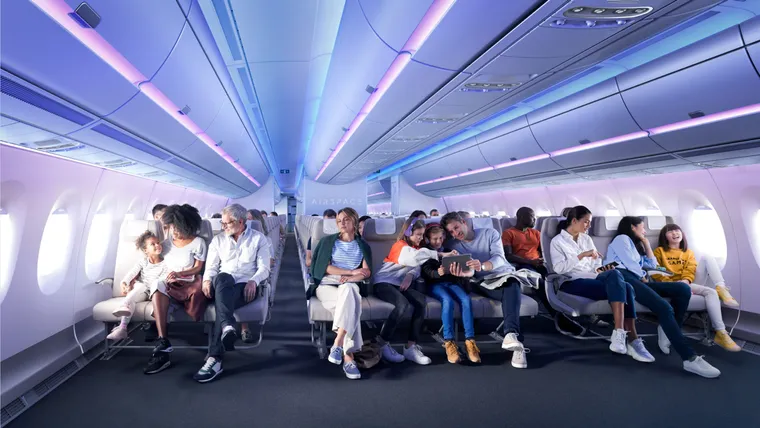
The delivery of the Philippine Airlines A350-1000, with its ten-abreast seating in economy, marked the first 3-4-3 economy configuration for the A350 since Airbus’ introduction of its New Production Standard (NPS) interiors for the aircraft.
NPS was previously referred to by multiple monikers including New Cabin Standard, and if it’s new to you, make sure you keep an eye out for the extra section for Business subscribers of our latest podcast episode, out shortly.
At its core, NPS is about making more space inside the cabin, together with a series of improvements that, in context, feel like notable change to the way Airbus has previously dealt with in-service improvements to its aircraft.
Airbus has previously favoured a “small bang” approach, where individual technologies and improvements were introduced separately or in small batches, reducing risk to programmes.
Improvements to the A320 family and noting the different challenges of a higher volume narrowbody production context — included:
- A321XLR (launch 2019, entry into service 2024)
- A321LR (launch 2015, entry into service 2018)
- Airbus Cabin Flex door configuration (launch 2015, entry into service 2018, separate to the A321LR)
- A320 Airspace cabin (launch 2017, entry into service 2020)
- A320 Airspace cabin XL bins (launch 2017, entry into service 2019)
- A320neo (new engine option) family (launch 2010, entry into service 2016)
- Sharklet wingtips (launch 2009, entry into service 2012)
- and before that other elements combined into PIPs, “performance improvement packages”, like the 2007 example that included updated engine pylons and wing belly fairings
NPS, which pulls together both cabin and airframe improvements into a bigger “bang” of changes, is different.
